


Key facts.
- The FinOps Foundation's State of FinOps 2026 reports 98% of practices now manage AI/agent spend, up from 63% in 2025 and 31% in 2024, a fast shift toward treating AI cost as a distinct discipline. source
- The IMF's 2026 note on agentic AI characterizes these systems as probabilistic, capable of producing different outputs (and costs) from identical prompts, so spend is variable by design. source
- Cost analysis of agent conversations shows spend is driven at runtime by tokens, tool calls and retries, growing roughly quadratically as context accumulates rather than by a provisioned capacity, so it has to be observed where it is generated. source
- An agent costs what it decides at runtime, token by token, from reasoning you never wrote; a bigger model does not fix that, the IMF calls these probabilistic. (source)
Why doesn't cloud FinOps cover agents?
Because cloud FinOps was built around provisioned resources with predictable unit costs. You size an instance, you know its hourly rate and the discipline is about right-sizing, reserving and turning off what you do not use. An agent breaks every one of those assumptions. There is no instance to right-size; there is a reasoning loop that decides, per request, how many tokens to spend, how many tools to call and how many times to retry. Two identical requests can cost different amounts because the model sampled a different path. The cost is not a property of what you provisioned, it is a property of what the agent did and the old practice has no hook for that.
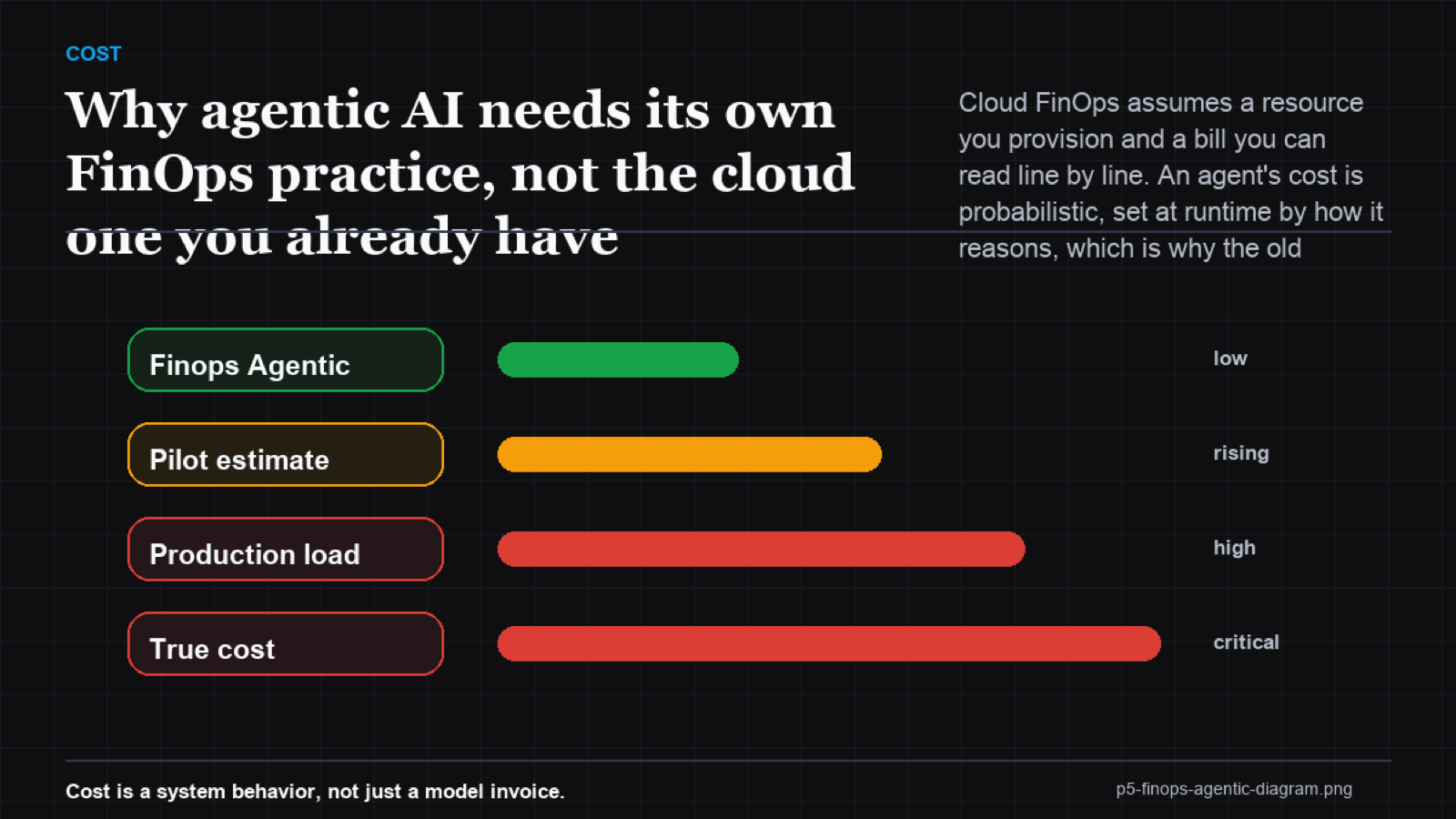
This is why a stronger model does not hand you predictability. A more capable model can lower the average token spend on a task, but it stays probabilistic, so the variance that makes the bill hard to forecast does not go away. The IMF framing is the useful one: identical inputs, different outputs, different costs. Agentic FinOps accepts that and measures the distribution, setting caps and alerts on per-task cost rather than pretending a single number will hold.
What does an agentic FinOps practice actually do?
It instruments cost where the agent creates it. Per-task token and tool-call accounting, so you can see the distribution and not just the monthly total. Hard per-task budget caps, so a runaway loop stops instead of billing. Routing rules that send easy sub-tasks to cheaper models and reserve the expensive one for where it earns its keep. And a standing review of cost per outcome as usage and models change, because the probabilistic cost moves and a one-time tune drifts. None of this is exotic; it is the cloud FinOps mindset rebuilt around a resource whose cost is decided at runtime rather than at provisioning. The teams that hold agent spend flat are the ones running this loop, not the ones reading a cloud bill and hoping.
| Practice | Cloud FinOps | Agentic FinOps |
|---|---|---|
| Cost unit | Provisioned resource | Per-task tokens, tools, retries |
| Predictability | Fixed unit rate | Probabilistic distribution |
| Main lever | Right-size, reserve | Cap, route, re-tune |
| Cadence | Periodic review | Continuous, behavior-driven |
The Pattern Intelligence Layer is where agentic FinOps lives as a capability. Per-task cost, token mix and routing efficiency are tracked at the pattern level, so the probabilistic spend shows up as a distribution you can cap and route against rather than a surprise on the invoice. Reliability at the pattern level is what turns a variable, runtime-decided cost into one you actually govern.
Frequently asked questions
Can't my existing cloud FinOps team just add AI?
They can own it, but the practice has to change. The cost unit moves from a provisioned resource to per-task runtime behavior, so the levers shift from right-sizing to capping, routing and re-tuning.
Why is agent cost so hard to forecast?
Because it is probabilistic. As the IMF note describes, identical inputs can produce different outputs and costs, so the bill is a distribution rather than a fixed unit rate and you budget the distribution.
Is a more efficient model enough on its own?
It lowers the average but not the variance. The cost stays runtime-decided and probabilistic, so you still need per-task caps and observation to keep it governed.