


Key facts.
- The FinOps Foundation's State of FinOps 2026 reports 98% of practices now manage AI spend, up from 63% in 2025 and 31% in 2024, and identifies AI cost management as a top needed skill. source
- The same report notes that allocating AI costs to business units is harder than for traditional infrastructure, because of varied pricing models and incomplete vendor billing data. source
- The "Expensively Quadratic" analysis of the agent cost curve shows cost is set by the build: loops that re-send the full history grow cost roughly quadratically, so a ten-turn session can cost closer to 50x a single call, a structure ops cannot fix after the fact. source
- Retries, context growth, and tool calls set the bill; a more capable model does not change that structure, the architecture you built does. (source)
Why can't ops just manage the cost afterward?
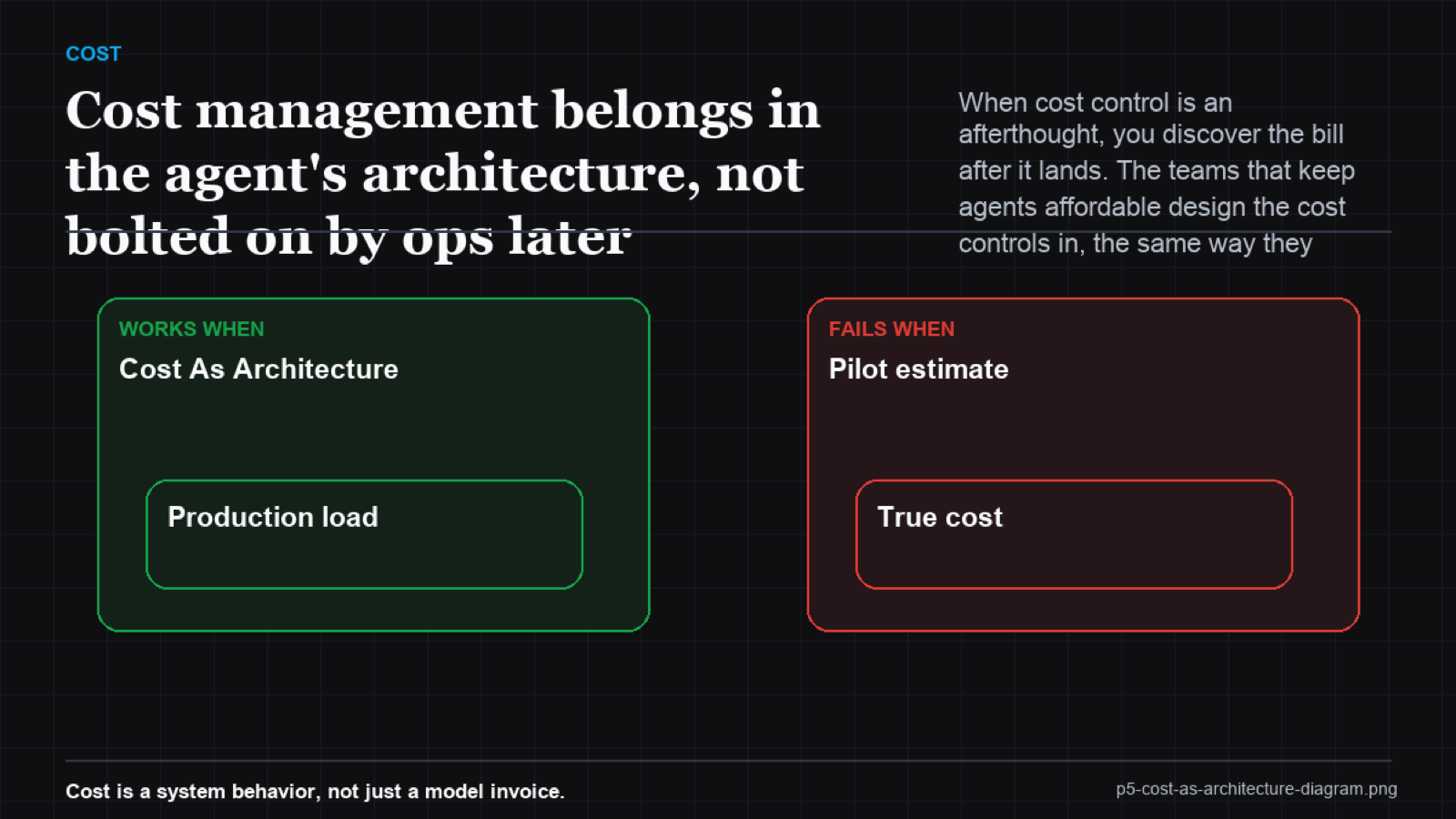
Because by the time ops sees the bill, the architecture has already decided what it would be. An agent that re-sends its full history every step, retries without a ceiling, and calls tools it did not need has a cost structure baked in, and no amount of dashboard-watching changes it. Ops can observe the spend, but the levers that control it, the retry limits, the context strategy, the model routing, the tool budget, live in the agent's design. The FinOps data shows the scramble: in two years, managing AI spend went from a third of teams to nearly all of them, which is what it looks like when cost arrives faster than the architecture was ready for. The teams that did not get surprised built the controls in.
A stronger model does not move this responsibility. It may change the per-token price, but the structure, how many tokens, how many calls, how much retrying, is a property of the build. So the cost decision sits next to the tool decision and the prompt decision, made by the people designing the agent, with the same care. That is what "architectural" means here: cost is a first-class design constraint, not a number someone reconciles at month end.
What does cost-by-design actually look like?
It looks like decisions made at build time with a number attached. A per-task budget cap and a retry ceiling, set in the agent, not hoped for in monitoring. A context strategy, cache the stable parts, compress the verbose parts, summarize the history, chosen because the cost model demanded it. A model-routing rule that sends easy sub-tasks to a cheaper model and reserves the expensive one for the hard ones. A tool budget that stops the agent from calling its way into a large bill. And a separation of decision and execution, so a single step cannot spend without a gate, which bounds risk and cost together. None of these are ops tasks. They are architecture, and they are why the agent stays affordable when the volume arrives.
| Control | Bolted on by ops | Designed into the agent |
|---|---|---|
| Budget cap | Alert after overspend | Hard per-task limit |
| Retries | Noticed in logs | Ceiling enforced in code |
| Context cost | Observed growing | Cached/compressed by design |
| Model choice | One expensive default | Routed by sub-task difficulty |
The Pattern Intelligence Layer is where cost becomes an architectural property you can see and set. Cost per outcome, retry rate, and context growth are tracked at the pattern level, so the budget caps, routing rules, and context strategy are tuned against real numbers at design time, not discovered by ops afterward. Reliability at the pattern level means the agent's economics are built in, which is the only place affordability actually holds when the traffic scales.
Frequently asked questions
Isn't cost control an operations responsibility?
Ops can observe spend, but the levers that set it (retries, context strategy, routing, tool budget) live in the agent's design. Cost has to be decided where those choices are made.
Why did managing AI spend become near-universal so fast?
FinOps data shows it jumped from 31% to 63% to 98% of teams in two years. That is what happens when cost arrives faster than architectures were built to control it.
Does a cheaper model remove the need for cost architecture?
No. The cost structure (how many tokens, calls, retries) is a property of the build, not the model. A cheaper model on a wasteful architecture still wastes.