


Key facts.
- FinOps Foundation's State of FinOps 2026 tracked AI-spend management practices: 31% of organizations in 2024, 63% in 2025, 98% in 2026. That's not steady adoption. That's a scramble. Organizations raced to build the cost visibility they should have started with.source
- ISO/IEC 42001:2023 requires defined roles, accountability and transparency for AI systems. Cost and impact reporting falls inside that accountability frame, not just safety and risk.source
- McKinsey's State of AI 2025 found roughly 39% of organizations could point to enterprise-level EBIT impact from AI. Visible, attributed value is what separates programs sponsors defend from ones they cut.source
Why does transparency decide whether support survives?
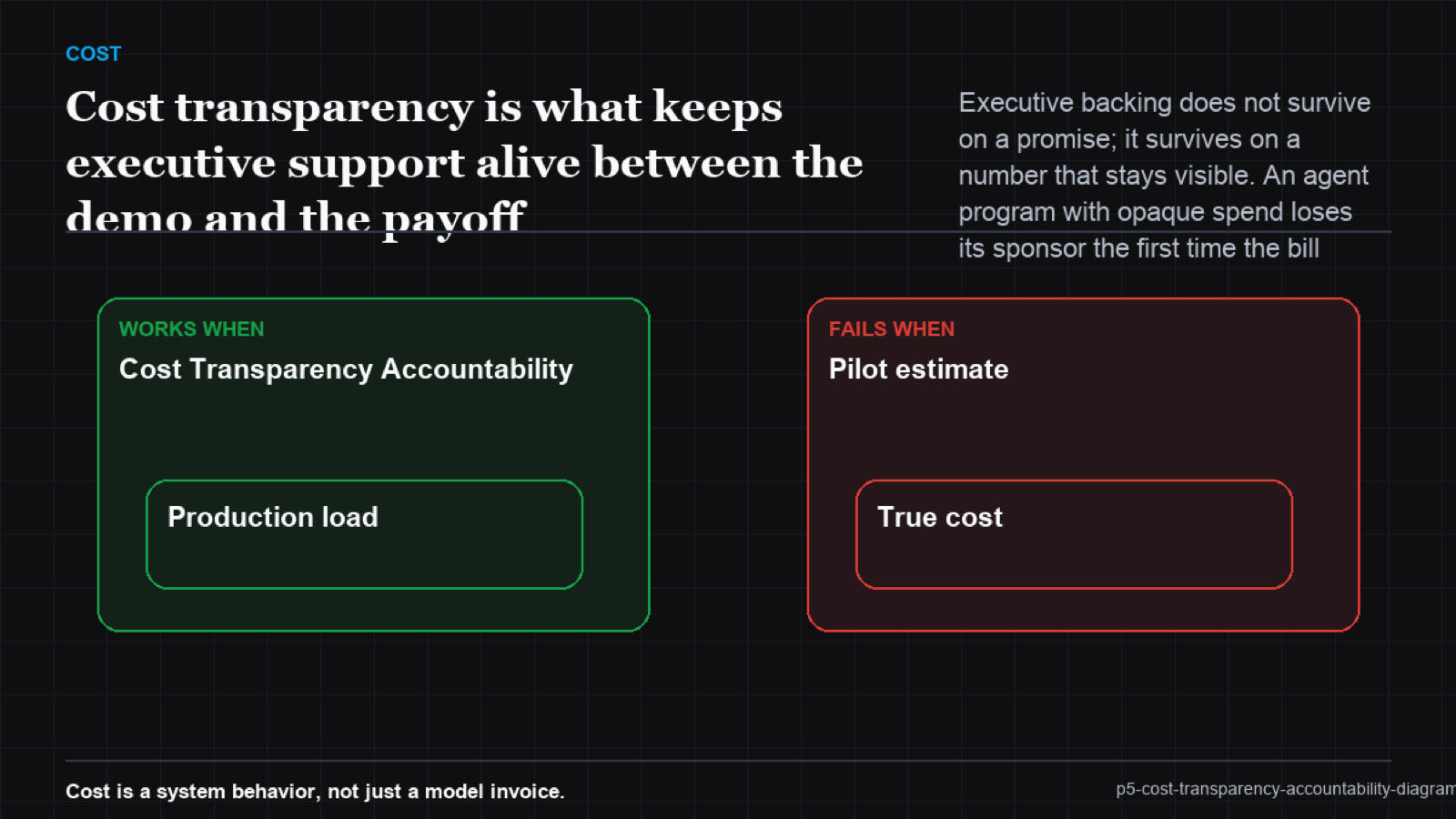
I've seen programs get killed at the quarterly review. Not because the agent wasn't working. Because the sponsor couldn't answer finance's question: "what exactly are we spending and what exactly are we getting back?" The invoice was there. The breakdown wasn't. That gap is a political vulnerability. The demo was six months ago. The CFO doesn't remember the demo. They see a line item. FinOps went from 31% to 98% AI-spend management in two years because enough programs hit this wall that everybody scrambled to build visibility after the fact. Don't scramble. Build it first.
A better model changes the cost. It doesn't build the reporting. Visibility, attribution, cadence. Those are practices you build around the agent. Skip them and you're asking a sponsor to defend a program they can't explain. ISO/IEC 42001's accountability requirements are organizational for this reason. The cost and value reporting is the sponsor's ammunition for every budget conversation until the program pays off.
What does cost accountability look like in practice?
Attribute the spend to the agent and the outcome. Cost doesn't get lost in a shared cloud bill. Report on the cadence the sponsor is judged on, monthly or quarterly. The number is current when the funding conversation happens. Pair every cost figure with a value figure on a metric the business tracks. The sponsor can show return, not just spend. Name an owner accountable for both, someone who answers for the trend, not a dashboard nobody reads. ISO/IEC 42001 management discipline applied to cost: clear roles, clear numbers, on time. Unglamorous. Exactly what keeps a sponsor in the fight long enough for the agent to pay off.
| Practice | Opaque program | Transparent program |
|---|---|---|
| Attribution | Lost in shared bill | Per-agent, per-outcome |
| Cadence | Surfaces at surprise | On the sponsor's cycle |
| Pairing | Cost only | Cost paired with value |
| Ownership | Diffuse | Named and accountable |
Managing AI spend jumped from 31% to 63% to 98% of practices in two years, a scramble for visibility a stronger model does not create, it only changes one input. (source)
The Pattern Intelligence Layer is where the cost and value are made legible. Spend and cost per outcome are attributed and tracked at the pattern level. The sponsor sees an honest, current picture at every review instead of an aggregate they cannot interpret. Reliability at the pattern level is what gives accountability something real to report, which is what keeps the support alive.
Frequently asked questions
Why did my sponsor pull support after a good demo?
Often because the spend went opaque after launch. Without attributed, cadenced cost-and-value reporting, the first surprise bill leaves the sponsor with nothing to defend the program with.
Isn't a working agent enough to keep funding?
Not by itself. McKinsey's data shows most programs cannot point to bottom-line impact, so visible, attributed value is what makes a working agent a funded one.
Does a better model improve transparency?
No. The model changes the cost it produces; transparency is the attribution, cadence and ownership you build around it, which ISO/IEC 42001 frames as an organizational practice.