


Key facts.
- McKinsey's State of AI in 2025 (1,993 respondents, 105 nations) found only ~39% of organizations report enterprise-level EBIT impact from AI, and ~6% are "AI high performers" attributing over 5% of EBIT to AI. source
- The same report finds that fundamental workflow redesign correlates most strongly with EBIT impact, meaning the value gap is about approach and integration, not model quality. source
- The IMF's 2026 Note "How Agentic AI Will Reshape Payments" (Davidovic and Tourpe) frames the leadership conversation in risk terms regulators already use: traceability, opacity, correlated behavior, and the need for audit trails and tiered human oversight. source
Why do good agent projects get cut?
Only ~39% of firms report any EBIT impact from AI; the frontier model will not move you into the 6% high-performer group, McKinsey ties it to approach. (source)
Often because the economic story was never told completely. The team presents the inference cost, which is the smallest and most flattering number, and assumes the value is self-evident. Leadership, looking at the McKinsey reality where most organizations cannot attribute any EBIT to AI, sees an expense with no proven return and starts asking why it should continue. The project is not always failing. It is failing to be legible. When the only number on the slide is the API bill, the conversation is about cost, and cost without a matching value figure loses.
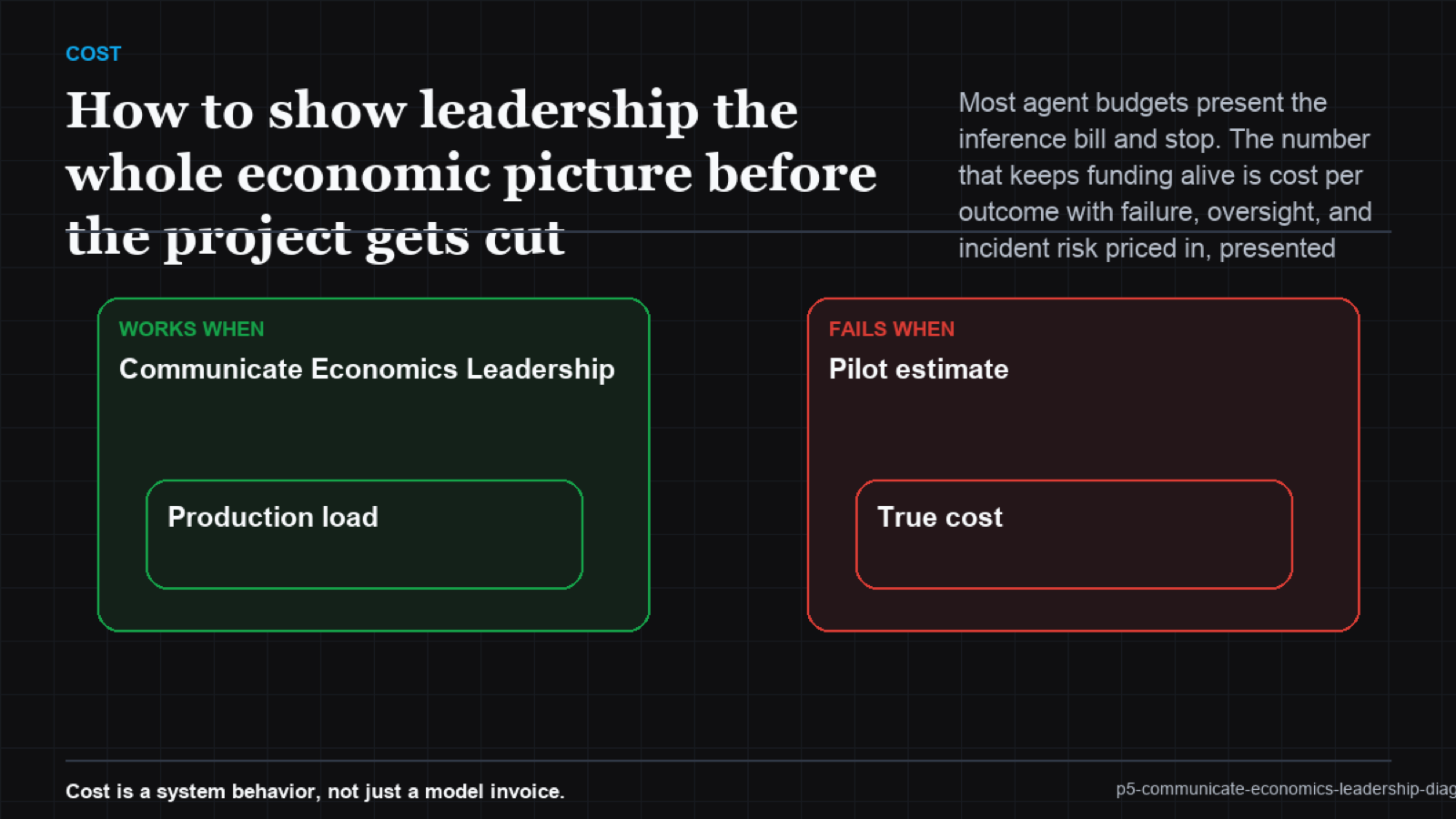
The fix is to bring the whole picture. Cost per successful outcome at production volume, with failure rates, retries, and human oversight priced in. The value side stated the way leadership measures it, in revenue, hours saved, or risk reduced, ideally tied to EBIT the way McKinsey's high performers do. And the risk side framed in the language the IMF and regulators use, so leadership sees that the controls are deliberate, not missing. A case built that way is one a CFO can defend, which is what keeps it funded.
What does a leadership-ready economic case include?
Four numbers and one frame. The four numbers: cost per successful outcome at real volume; the failure and oversight cost that the happy-path bill hides; the value in the unit leadership already tracks; and the worst-case incident exposure if a control fails. The one frame: the approach, stated as the deliberate scope and oversight choices that put you on the path McKinsey's high performers took, rather than the open-ended autonomy that produces the 95% with nothing to show. Presented together, these turn an agent from a line item under suspicion into an investment with a defensible return and a known downside.
| What leadership sees | Weak case | Strong case |
|---|---|---|
| Cost | Inference bill only | Cost per outcome, failures + oversight included |
| Value | Implied, qualitative | In EBIT / revenue / hours, attributable |
| Risk | Unstated | Worst-case exposure, in regulator language |
| Why it works | "The model is good" | Scope + workflow + oversight by design |
The Pattern Intelligence Layer is where these numbers come from without a fire drill. Cost per outcome, failure rate, oversight load, and risk exposure are tracked at the pattern level, so the economic case is a report you can pull, not a story you have to assemble under deadline. Reliability at the pattern level is what lets you show leadership the whole picture early, which is how the funding survives the first hard question instead of dying at it.
Frequently asked questions
Why isn't the inference bill enough to show leadership?
Because it is the smallest number and carries no value. Leadership facing the McKinsey reality, where most orgs attribute zero EBIT to AI, needs the full cost-and-value picture to justify continuing.
How do I make value legible to a CFO?
State it in the unit they track: EBIT, revenue, or hours saved, ideally attributable the way McKinsey's ~6% high performers do. Pair it with cost per outcome and worst-case risk.
Will a better model improve my business case?
Rarely on its own. McKinsey ties impact to workflow redesign and approach, not model quality. The case is won on scope, integration, and oversight, not raw capability.