


Key facts.
- McKinsey's State of AI 2025 found CEO oversight of AI governance was among the factors most strongly correlated with EBIT impact from generative AI, especially at larger companies. source
- The same study found about 44% of leading companies have CEO or board-level support, more than double the rate of the bottom performers. source
- OSWorld shows top models completing about 12% of real computer-use tasks versus 72% for humans, the gap sponsorship has to fund the system to close. source
Why does sponsorship move the number so much?
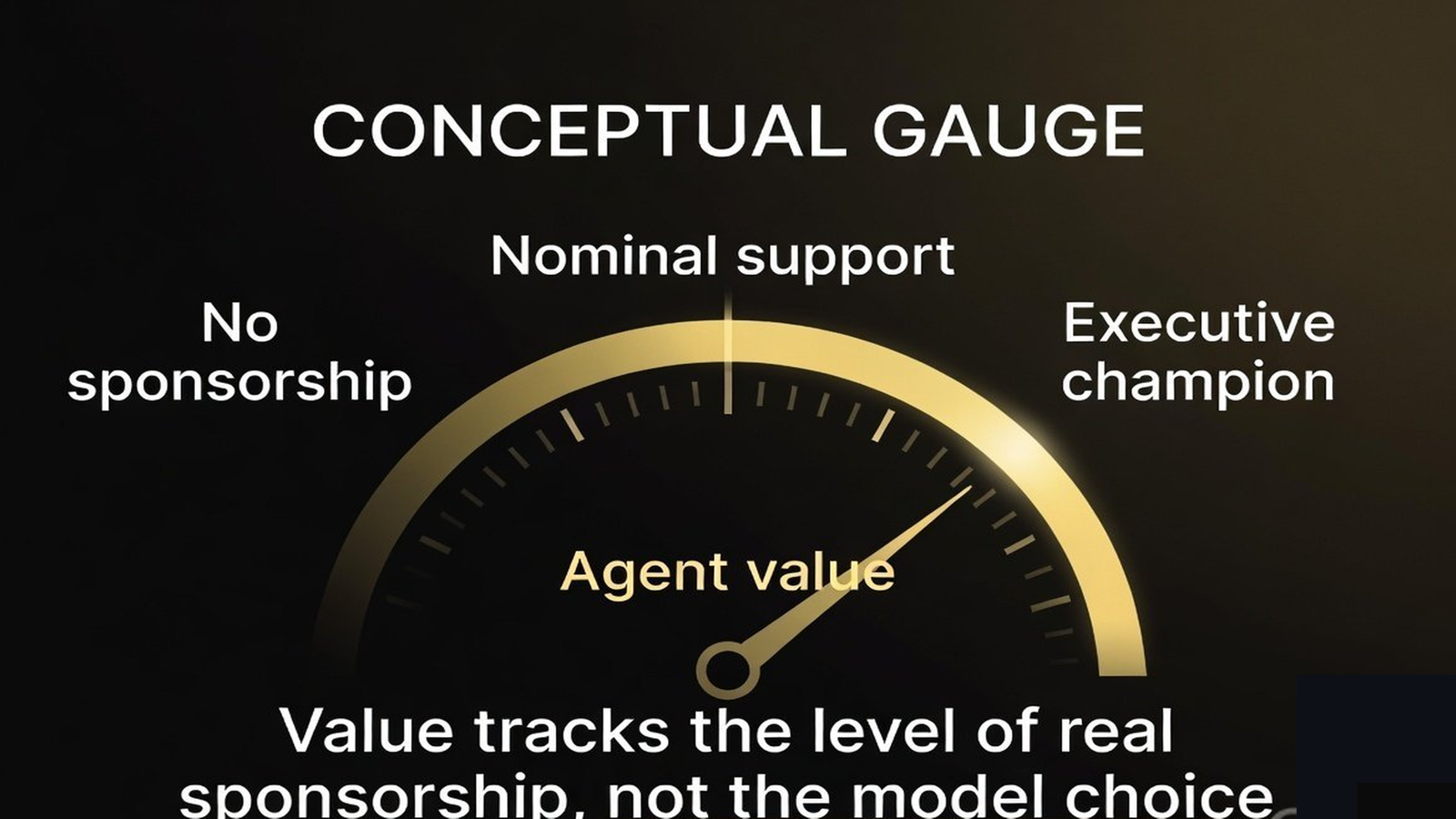
An agent that matters crosses boundaries. It touches a workflow one team owns, data another team guards and a risk posture a third team sets. Nobody below the executive line has the authority to align all three, so without a senior owner the project stalls in the gaps between departments, waiting on decisions no one is enabled to make. The McKinsey finding that CEO oversight is among the factors most correlated with EBIT impact is really a finding about authority: the agent that has someone who can clear the blockers is the agent that reaches production.
Sponsorship also decides whether the reliability work gets funded. The OSWorld gap is a reminder that the model alone delivers little; the value comes from the verification, the observability and the process redesign built around it. Those are exactly the line items a tech-team side project cannot fund and a sponsored initiative can. The leader is not there for the ribbon-cutting. They are there to pay for the parts that make the agent dependable.
What does real sponsorship require?
| Dimension | Side project | Sponsored initiative |
|---|---|---|
| Owner | A team lead | A named executive |
| Cross-team blockers | Stall in the gaps | Cleared by authority |
| Reliability budget | Unfunded | Funded as core work |
| Outcome | Pilot purgatory | Production and return |
A sponsor funds reliability work a better model cannot replace, so unfunded retries are the cost (OSWorld: 12% to 72%). (arXiv:2404.07972)
The leader's job is to make reliability a funded priority and reliability is what VibeModel delivers as the Pattern Intelligence Layer. When a sponsor can point to consistent behavior at the pattern level, the same situation handled the same correct way every time, they have something concrete to defend to the board and the funding for the agent survives the quarter when the novelty wears off.
Frequently asked questions
Is executive sponsorship just optics?
No. It is authority and budget. The sponsor clears cross-team blockers and funds the reliability work a side project cannot, which is why it tracks so closely with measured value.
What if leadership only wants the model?
Then the OSWorld gap bites: the model alone does little. Sponsorship has to fund the system around it or the value never appears.
How visible does sponsorship need to be?
Visible enough that teams know the agent is a priority, not a side bet. Champions who role-model use move adoption more than a quiet budget line.