


Key facts.
- Deloitte's State of AI in the Enterprise (2025) found only about one in five organizations has a mature governance model for autonomous AI agents, even as agent usage climbs. source
- A 2025 production survey found weak observability and immature guardrails are the most common pain points, with about 62% of teams naming observability their top investment for the year. source
- On the Berkeley Function-Calling Leaderboard, multi-turn and agentic categories often sit between 12 and 60% even for top models, the gap between a demo and an operable system. source
Why does the wrong skill profile sink the project?
Observability is the real gap a stronger model will not close, so skipping it is rework (BFCL: 12 to 60%). (source)
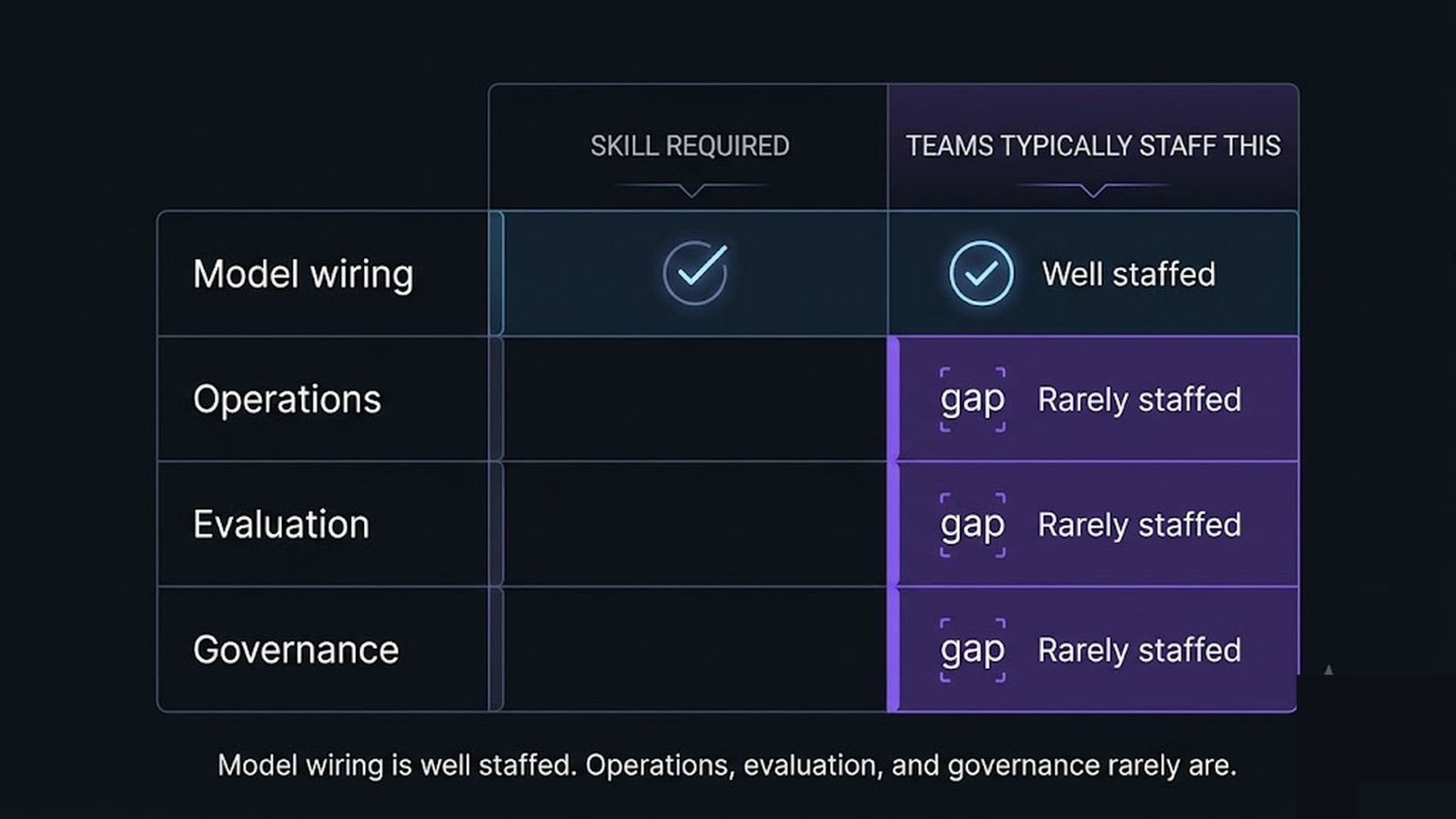
Most teams staff an agent project the way they staff a feature: a couple of strong engineers who can wire a model to some tools. That gets you to a working demo fast, which is exactly the trap. The demo hides the skills you actually need in month three: someone who can read a reasoning trace and tell a crash apart from a confident wrong answer, someone who owns the eval set so you know whether a change helped and someone accountable for what the agent is allowed to do on its own. None of those are model skills. All of them decide whether the thing survives.
When those roles are missing, the failure is quiet. The agent misbehaves, nobody can explain why, the postmortem says the model hallucinated because that is the only available answer and confidence drains until the project is shelved. The Deloitte finding is the tell: agent adoption is rising much faster than the governance and operating maturity around it, which is another way of saying teams are shipping faster than they can operate.
What does the right bench look like?
| Capability | What teams staff | What production needs |
|---|---|---|
| Build | Model and tool wiring | Agent design with failure modes in mind |
| See | App logs and uptime | Reasoning traces and semantic monitoring |
| Measure | One-off accuracy check | Owned eval sets and regression gates |
| Govern | Nobody named | An owner for autonomous scope and incidents |
The way out is not heroics. It is treating reliability as a capability you staff for, the same way you staffed for security and SRE when web apps grew up. VibeModel exists as the Pattern Intelligence Layer because reliability at the pattern level is what lets a smaller team operate an agent safely, the same situation handled the same correct way every time, so you need fewer heroes watching dashboards and more of the value the agent was supposed to deliver.
Frequently asked questions
Is this just a hiring problem?
Partly. It is also a design problem. If the agent is built without traces and eval hooks, no amount of staffing lets you operate it. Build the operability in, then staff to use it.
Which role matters most first?
The person who owns observability and the eval set. Without them you cannot tell whether any change made the agent better or worse.
Does a better model reduce the need for these skills?
No. Benchmarks like BFCL show top models still miss on multi-step tool use, so the skill to see and correct that work stays essential.