

Key facts.
- Tran and Kiela find single-agent systems match or beat multi-agent ones under matched budgets, so the "team" framing oversells the architecture (Tran and Kiela, 2026).
- A single successful demo run says nothing about the distribution; pass^k consistency is the number that matters in production (tau-bench, 2024).
- Gartner reports over 40% of agentic projects at risk of cancellation by 2027, a gap between the pitch and the outcome (reported).
Why does the demo always work?
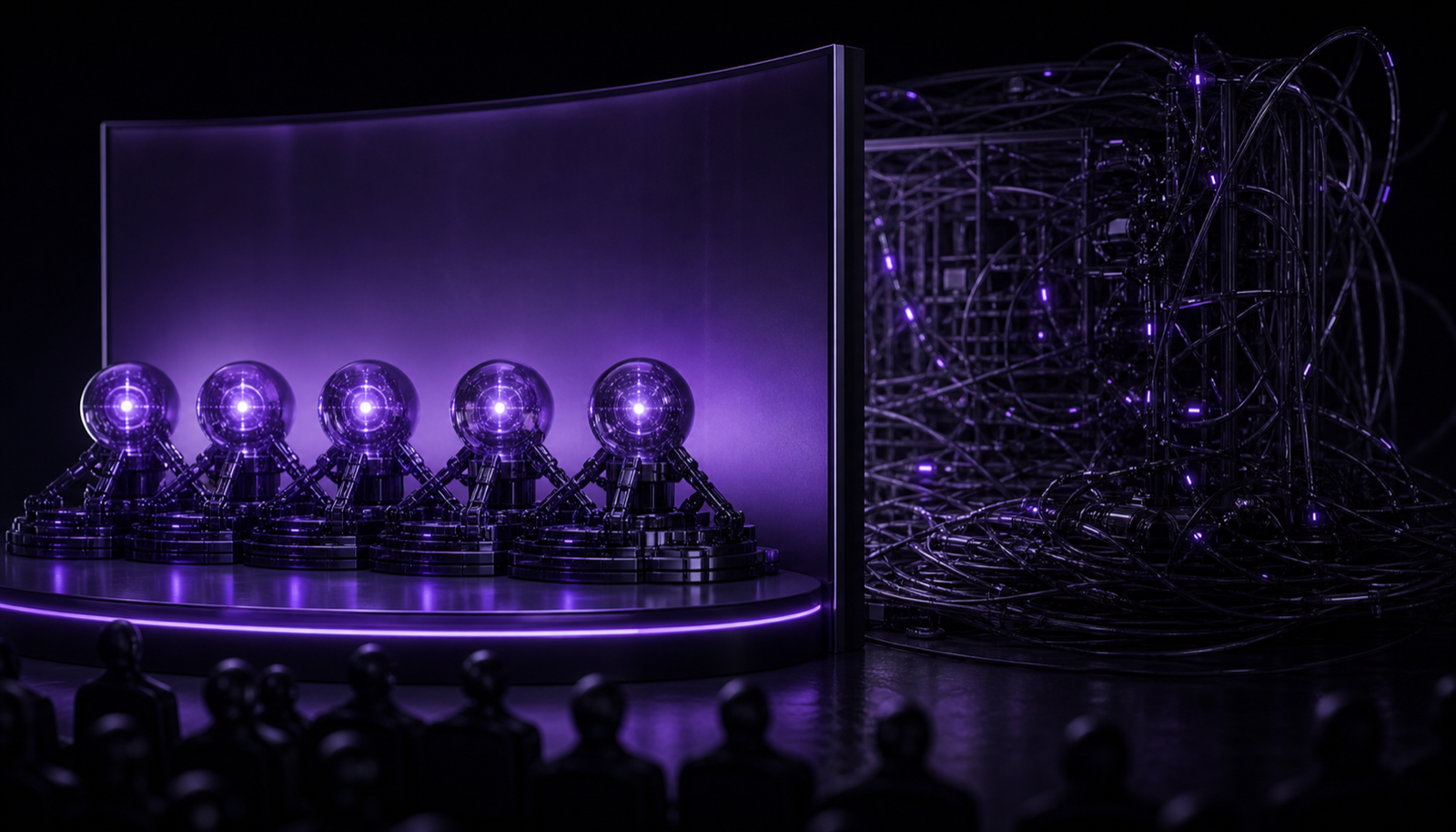
Because a demo is a single sample from a wide distribution, chosen to succeed. Production is the whole distribution, run at volume. The "team of agents" metaphor sells because teams feel reliable, but a human team's reliability comes from standups, shared docs, and people who notice when something is off. Strip those out and you have five strangers handed overlapping tasks with no way to coordinate. The metaphor is doing marketing work the architecture has not earned.
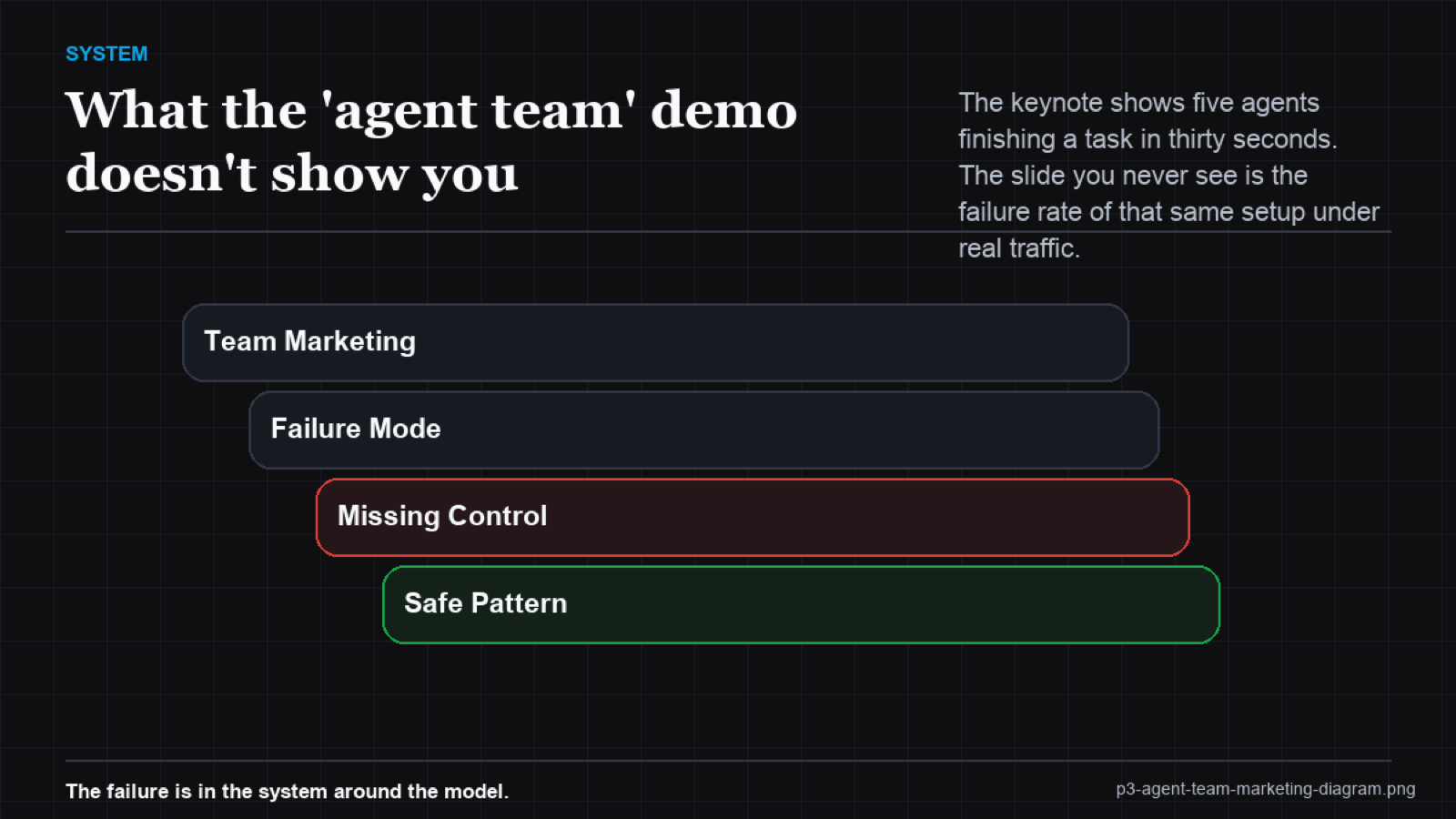
Pitch vs. production
| The pitch | Production |
|---|---|
| One scripted success | Thousands of varied runs |
| Agents framed as a team | Agents with no shared coordination |
| Failure rate unmentioned | Failure rate is the headline number |
The demo runs once; production surfaces the variance a stronger model inherits, repeating a tau-bench task under a quarter of 8 tries, at retry cost. (arXiv:2604.02460)
VibeModel exists to make the production distribution visible and to tighten it. The Pattern Intelligence Layer measures where the coordination actually fails and catches those patterns before they reach a customer. You can still give the great demo. We make sure the thousandth run looks like the first.
Frequently asked questions
Are agent teams just hype then?
No. They work when the coordination is engineered. The hype is pretending the metaphor substitutes for that engineering.
What number should I ask a vendor for?
Ask for pass^k or its equivalent on a realistic task, not a single success rate. Consistency is the honest metric.