


Key facts.
- On WildToolBench, models top out around 15% session-level accuracy on realistic multi-tool sessions, the kind of end-to-end work an under-tested agent meets in production. source
- 2026 enterprise reporting found about 64% of pilots that tried to expand hit blocking issues and the deployments that scaled were the ones that proved a narrow version stable before widening it. source
- A 2025 production survey found weak observability and testing the most common pain point, the exact capability passive teams underinvest in. source
What does passive friction look like?
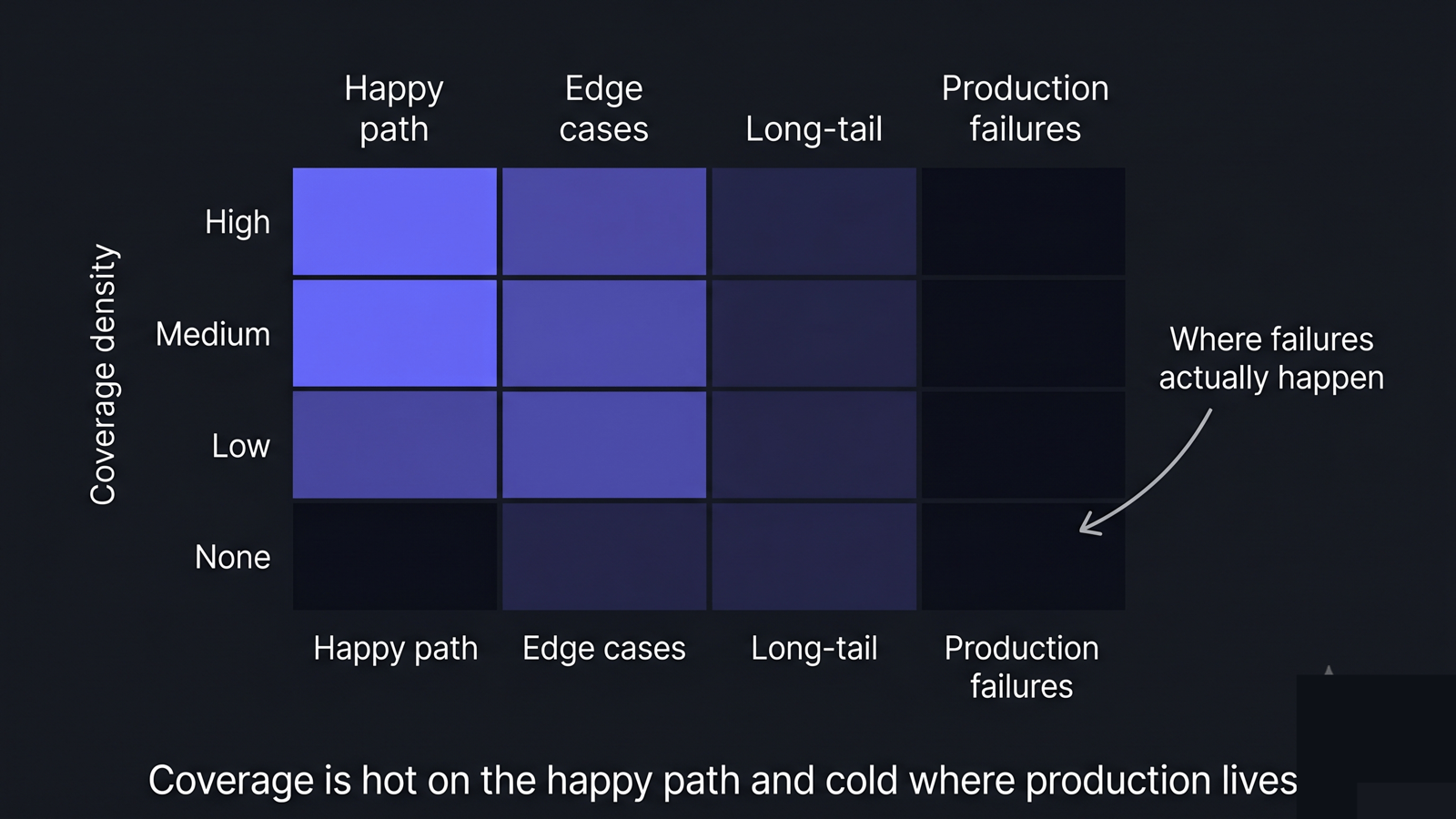
Skipped testing shifts shape per surface: clean in the demo, dead on the tail; a stronger model will not save it. (arXiv:2604.06185)
It rarely looks like opposition. It looks like a team that runs the happy-path test, signs off and moves on. It looks like the domain expert who never gets asked for the twenty edge cases she handles every week, so the agent never learns them. It looks like a knowledge transfer that was a single meeting instead of an ongoing loop. None of that registers as resistance, which is why it is so dangerous: the project looks supported right up until the agent meets a real case it was never prepared for and then the support evaporates because the thing visibly does not work.
The WildToolBench number is the technical reason this matters. Real sessions, the multi-step, multi-tool work that production actually is, are where models are weakest. An agent that was tested only on clean inputs is being deployed precisely into the regime it handles worst, with none of the domain knowledge that would have helped it cope. The fix is not more model. It is the transferred knowledge and the testing that the passive path skipped.
How do you replace passive friction with real investment?
| Practice | Passive path | Funded path |
|---|---|---|
| Testing | Happy path, sign off | Adversarial, messy-input coverage |
| Knowledge transfer | One meeting | Ongoing loop with the expert |
| Rollout | Wide, fast | Narrow, proven, then widen |
| Outcome | Falls over on the long tail | Handles the cases that matter |
This is reliability earned the hard way and it is exactly what the Pattern Intelligence Layer is built to capture. When the domain expert's edge cases become patterns the system handles the same correct way every time, the knowledge transfer is no longer trapped in one meeting or one person's memory. VibeModel makes that transfer durable, so the long tail your team knows about becomes the long tail the agent handles, not the surprise that sinks the project.
Frequently asked questions
Why is passive friction worse than open resistance?
Open resistance you can address. Passive friction looks like support, so nobody fixes the missing testing or knowledge transfer until the agent fails publicly.
How much testing is enough?
Enough to cover the messy inputs and edge cases the domain experts actually see, not just the happy path the demo used. Benchmarks like WildToolBench show real sessions are where agents break.
Who owns knowledge transfer?
The domain expert and the team together, as an ongoing loop. One handoff meeting does not move the tacit knowledge an agent needs for the long tail.