


Key facts.
- WildToolBench evaluated 57 LLMs on real user behavior patterns and found none exceeded 15% accuracy, versus near-saturation on cleaner benchmarks. source
- The benchmark's hard cases are exactly production's: compositional tasks, intent spread implicitly across turns and mixed queries, clarifications and casual conversation. source
- At scale that variety bites hard: Galileo's Agent Leaderboard v2, scoring agents across banking, healthcare and insurance scenarios, found the top model completing just 62% of multi-step action sequences, so every point of failure becomes a flood once real volume hits. source
- On WildToolBench's messy queries none of 57 models cleared 15%; a stronger model still cliffs and the retries hit at production volume. (arXiv:2604.06185)
Why does real variability break the agent?
Because the demo and production draw from different distributions and the agent was built and tested on the easy one. A demo query is a clean, complete, single-intent sentence. A real customer message is a fragment or three intents at once or a question buried in small talk or a clarification of something from two turns ago. WildToolBench deliberately captures this wild distribution and the result is brutal: models that look near-perfect on clean benchmarks collapse below 15% when the input behaves like a real person. So an agent that handled every demo question flawlessly meets actual customers and fails most of them, not because it got worse, but because the demo never tested the inputs that matter.
Volume turns this from a quality problem into an economics problem. At scale, every percentage point of failure is a flood of bad interactions and the variety of inputs guarantees the agent constantly meets cases it was never shaped for. The agent that was impressive at ten curated questions is overwhelmed at ten thousand real ones.
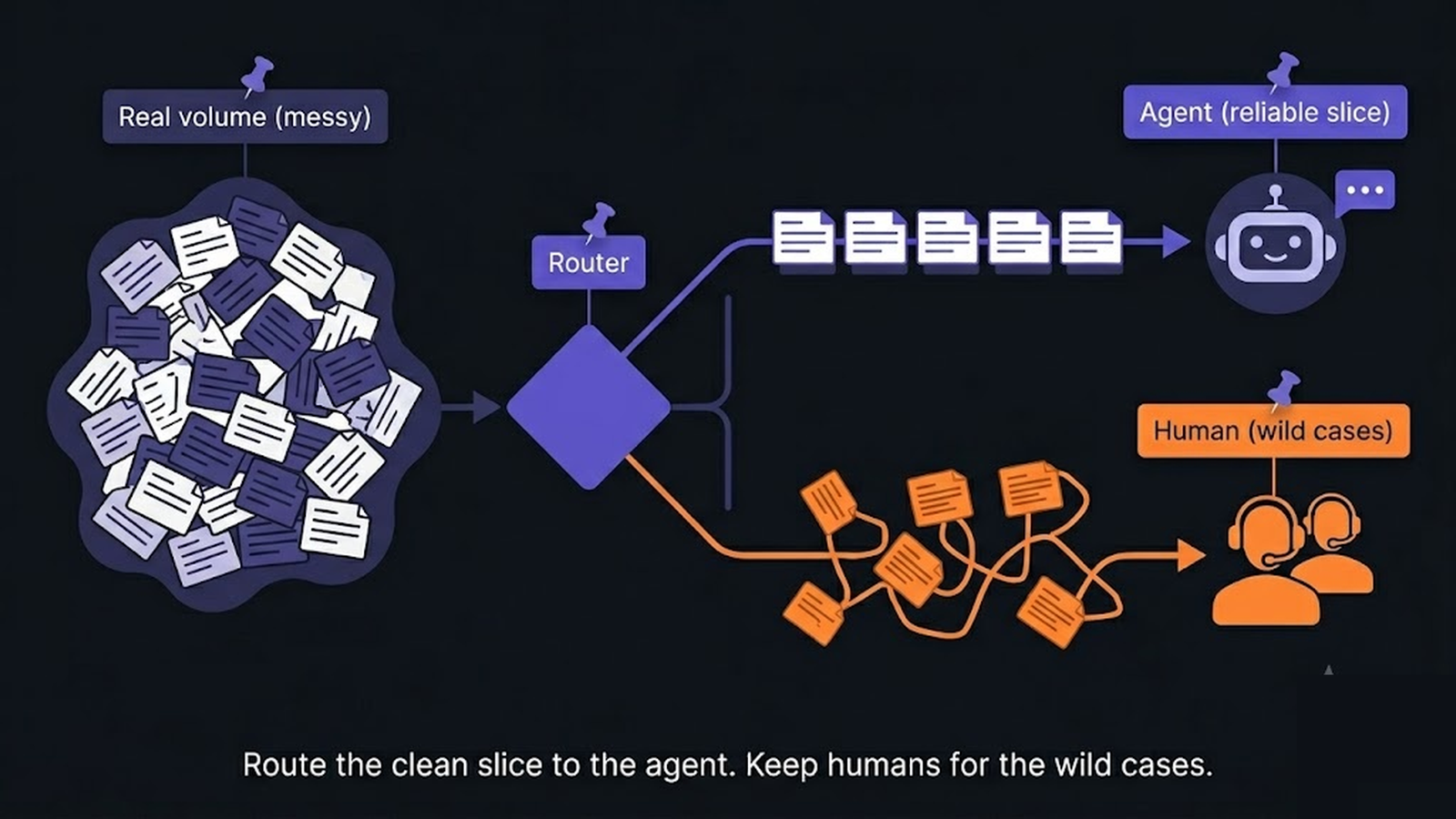
What survives real volume?
A bounded agent that handles the cases it reliably handles and routes the rest. Characterize the queries the agent is genuinely good at, the well-formed, in-scope, single-intent ones and let it own those at volume. Detect the messy, compositional, out-of-scope inputs that WildToolBench shows agents fail and route them to a human rather than letting the agent guess. The win is not an agent that handles everything badly. It is an agent that handles a defined slice excellently and knows to hand off the rest, which at real volume is what actually reduces load without creating a flood of failures.
| Scope design | Behavior at real volume |
|---|---|
| Handle everything | Collapses on the wild distribution |
| Own a defined slice, route the rest | Reliable on its slice, hands off the hard cases |
Defining that reliable slice is part of what VibeModel does as the Pattern Intelligence Layer. We model the patterns of the queries an agent handles reliably and the wild ones it does not, so your support agent absorbs real volume on the cases it can own and routes the rest before they become failures.
Frequently asked questions
Why does the demo mislead so badly?
Demos use clean queries; real customers do not. WildToolBench shows models near-saturated on clean tasks fall below 15% on real behavior.
Is the fix a better model?
Only partly. All 57 models stayed under 15% on the wild distribution. Bounded scope and routing matter more than raw capability.
How do I find the agent's reliable slice?
Characterize the query types it handles consistently and let it own those, detecting and routing everything outside that slice.