

The agents that ship aren't running smarter models, they're running better systems. Structured orchestration alone beat a strong single agent by 90.2% on a research eval, the structure did the work, not new weights (Anthropic, 2025). Scope, verify, orchestrate is the line between a demo and production.

Key facts.
- Long-horizon reliability is its own discipline: getting agents to succeed repeatedly depends on the system around the model, scoping, verification, recovery, not just the base model (Beyond pass@1: A Reliability Science Framework for Long-Horizon LLM Agents, arXiv:2603.29231, 2025).
- Orchestration done right is a documented win: Anthropic's orchestrator-worker multi-agent system outperformed a strong single agent by 90.2% on a breadth-first research eval (at the cost of far more tokens), because the structure, not a new model, did the work (Anthropic, multi-agent research system, 2025).
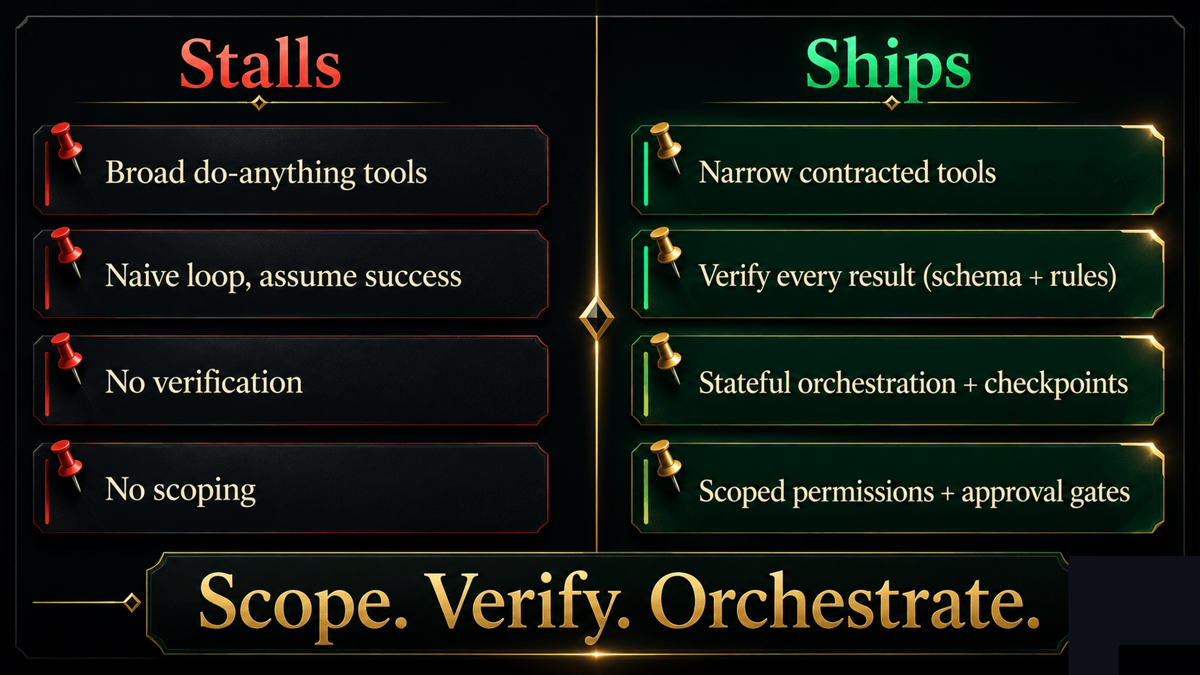
- The failed pattern is the opposite: broad do-anything tools in a naive loop that assumes success, with no scoping or verification to bound what a wrong step can touch (agent-integration engineering practice).
What does the failed pattern look like?
Shipped and stalled agents run similar models; the more capable one in a naive loop stalls just as hard. (arXiv:2603.29231)
An open world and a black box. The agent gets broad, do-anything tools with loose or no contracts, runs a naive loop that assumes each call succeeded, and retries or reasons harder when something looks off. There is no schema enforcing the result, no verification that the outcome matched intent, and no scoping to bound what a wrong step can touch. When the tool has real power, that pattern is dangerous: a broadly capable agent with production access and no enforced gate treats a powerful, stateful tool as a consequence-free function, the failed pattern in its most expensive form. The model was not the problem. The integration treated a powerful, stateful tool as a trusted, consequence-free function.
What does the shipping pattern share?
Three things, regardless of domain. Scoping: narrow tools with clear contracts, explicit permissions, and bounded domains, not a single tool that can do anything. Verification: schema enforcement plus business-rule checks plus, where needed, an independent judge, so a result is validated before it drives an action. Orchestration: explicit, stateful control flow with checkpoints, error branches, recovery, and human gates on high-impact steps, rather than an open reasoning loop. These map directly onto where failures concentrate, system design and verification, which is why scoping and verification lift success on the same model. The structured orchestration win Anthropic reported came from exactly this kind of design, not a smarter base model (Anthropic).
How do you move from the failed pattern to the shipping one?
Start narrow and add the layers before you add scope. Replace broad tools with specific, contracted ones and validate every input and output against a schema. Put verification between the tool result and the next action, deterministic checks first, a judge only where semantics demand it, and business-rule checks on anything consequential. Move from an open loop to stateful orchestration with checkpoints, explicit error handling, and approval gates on high-impact actions, and add tracing from day one so failures are visible. Then widen scope deliberately, adding verification as you go rather than reaching for autonomy first. The difference that ships is not a better model; it is treating every tool call as a contract with verification and recovery.
Failed versus shipping integration
| Dimension | Stalls in the demo | Reaches production |
|---|---|---|
| Tools | Broad, do-anything | Narrow, contracted, scoped |
| Results | Assumed successful | Schema + business-rule verified |
| Control flow | Open reasoning loop | Stateful, checkpointed, recoverable |
| High-impact actions | Run freely | Human approval gate |
| Visibility | Logs after the fact | Tracing and evals from day one |
The pattern is that the agents which ship are not running smarter models, they are running better systems: scoped tools, verified results, and explicit orchestration, exactly where the failures concentrate. Treat every tool call as a contract with verification and recovery, widen scope only behind those layers, and integration becomes the backbone instead of the weak link. Building that scoped, verified, orchestrated layer is reliability at the pattern level, which is what VibeModel builds as the Pattern Intelligence Layer.
Frequently asked questions
Is there really no model difference between success and failure?
Capability helps, but the deciding factor across cases is the integration pattern: scoping, verification, orchestration. Teams ship on today's models by building those layers, and stall without them on the same models.
Where do I start if my agent stalls in pilots?
Narrow the tools and add verification between each tool result and the next action. Then move to stateful orchestration with gates. Add scope last, behind the checks.
Does orchestration mean multi-agent?
Not necessarily. It means explicit, stateful control flow with verification and recovery. Multi-agent orchestration can help, as Anthropic's result shows, but the win is the structure, not the agent count.