


Key facts.
- BFCL v4 multi-turn accuracy data shows performance correlates with schema clarity; ambiguous tool schemas produce higher error rates across all tested models (BFCL v4, gorilla.cs.berkeley.edu).
- DORA 2024: testing completeness and deployment automation separate high-performing teams from low-performing ones. Same pattern shows up in enterprise agent tool integrations.
- Enterprise AI agent pilot failures point to the same three engineering gaps: error handling was happy-path-only, test data didn't match production variety, post-action verification was missing with no state confirmation after writes.
- What the reliable integrations have in common: the failure taxonomy was documented before the first production deployment, not assembled from incident reports after the fact.
- Teams that invest in scaffolding upfront ship subsequent integrations faster. The reliability infrastructure transfers instead of getting rebuilt from scratch each time.
Case 1: CRM integration that failed at scale
Mid-size enterprise, customer service agent, CRM integration. Testing worked fine: clean records, complete fields, current schema. In production at scale, three failure patterns emerged. First, records created before the schema migration three years prior had null values in fields the agent expected. Second, the CRM's partial update endpoint returned 200 even when validation rules prevented some fields from updating. Third, the rate limiting was 60 requests per minute in the US region and 30 in the EU region - a difference that only surfaced when EU customers reached the same scale as US customers. Three distinct engineering problems, all predictable, none caught in testing.
Case 2: The integration that shipped
A competing team in the same organization deployed a supply chain integration with a different approach. Before writing a line of integration code, they built a failure taxonomy document: every way the ERP API could fail, organized by category. They then wrote integration tests explicitly for each failure category, including null field handling, partial response processing, and rate limit scenarios. They ran the integration against anonymized production data samples before go-live. And they built a state verification query that ran after every write operation to confirm the ERP record matched the intended update. The integration went live with zero P0 incidents in the first 90 days.
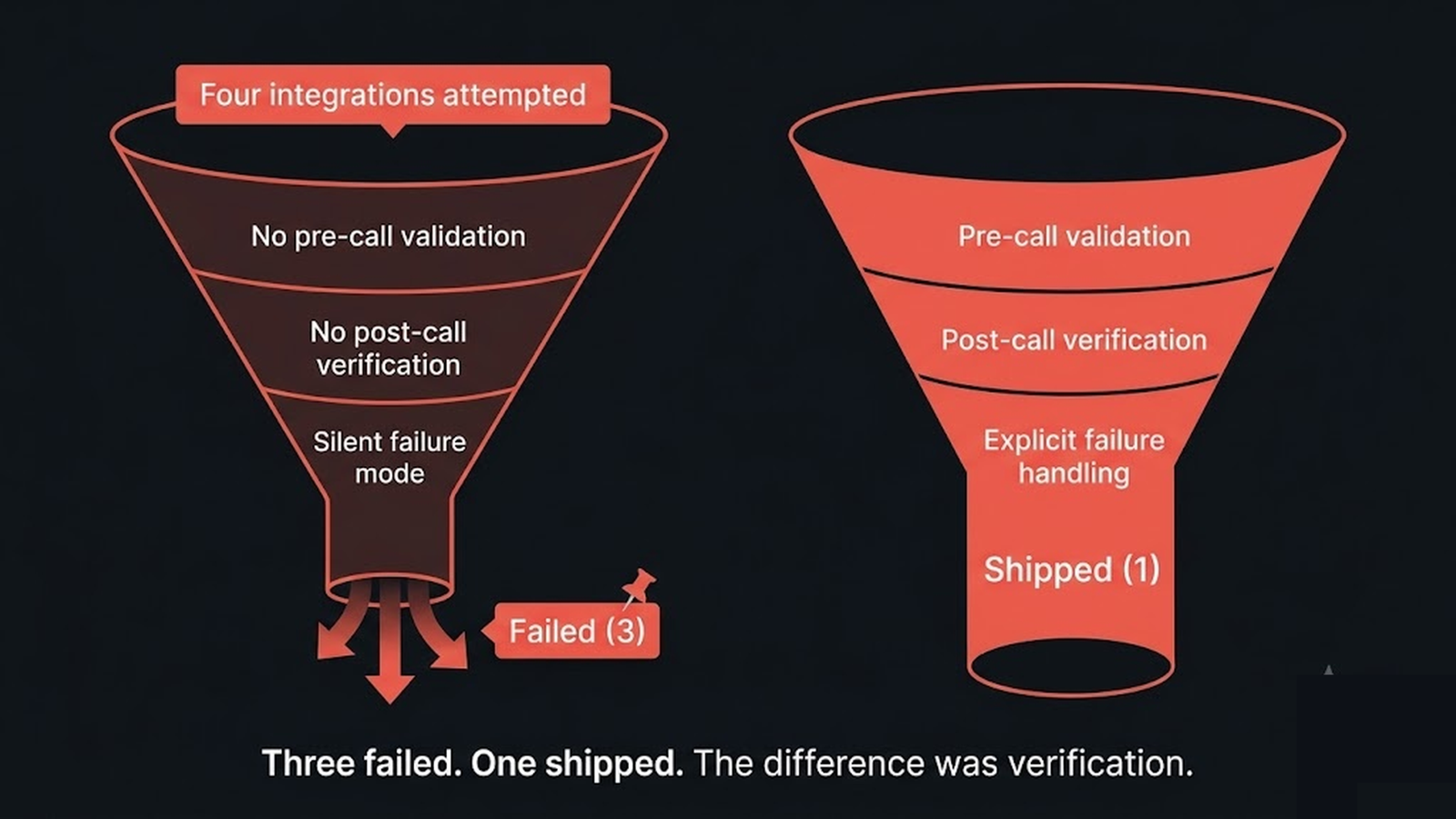
What failed integrations have in common
| Integration outcome | Error handling | Test data | Post-action verification | Failure taxonomy |
|---|---|---|---|---|
| Failed at scale | Happy path only | Synthetic, clean | Absent | Not documented |
| Failed at regional expansion | Partial | Single-region sample | Present for writes | Partially documented |
| Failed after schema change | Full | Production-representative | Present | Documented, not versioned |
| Shipped reliably | Full, categorized | Production-representative, refreshed | Present, automated | Documented, versioned, tested |
BFCL v4 shows model gaps narrow on sharp schemas and widen on vague ones; the integration that shipped won on scaffolding, not a stronger model. (BFCL)
VibeModel's Pattern Intelligence Layer learns from the failure patterns in your own integration history and from the broader corpus of documented integration failures. When you begin a new tool integration, the pattern layer surfaces the failure signatures from past integrations that are structurally similar to the one you're building. That pattern knowledge doesn't guarantee success. It tells you which failure categories to address before your users find them for you.
Frequently asked questions
Is there a standard template for a tool integration failure taxonomy document?
No universal standard. The categories are consistent across teams that have built this: transport (network, timeout, TLS), API-level (auth, rate limits, schema errors), data (null fields, type mismatches, encoding issues), state (partial success, async completion, idempotency violations), and business logic (validation rules, regulatory restrictions, workflow state mismatches).
How long does a production-ready tool integration actually take?
Full failure taxonomy coverage: 4-8 weeks for a single enterprise tool. Teams that built the reliability infrastructure once often complete subsequent integrations in 2-3 weeks, the scaffolding transfers. Teams that skip the taxonomy work typically spend months on post-incident remediation.
Should we build integrations for all tools at once or prioritize?
Prioritize by business impact and failure consequence, not by technical complexity. An integration that handles customer payment data warrants the full reliability investment regardless of technical simplicity. An integration that handles low-stakes read operations can be built with a lighter approach and upgraded if usage grows.