


Key facts.
- tau2-bench (arXiv:2506.07982) uses a dual-control benchmark environment to separate model capability from system reliability in tool-use scenarios, finding that system-level reliability requires engineering investments independent of model generation (tau2-bench, arXiv:2506.07982, 2025).
- BFCL v4 shows consistent improvement in single-call function-calling accuracy across model generations, while multi-turn and complex scenario accuracy has improved more slowly - the engineering scaffolding requirement does not shrink proportionally with model capability improvement.
- Measuring Agents in Production (arXiv:2512.04123) found that the teams deploying agents reliably in production share a characteristic: they build tool reliability infrastructure - error handlers, validators, monitors - rather than relying on model capability alone.
- The three reliability components that remain engineering problems regardless of model quality are: schema drift handling (APIs change, models do not automatically adapt), production data edge case handling (rare inputs require explicit coverage), and failure recovery orchestration (what happens after a tool call fails requires explicit design).
- Tool integration debt, where reliability shortcuts taken during development create compounding maintenance costs, grows faster in agent systems than in traditional software because the agent's behavior is harder to predict when the scaffolding changes.
Why model improvement is a partial answer
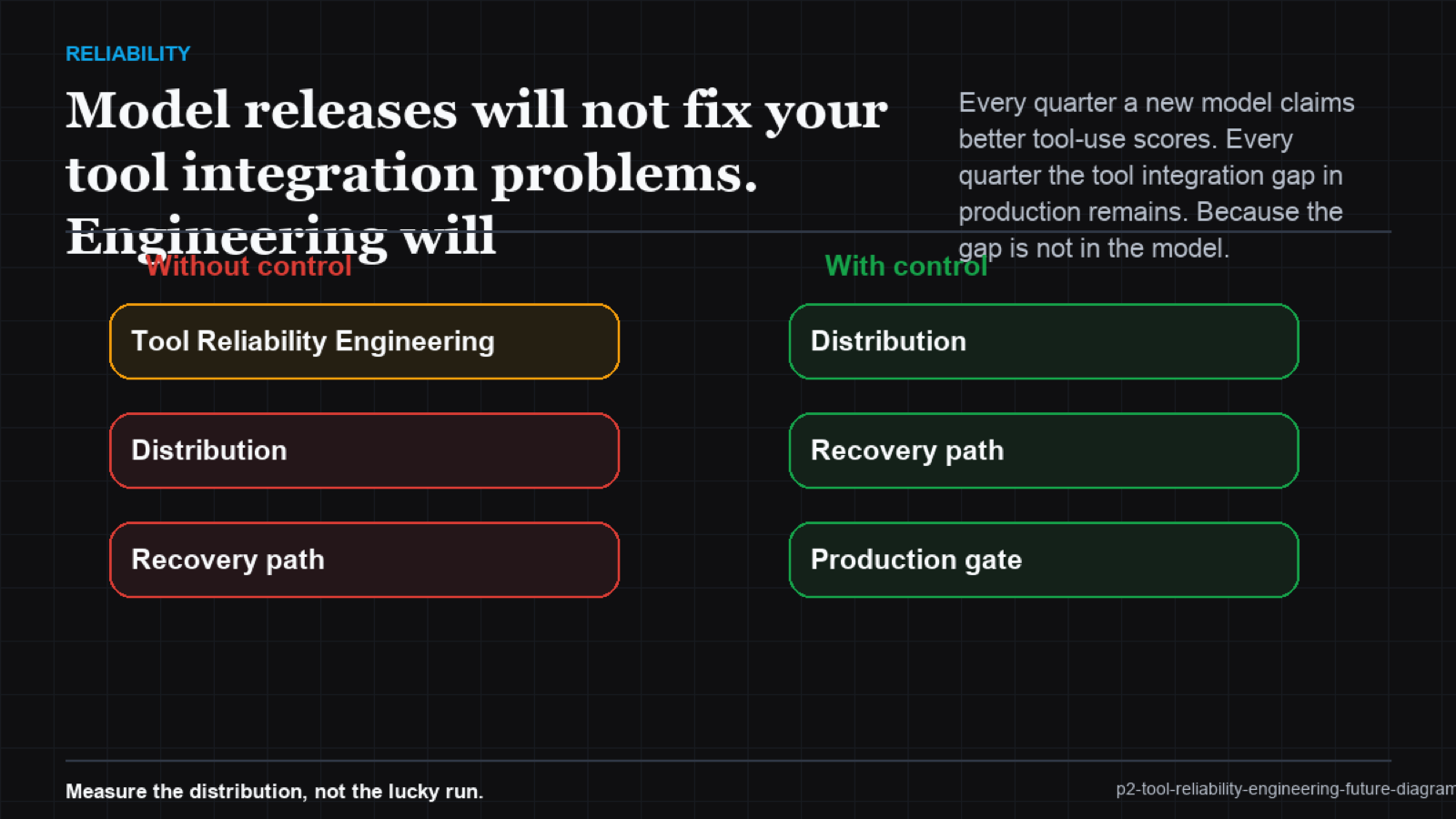
tau2-bench measures a gap between what a model can do and what the system reliably does; that gap closes on scaffolding, not the next model. (arXiv:2506.07982)
Better models reduce the single-call error rate. They do not eliminate schema drift, because the API changes independent of the model. They do not handle production data edge cases, because those edge cases require explicit coverage in the tool wrapper. They do not design failure recovery paths, because that is an architectural decision. Each of these is a load-bearing reliability component that the model cannot carry alone.
The pattern I see in teams that are waiting for the next model release to solve their tool reliability problems: they are waiting for the wrong thing. A model that is 10% better at function calling still fails on the 3% of tool calls that hit a schema variant the model has never seen. A model that is 20% better at reasoning still does not know that your CRM API returns partial results on certain record types. The model's improvement is real and worth capturing. It is just not the improvement that closes the reliability gap.
What tool reliability engineering actually looks like
The engineering investments that produce reliable tool-calling agents in production share a pattern. They start with a comprehensive failure taxonomy for each tool integration - every way this tool can fail, categorized by type. They continue with explicit handling for each failure category, including response taxonomy, retry logic, and escalation paths. They add production-representative testing on a regular cadence. They instrument every tool call with parameter-level tracing. And they maintain the scaffolding as both the model and the tools evolve. This is software reliability engineering applied to a new class of system. The practices are not new. The application is.
Reliability components: model vs engineering responsibility
| Reliability component | Model contribution | Engineering contribution | Primary owner |
|---|---|---|---|
| Single-call accuracy | High (improves with each generation) | Schema definition quality | Shared |
| Schema drift handling | Low (model does not track API changes) | Contract testing, version management | Engineering |
| Production edge case handling | Low (distribution not in training) | Production-representative test data | Engineering |
| Failure recovery | Low (model lacks persistent state) | Retry logic, circuit breakers, escalation | Engineering |
| Audit and observability | None | Tool call tracing, parameter logging | Engineering |
VibeModel's Pattern Intelligence Layer gives teams a data-driven view of where their tool reliability gaps actually are - not where they assume the gaps are based on benchmark scores. By analyzing production failure patterns, the system identifies which reliability components are underinvested for each specific tool integration. That analysis makes the engineering roadmap concrete: these three tool wrappers need failure taxonomy work, this integration needs schema contract testing, this tool's retry logic needs a semantic failure class added. That is not a model problem. That is an engineering plan.
Frequently asked questions
How do we make the case internally to invest in tool reliability engineering rather than waiting for model improvements?
Data from your own production environment is the most compelling case. Instrument your current agent's tool calls, collect the failure distribution over four weeks, and show which failures are model errors versus schema issues versus edge case gaps versus missing retry logic. The split typically shows 60-70% of failures are engineering problems, not model problems.
What is the right team structure for maintaining tool reliability infrastructure?
A dedicated AI reliability engineering function, or embedding reliability responsibilities with the teams that own specific tool integrations, with a shared standards body for error taxonomy and failure handling patterns. The specific structure matters less than having explicit ownership for each component of the reliability stack.
How do we prioritize which tool integrations to invest in first?
By failure rate, blast radius of failure, and business criticality. The combination of high failure rate and high business impact is the starting point. Tools that fail silently (success-state mismatches) are higher priority than tools that fail loudly, because silent failures propagate further before anyone responds.