


Key facts.
- WildToolBench (arXiv:2604.06185): none of the 57 evaluated frontier models exceeded 15% session accuracy; complex multi-tool orchestration scenarios showed the lowest completion rates across all models (WildToolBench, arXiv:2604.06185).
- Tran and Kiela (arXiv:2604.02460) found that single-agent systems outperform multi-agent equivalents under equal compute budgets for many task types, challenging the assumption that more agents always means better outcomes (Tran and Kiela, arXiv:2604.02460, 2026).
- BFCL v4 data shows that function-calling accuracy drops as the number of available tools increases, with models showing measurable degradation in tool selection accuracy above 20 tools in a single context.
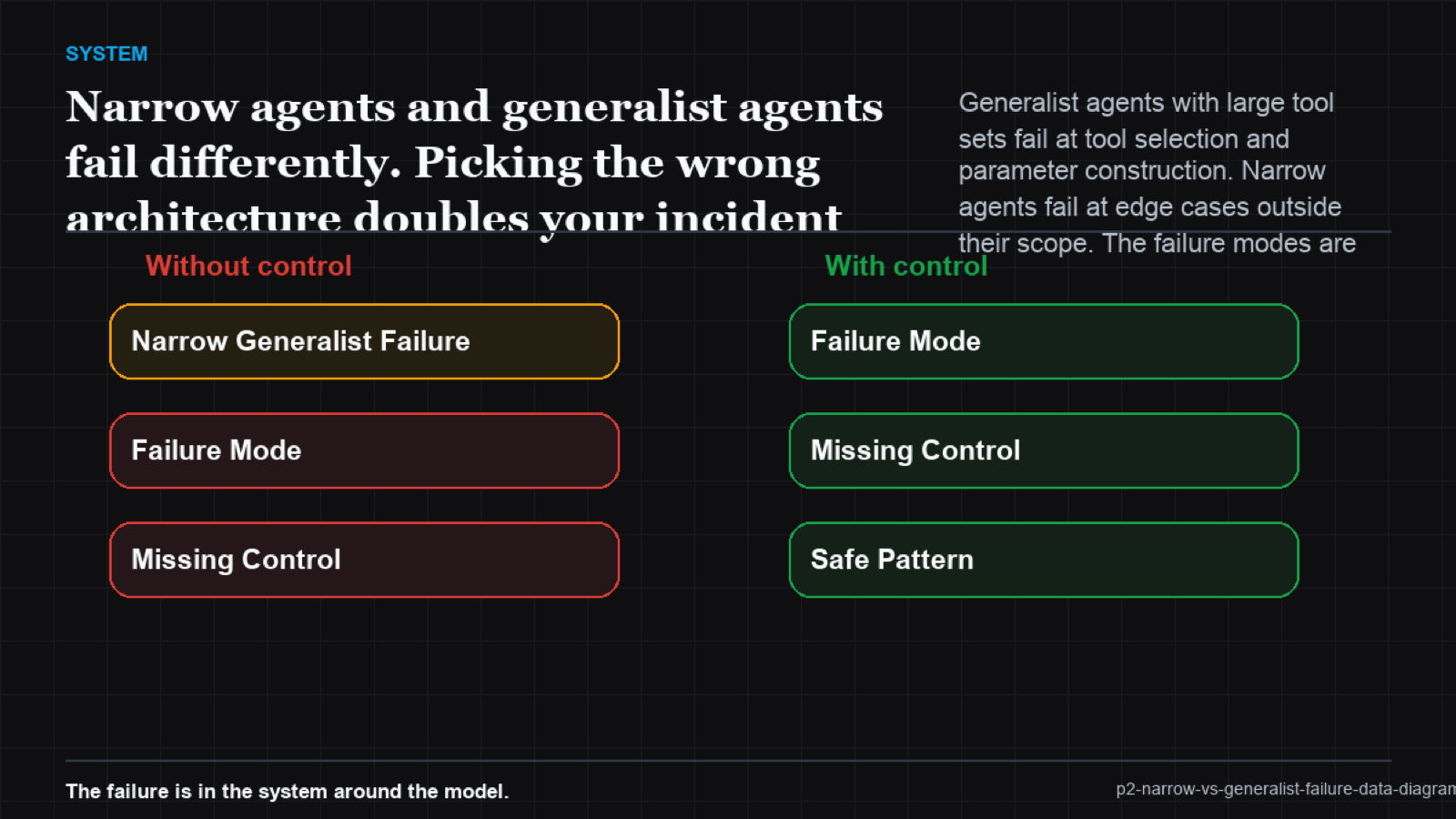
- Narrow agents fail characteristically at domain edge cases - where the task falls slightly outside the defined scope - while generalist agents fail characteristically at tool selection and parameter hallucination across competing tool options.
- Production incident data from enterprise agent deployments shows that generalist agents produce more incidents per deployed hour than narrow agents in the same organization, while narrow agents produce fewer incidents with faster mean time to resolution.
The two failure signatures
Narrow agents fail at the edges of their defined scope. An agent built to handle password reset requests fails when a customer asks about a password reset and an account suspension simultaneously. The failure mode is predictable, documentable, and addressable through scope definition. The agent does not fail at the core task. It fails at the boundary.
Generalist agents fail at selection and construction. Given twenty tools, the agent selects the wrong one 15% of the time. Given a tool it selected correctly, it constructs a parameter using information from the wrong part of the conversation 10% of the time. These failures compound across multi-step tasks, and they are harder to diagnose because the failure mode is not "outside scope" - it is "wrong choice inside scope." That distinction matters for remediation.
What the failure data implies for architecture decisions
The WildToolBench result should change how teams frame the scope question. The question is not "how capable should our agent be?" It is "which failure rate is acceptable, and which failure mode is remediable?" A narrow agent with a 5% out-of-scope failure rate is manageable: you can identify the scope gaps and either expand the agent's scope or route those cases to a human. A generalist agent with a 30% task failure rate from tool selection errors is harder to manage because the failures are distributed across the task space and each has a different root cause.
Tran and Kiela's result adds another dimension: the multi-agent version of a generalist, often proposed as the solution to scope limitations, underperforms the narrow single-agent version under equal compute budget. This suggests that the path from narrow to broad coverage runs through sequential narrow agents with explicit handoff logic, not through a single ambitious generalist.
Architecture comparison: failure modes and mitigation
| Architecture | Primary failure mode | Failure predictability | Mitigation path |
|---|---|---|---|
| Narrow single-purpose | Out-of-scope requests | High - predictable boundary | Explicit scope definition, graceful escalation |
| Generalist single-agent | Tool selection, parameter hallucination | Medium - distributed failures | Tool set curation, parameter validation |
| Multi-agent generalist | Coordination, handoff gaps | Low - emergent failures | Explicit protocol, observability at handoffs |
| Narrow multi-agent | Handoff edge cases | Medium - handoff-specific | Typed handoff schemas, verification gates |
VibeModel's Pattern Intelligence Layer makes the failure mode comparison data-driven for your specific deployment. By learning which task patterns in your agent's scope correlate with tool selection errors versus parameter construction errors versus scope boundary failures, it gives you an empirical basis for the architecture decision rather than an assumption. The pattern data tells you whether you have a scope problem or a selection problem, and those have different solutions.
Frequently asked questions
Does a smarter model close the narrow-versus-generalist gap?
WildToolBench ran 57 LLMs, none past 15% session accuracy; a stronger model joins them, narrow scope still wins. (arXiv:2604.06185)
At what tool count does generalist agent performance degrade significantly?
BFCL data suggests measurable degradation above approximately 20 tools in context. Practical deployments often see it earlier, depending on how semantically similar the tools are to each other. Tool similarity is a bigger driver of selection errors than raw tool count.
Can fine-tuning a generalist agent make it as reliable as a narrow one?
For specific task distributions, yes. But fine-tuning trades off generalization for performance on the training distribution. If your production task distribution shifts, the narrow-task fine-tuning may not transfer. The reliability gain from narrow scope is architectural, not model-dependent.
How do we handle the tasks that a narrow agent cannot handle?
Explicit escalation paths are the standard answer: the narrow agent recognizes it is at the scope boundary and hands off to a human or to a different specialized agent rather than attempting the task and failing badly. Failure at the boundary is a feature, not a bug, if the escalation path works.