


Key facts.
- Under an equal thinking-token budget, a single agent matched or outperformed multi-agent systems on multi-hop reasoning, so apparent multi-agent gains often came from spending more compute, not from coordination. source
- On WebArena, the best GPT-4 agent completes only 14.4% of real web tasks against 78.2% for humans, so a broad open-scope agent is unreliable exactly where it is asked to do the most. source
- "The Illusion of Diminishing Returns" found per-step accuracy degrades as a run lengthens, so success falls off compoundingly with scope, evidence that broad autonomy is where the cost and error pile up. source
Why does narrow scope cost less per outcome?
Widen an agent past where it is reliable and it pays again in rework; a bigger model does not fix it, one agent matched multi-agent setups at equal budget. (arXiv:2604.02460)
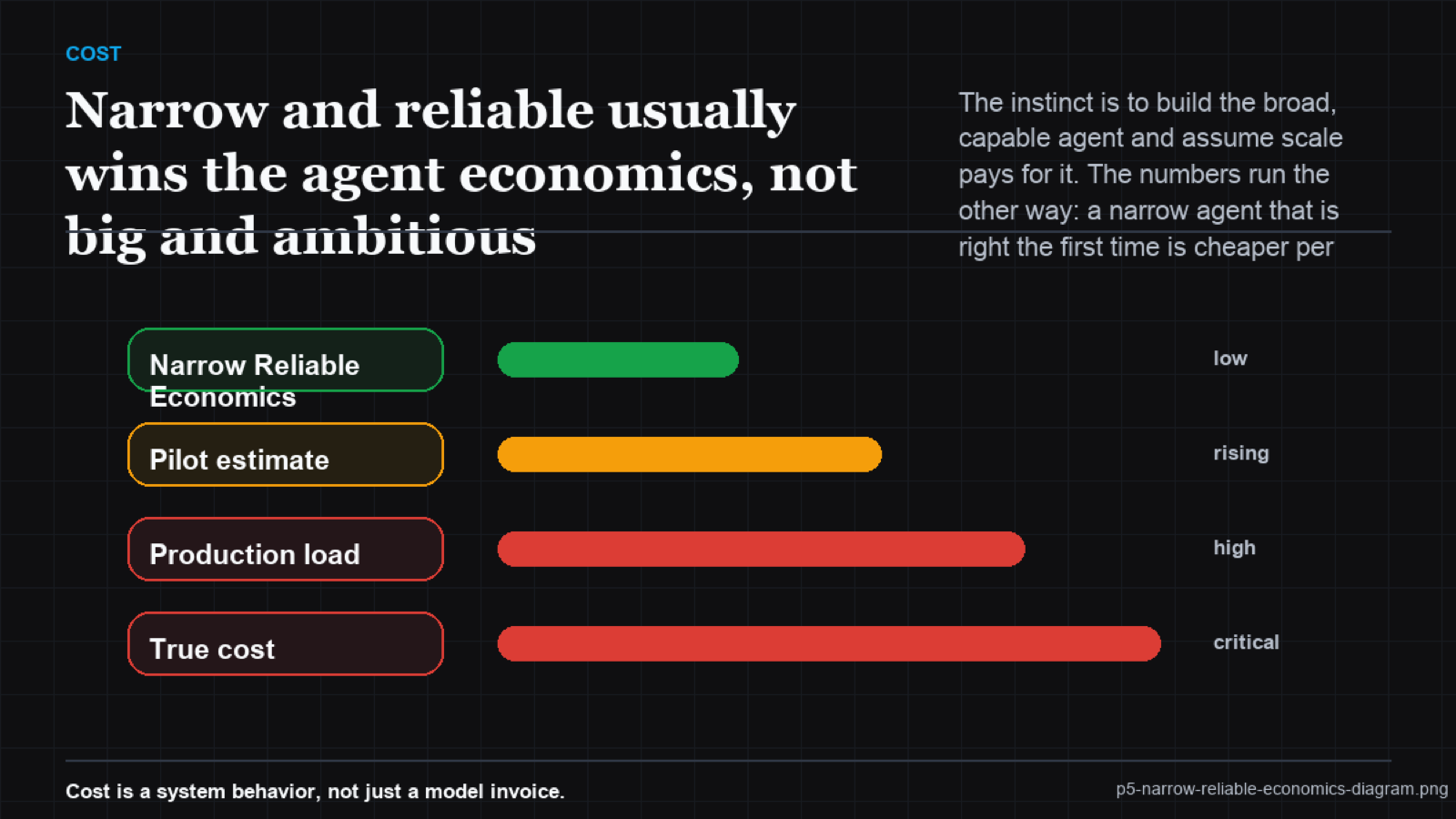
Because reliability is the cheapest cost control you have. A narrow agent runs against a small, well-understood set of inputs, so its error rate is low and predictable. Low error rate means the first attempt usually produces the right answer and one pass is the cheapest an outcome can be. The broad agent faces a wider input distribution it was never reliable across, so it fails more often and every failure is paid for twice: once for the wrong run, again for the retry or the human who has to catch and fix it. The nominal token price can be identical and the broad agent still costs more, because cost per outcome counts the reruns the cost-per-call number hides.
A stronger model narrows this gap without closing it. The Stanford budget-matched result is the cleanest evidence: when you hold compute equal, the broad multi-agent arrangement stops looking cheaper, because its advantage was the extra spend. So upgrading the model lowers the error rate a little and leaves the structure of the cost intact. The agent that is reliable on a narrow task stays the cheapest way to get that outcome, whatever model is underneath.
How do you find the scope where the economics work?
Measure the error rate as you widen the task, not just the capability. Start narrow, where the agent is reliable and add scope one increment at a time, watching cost per correct outcome rather than cost per call. The moment that number starts climbing, you have found the edge of the agent's reliable range and that is where the scope should stop. Past it, you are paying for adaptability the task does not reward and the retries quietly turn a cheap demo into an expensive production line. The agents that pay are the ones whose scope was set by where they stay reliable, not by how much they could be asked to attempt.
| Dimension | Narrow, reliable agent | Broad, ambitious agent |
|---|---|---|
| Error rate | Low, predictable | Higher, variable |
| Passes per outcome | Usually one | Often several |
| Oversight cost | Spot checks | Per-item review |
| Cost per correct outcome | Low | Inflated by rework |
The Pattern Intelligence Layer is where this trade is decided on numbers. Error rate and cost per outcome are tracked at the pattern level as scope changes, so the edge of the agent's reliable range shows up as a trend before the bill does and the scope is set where the economics actually favor it. Reliability at the pattern level is what keeps a narrow agent narrow on purpose, which is usually where the money is.
Frequently asked questions
Isn't a broad agent more valuable because it does more?
Only if it does more reliably. A broad agent that needs retries and review on the extra work often costs more per correct outcome than a narrow one, so the added scope can subtract value rather than add it.
Does a bigger model make broad scope economical?
It helps at the margin but does not change the structure. The budget-matched Stanford result shows the broad arrangement's advantage was compute, so a stronger model lowers the error rate a little and leaves the cost shape intact.
How do I know where to stop widening?
Watch cost per correct outcome as you add scope. When it starts rising, you have passed the agent's reliable range and that increment is costing more than it returns.