


Key facts.
- "The Illusion of Diminishing Returns" found per-step execution accuracy drops as tasks lengthen, so longer runs fail at a compounding rate, which means at scale a meaningful share of runs fail and must be retried or escalated. source
- Tran and Kiela showed that when token budget is held equal, single-agent systems match or beat multi-agent ones, so the extra spend of a multi-agent design often buys no reliability, only cost. source
- Anthropic reported multi-agent runs at roughly 15x the token cost of chat, so the architectures that lift quality also lift cost, and the trade only works above a value threshold (reported). source
- MIT NANDA's State of AI in Business 2025 reported that only about 5% of enterprise GenAI pilots delivered measurable financial impact, which is exactly the failure of unit economics at scale (reported). source
Why does the demo mislead on economics specifically?
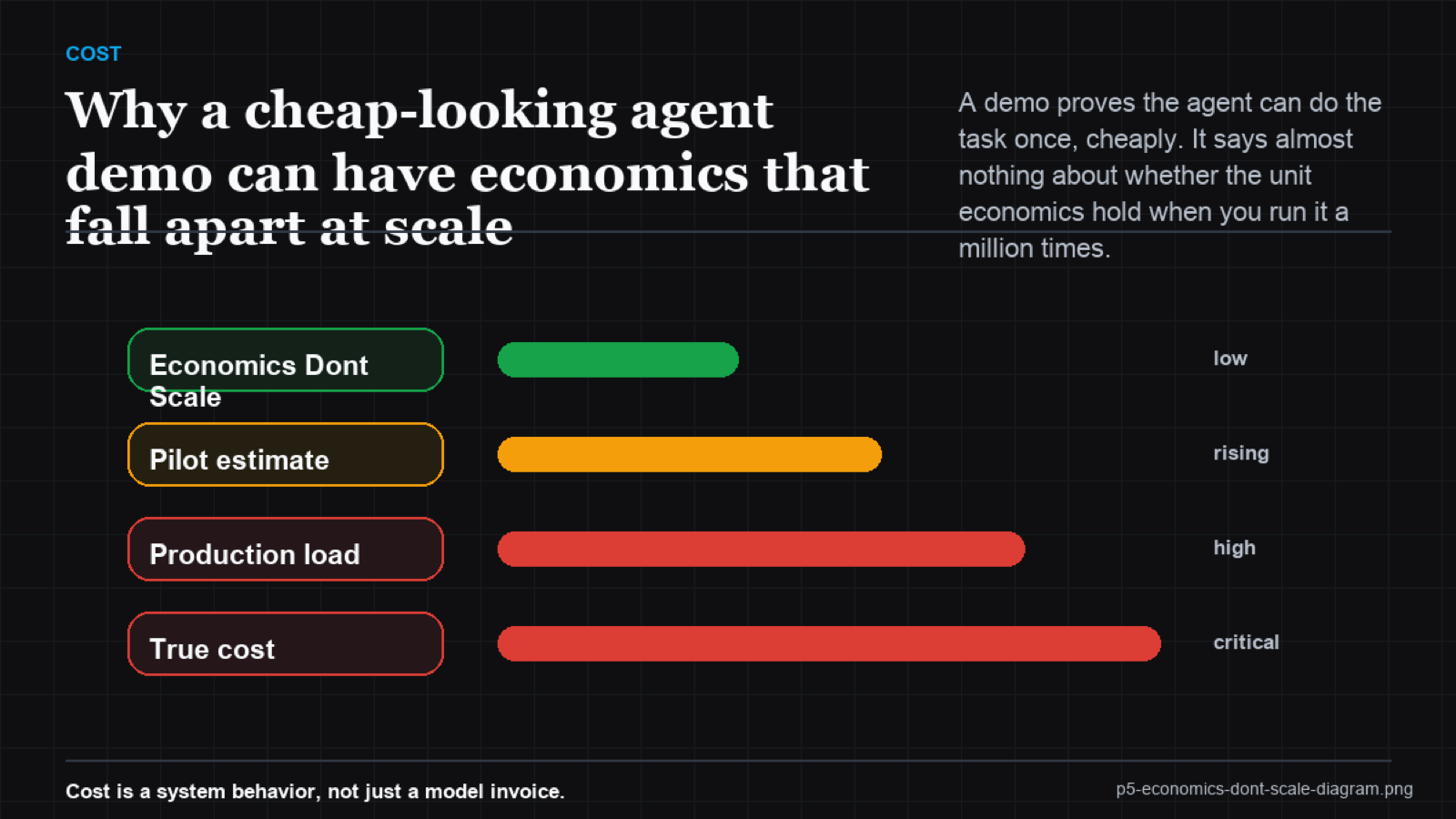
Because a demo measures cost per run on a successful run, and at scale the metric that decides the project is cost per successful outcome across all runs. Those diverge whenever the success rate is below 100%, which the production survey and benchmark results show it always is. If one in three runs fails and has to be retried or handed to a human, your true cost per outcome is not the demo's cost per run, it is that cost divided by the success rate plus the cost of handling the failures. A demo that looks ten times cheaper than the human process can, at a realistic success rate, end up barely cheaper or even more expensive once the failures are priced in.
This is why "the demo was cheap" is not a business case. The demo deliberately excludes the costs that scale: the failed attempts, the oversight that catches them, and the rework when oversight misses. The teams whose economics hold compute cost per successful outcome from a realistic success rate before they scale, not after the invoice.
What makes the economics actually work?
A success rate high enough that failed-run cost stays small, a scope narrow enough to keep that rate high, and a value per outcome that clears the true cost per outcome with margin. Narrow, reliable agents win here, because a high success rate keeps the failure tax low, while broad ambitious agents pay the tax on a large share of runs. The same logic explains why multi-agent designs need a value threshold: at 15x the tokens, the outcome has to be worth far more to justify the run. Economics at scale is a question about the whole distribution of runs, and the demo only ever showed you the best one.
| Lens | Demo | Scale |
|---|---|---|
| Unit | Cost per run | Cost per successful outcome |
| Success rate assumed | 100% | Realistic, below 100% |
| Failure handling | Excluded | Retries + oversight + rework |
| Verdict | Looks cheap | Decides the project |
A demo prices one clean run; at scale success falls off as accuracy to the power of steps (arXiv 2509.09677), and a better model bends that curve only slowly. (arXiv:2509.09677)
The Pattern Intelligence Layer is where cost per successful outcome becomes a measured property rather than a hopeful assumption. Success rate, failed-run cost, and the value threshold for expensive architectures are tracked at the pattern level, so the economics are known before scale, not discovered after. Reliability at the pattern level is also reliability of the unit economics, which is what keeps a project funded.
Frequently asked questions
The demo was ten times cheaper than a human. Are we good?
Only if the success rate is near 100%. At a realistic rate, failed runs and oversight can erase most of that gap. Compute cost per successful outcome.
Why do narrow agents win on economics?
A narrow scope keeps the success rate high, which keeps the failure tax small. Broad agents pay that tax on a large share of runs.
When is multi-agent worth the cost?
Only when the outcome value clears the higher token cost. Anthropic's ~15x is the bar the value has to beat.