

Key facts.
- Anthropic reported its multi-agent research system consumed roughly 15x the tokens of single-agent chat, with token usage explaining most of the performance variance (reported). source
- WildToolBench shows the inconsistency that fuels retries and loops: across 57 models and 1,024 real-world tasks, none topped about 15% session accuracy. source
- Because most LLM APIs bill the full conversation history on every call, a multi-step agent loop accumulates context cost faster than a per-step estimate suggests, an effect industry write-ups describe as quadratic in the number of steps (reported). source
- MIT's NANDA "State of AI in Business 2025" found only about 5% of enterprise GenAI pilots delivered measurable financial impact, so a bill that quietly multiplies is often what turns a promising pilot into one that gets cut. source
Why does each multiplier hide in the demo?
Retries, loops, context, and chatter stack: Anthropic's multi-agent system burned ~15x the tokens of chat. A better model won't stop them; on WildToolBench none topped ~15% session accuracy. (arXiv:2604.06185)
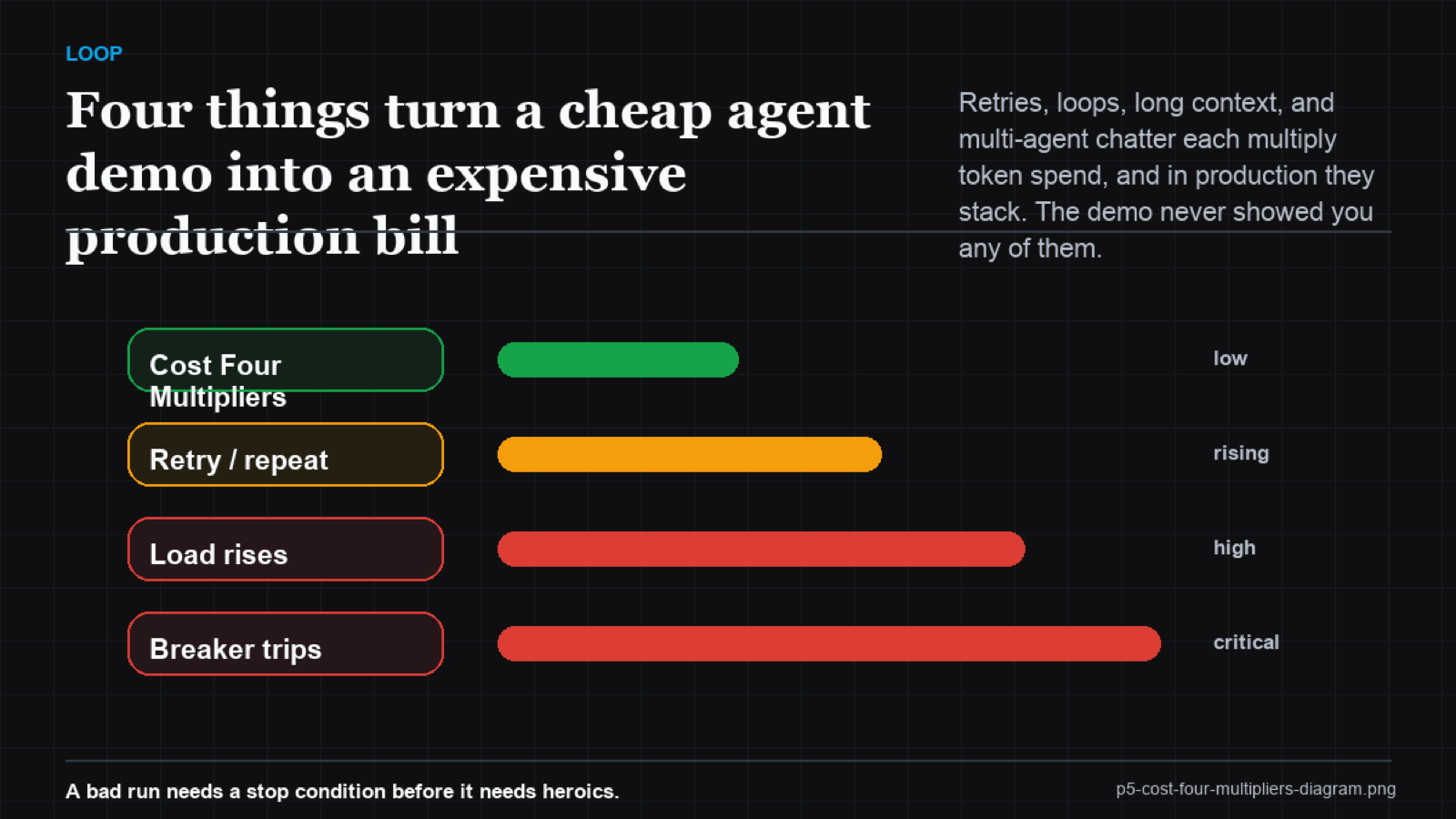
Because a demo is engineered to succeed on the first try, on a short prompt, as a single agent. Retries do not fire because nothing fails. Loops do not happen because the task completes. Context stays small because the conversation is short. And there is no second agent to talk to. Production removes all four protections at once. A failed tool call triggers retries, each one a fresh billable call. An unsolvable sub-task sends the agent looping until a limit stops it, if a limit exists. Long real tasks grow the context every step, and since the API bills the whole history each call, late steps cost far more than early ones. And a multi-agent design pays for coordination traffic the demo never generated.
The fix for each is specific, which is why naming them matters. Retries need idempotency and a cap. Loops need a hard step budget. Context needs trimming or summarization so the history does not grow unbounded. Multi-agent chatter needs a reason to exist, used only where the task value clears the token cost. Design these four and the production bill stops being a surprise.
Which multiplier hurts most?
It depends on the workload, which is the point: you have to measure your own. Long-context tasks are dominated by context accumulation. High-failure tool environments are dominated by retries. Open-ended tasks are dominated by loops. Multi-agent designs are dominated by chatter, as Anthropic's 15x shows. A team that assumes one cause and optimizes only it leaves the real driver running. The discipline is to attribute cost to each multiplier from your traces, then cut the largest one first.
| Multiplier | Demo behavior | Production behavior | Control |
|---|---|---|---|
| Retries | None | Per failed call | Idempotency + cap |
| Loops | Completes | Runs to limit | Hard step budget |
| Context growth | Short | Bills full history each call | Trim / summarize |
| Multi-agent chatter | Single agent | Coordination traffic | Use only when value clears cost |
The Pattern Intelligence Layer makes these controls properties of the pattern, not heroics added during a cost review. The retry cap, the step budget, the context discipline, and the multi-agent justification are enforced on every run, so the bill tracks value instead of accident. Reliability at the pattern level includes the reliability of a cost you can predict before you ship.
Frequently asked questions
Why is my production bill so much higher than the demo?
The demo hid retries, loops, context growth, and chatter. Production runs all four, and they stack. Attribute your spend to each and cut the largest.
Is multi-agent always more expensive?
Yes, on tokens. Anthropic reported ~15x versus chat. It is worth it only when the task value clears that cost, not by default.
Which control do I add first?
A hard step budget and a retry cap, because runaway loops and retries can produce the worst surprises fastest.