

Key facts.
- Anthropic's engineering write-up on its multi-agent research system reports it used about 15x more tokens than a chat interaction, and that token usage by itself explained about 80% of the variance in their evaluation. source
- The "AgentTaxo" work (ICLR 2025 FM-Wild workshop) dissects where tokens go in multi-agent systems and names the overhead a "communication tax": duplicated and redundant inter-agent tokens that scale with the number of agents, not the value of the task. source
- "Cut the Crap" builds an economical communication pipeline precisely because naive multi-agent message passing wastes tokens, confirming the overhead is a real, addressable cost rather than a rounding error. source
- Agents talking is billed in tokens: Anthropic's system used ~15x a chat. A frontier model still pays that 15x first. (arXiv:2410.02506)
Where does the extra money actually go?
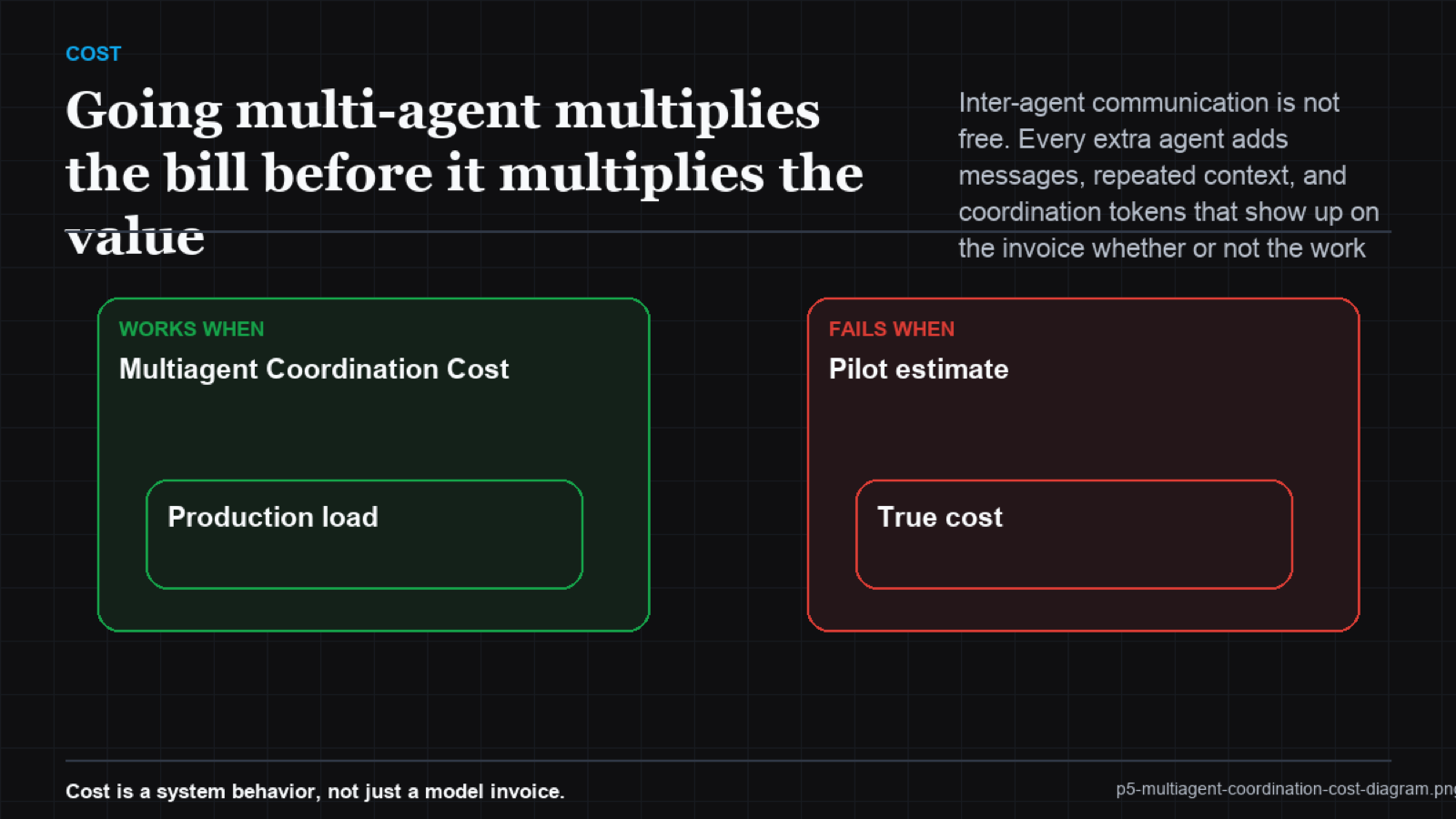
It goes into the messages. In a single agent, the model reads the task, thinks, and acts, and you pay for that one context. In a multi-agent system, each agent carries its own copy of the shared context, each handoff re-states what the last agent did, and a coordinator often re-reads every sub-result to decide what happens next. None of that is the work. It is the overhead of having the work done by a committee. AgentTaxo measured this directly and found a large share of tokens in popular multi-agent frameworks are duplicated communication, which is why they call it a tax. You pay it on every run, and it grows with the number of agents you add.
The Anthropic number puts a scale on it. About 15x the tokens of a chat is not a small premium. It is an order of magnitude, and their own analysis says token usage is the dominant driver of both performance and cost. That is the honest version of the multi-agent pitch: you can buy more capability, but you buy it with tokens, and the token bill is the first thing that moves.
When is the multiplier worth paying?
Anthropic is clear about the condition. The economics work when the task decomposes into independent directions that several agents can pursue in parallel, so the extra tokens buy real parallel progress. When the task has tightly coupled state or many dependencies between agents, the coordination overhead arrives before any parallelism gain, and you pay the 15x without earning it. The decision is not "multi-agent is better." It is "does this specific task split into parallel work worth more than the communication tax." If you cannot answer yes with a number, a single agent is the cheaper and usually more reliable choice.
| Cost driver | Single agent | Multi-agent |
|---|---|---|
| Context copies | One | One per agent |
| Handoff re-statement | None | Every transfer |
| Coordination tokens | None | Grows with agent count |
| Token multiple (Anthropic) | ~1x | ~15x |
The Pattern Intelligence Layer is where this stops being a surprise on the invoice. The communication tax is a measurable pattern: tokens spent on coordination versus tokens spent on the task, tracked per workflow. When that ratio is visible before you scale, you can see whether a given task earns its multi-agent premium or just pays it. Reliability at the pattern level means the architecture you ship is the one whose economics you have already checked, not the one whose bill you discover in production.
Frequently asked questions
Is multi-agent always more expensive?
For the same task, yes, on tokens. The agents have to communicate, and that communication is billed. It is only worth it when the task splits into parallel work that the extra tokens genuinely buy.
How much more expensive?
Anthropic reported about 15x the tokens of a chat for their multi-agent research system, with token usage explaining roughly 80% of the performance variance. Treat an order of magnitude as the planning baseline.
Can the coordination cost be reduced?
Partly. Work like "Cut the Crap" trims redundant inter-agent messages. But the tax never reaches zero, so the first lever is asking whether the task needs multiple agents at all.