


The accuracy in the narrow beam does not tell you what happens at the edges.
Key facts.
- Gartner predicts more than 40% of agentic AI projects will be canceled by end of 2027, with inadequate risk controls as a primary cause — and risk controls are weakest in expanded scopes (Gartner, 2025).
- Agentic systems introduce risks from underspecification and goal-directedness that are qualitatively different from chatbot risks — narrow success masks these risks because narrow tasks are typically well-specified (IBM, 2025).
- Most AI agents released in the 2024-2025 surge remain stuck in "pilot purgatory" — they work in the demo scope but fail to scale reliably when scope expands (MindStudio, 2025).
- Privilege creep — agents accumulating access beyond their original task — is an active security and reliability risk that enterprises must manage explicitly as deployments expand (Obsidian Security, 2025).
Why narrow accuracy does not predict expanded performance
A document classification agent trained and deployed on English-language invoices from three vendors achieves high accuracy because the input space is small and homogenous. The agent's accuracy is not a property of the agent's general invoice understanding. It is a property of that specific distribution.
Expand the scope to invoices from 40 vendors, in four languages, with varied formats — and the agent's input distribution shifts dramatically while its internal model does not. The accuracy that made it seem reliable was a function of distribution match. Remove the narrow distribution and the reliability signal disappears.
The dangerous dynamic: the team that expanded scope never tested on the new distribution before deploying. They saw 97% in the narrow pilot, trusted that number, and launched. The failure appears in production weeks later as edge cases accumulate. By then the agent has been making decisions for weeks and the blast radius of the errors is large.
How organizational dynamics accelerate scope expansion beyond what the agent can handle
When a narrow deployment succeeds, two things happen simultaneously. First, the business case grows: "we saved 40 hours a week on vendor A, let's do all vendors." Second, the team's understanding of the agent's limitations shrinks: "it worked, so it obviously works." Both forces push toward scope expansion before validation.
This is not unique to AI. It is the standard pattern for any new tool that succeeds in a limited deployment. What makes AI agents different is that the failure mode when scope exceeds capability is not a visible error — it is a confident wrong answer. The agent does not return an error code when it encounters an input outside its reliable distribution. It returns an output with the same surface confidence as a correct answer.
Gartner identifies unclear business value and inadequate risk controls as the leading causes of agentic project cancellations. Both trace to the same root: the scope expanded past what the original evaluation measured, and no one was watching for the performance cliff.
How to treat narrow success as a risk signal, not a green light
Narrow success is evidence that the agent works on the narrow distribution. Nothing more. The right response to a successful narrow pilot is not scope expansion — it is scope characterization. Before any expansion, document the input distribution the pilot ran on: input types, formats, languages, edge-case frequency, error types. That document is the boundary of validated performance.
Any expansion proposal can then be evaluated against that document. Does the new scope overlap substantially with the validated distribution? If yes, the risk is low. If no, the expansion requires its own evaluation cycle on representative samples from the new distribution before production deployment.
This is not a reason to avoid expansion. It is a reason to expand with evidence rather than with trust in a number that was measured under different conditions.
The structural addition: production monitoring scoped to the expansion boundary. When new input types appear in production, they get flagged for human review rather than processed with the same confidence as inputs from the validated distribution. This gives the team early warning before errors accumulate to the scale of a production incident.
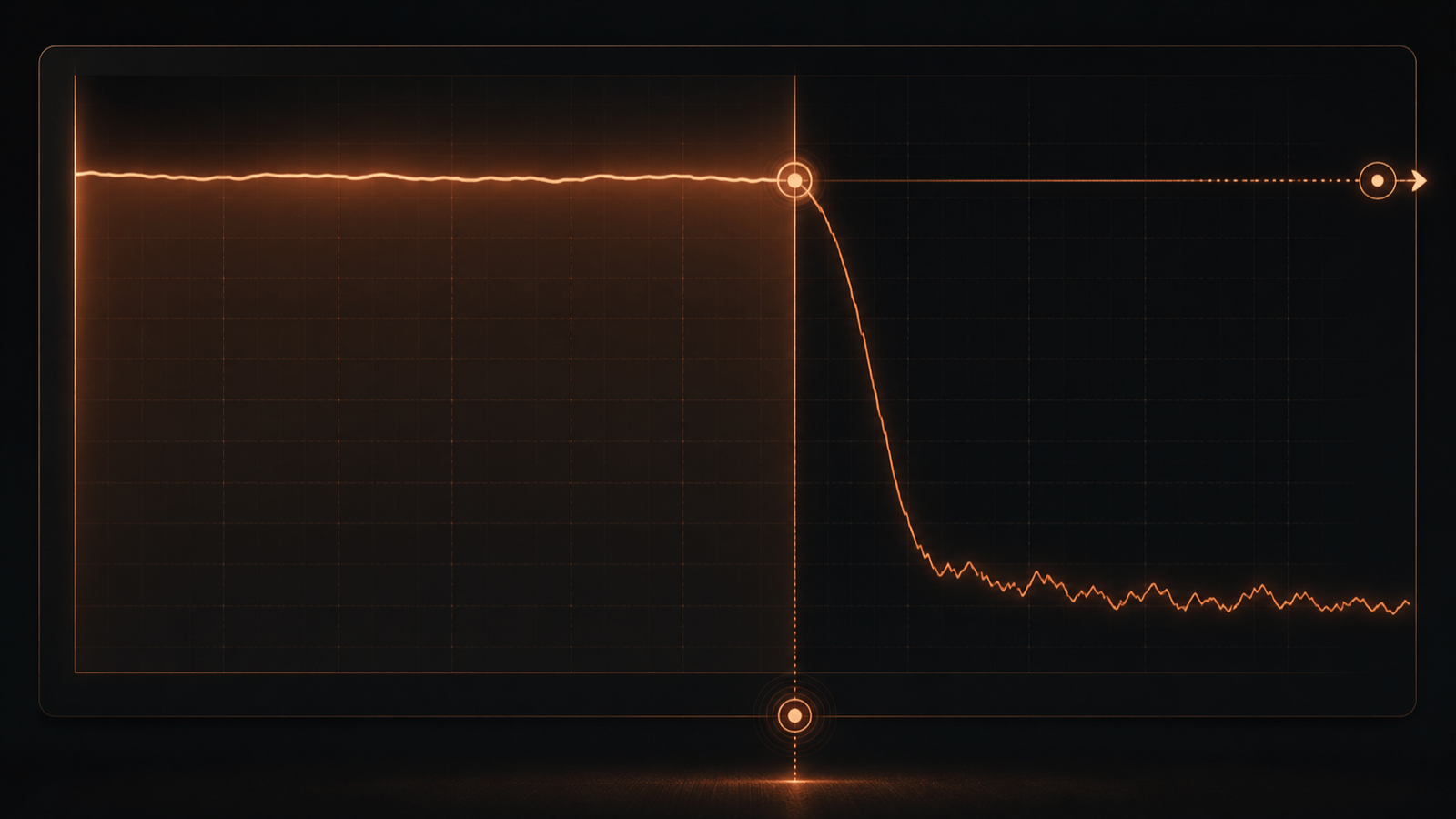
The performance cliff at the scope boundary is predictable. The failure is in not measuring where the cliff is before deploying beyond it.
| Stage | What teams typically do | What they should do |
|---|---|---|
| Narrow pilot succeeds | Record the accuracy number and call it proven | Document the exact input distribution the number was measured on |
| Scope expansion proposed | Reference the pilot accuracy as justification | Evaluate whether new scope overlaps validated distribution |
| Expansion deployed | Monitor aggregate error rate (slow signal) | Flag inputs outside validated distribution for human review |
| Errors accumulate | Investigate weeks after the fact with large blast radius | Catch at boundary with early warning signal before accumulation |
The performance cliff at the scope boundary is knowable before deployment if you have characterized the validated distribution. VibeModel's Pattern Intelligence Layer tracks which input types and formats fall within your agent's validated reliability envelope, and which represent out-of-distribution exposure — so scope expansion decisions are made against real performance data, not against the pilot number that no longer applies.
Frequently asked questions
Why does an AI agent perform well in pilots but fail after scope expansion?
Because pilot performance measures accuracy on a narrow, well-characterized input distribution. Scope expansion changes the distribution. The agent's model does not update automatically when the scope changes — it continues applying patterns learned from the narrow distribution to inputs those patterns do not generalize to.
What is "pilot purgatory" for AI agents?
Pilot purgatory describes deployments that succeed in a controlled demo scope but cannot reliably scale to production volumes and input diversity. The agent works in the condition it was tested under and fails when those conditions change — which is always what happens in production.
How do I know when my agent's scope is approaching its reliability boundary?
Monitor the ratio of inputs that match your pilot distribution to inputs that do not, alongside the error rate. When the share of out-of-distribution inputs rises, the error rate rises with it. Flagging out-of-distribution inputs at ingestion — before the agent processes them — gives you the early warning.
Is there a safe way to expand agent scope without a full re-evaluation cycle?
Yes: expand to a subset of the new scope first, with 100% human review of agent outputs on that subset for two to four weeks. Use that review data to characterize the agent's error rate on the new distribution before removing human oversight. This converts the expansion from a trust-based decision to an evidence-based one.