


Key facts.
- Gartner projects that more than 40% of agentic AI projects will be canceled by the end of 2027, citing escalating costs, unclear value and weak risk controls, the usual symptoms of unmanaged scope.source
- 2026 enterprise reporting found about 64% of pilots that tried to expand scope hit blocking issues, while narrow single-function agents scaled far more reliably than broad ones.source
- METR's time-horizon work shows reliability collapsing as task length grows, that's what scope creep does to an agent's workload.source
Why does scope creep break agents specifically?
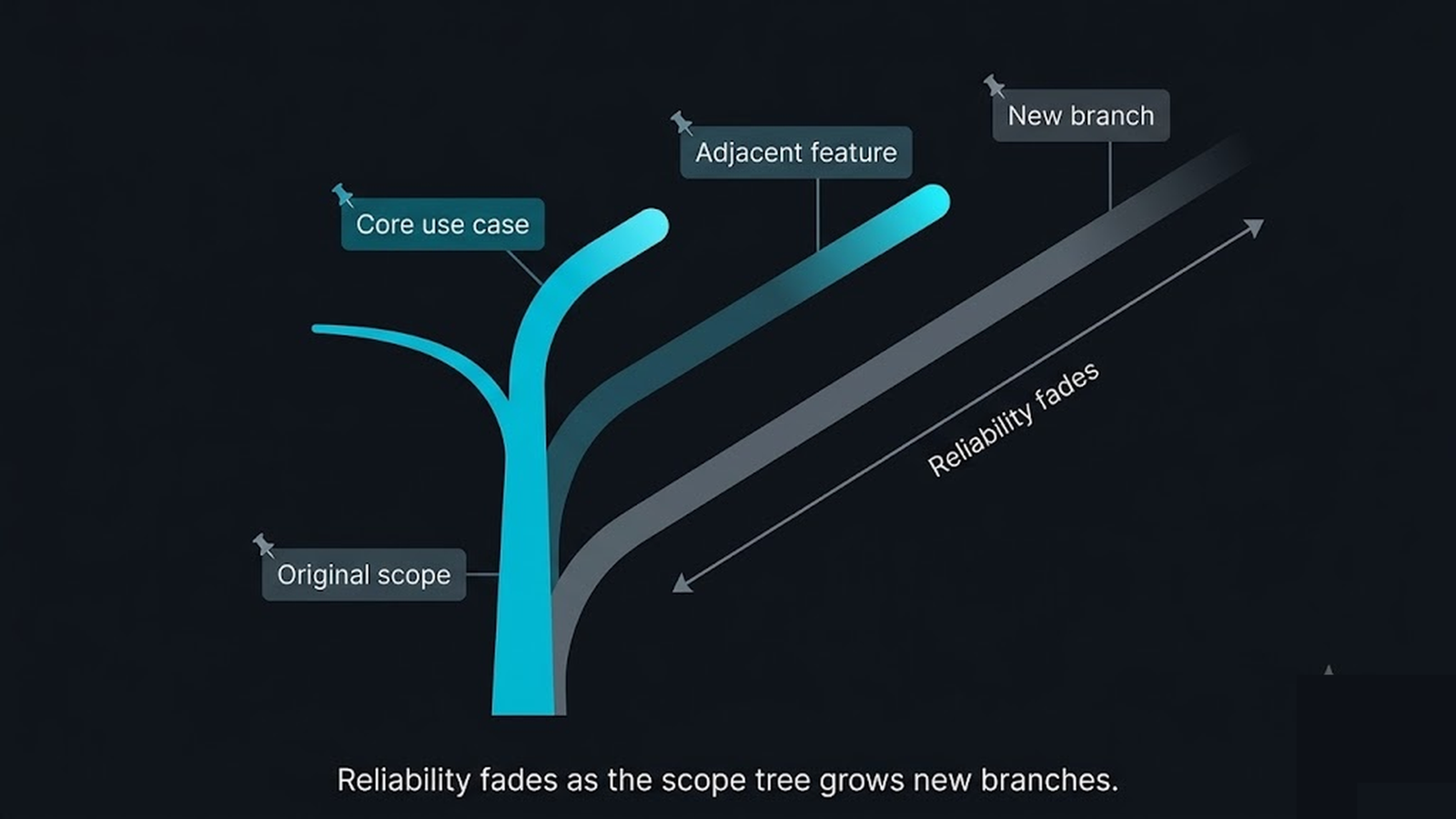
Traditional software degrades gracefully as you add features; an agent does not. The METR result is the reason. Reliability is a function of task length and complexity and it drops fast. A pilot scoped to one well-defined task sits in the regime where agents are strong. Add a stakeholder's pet case, then another team's edge condition, then a tempting adjacent workflow and you have pushed the agent into longer, branchier tasks where its success rate falls off the cliff METR measured. The pilot did not get more ambitious. It got less reliable, one well-meaning addition at a time.
This is why the deployments that scale share one habit: they hold the line. They prove the narrow version is stable, then expand on evidence rather than enthusiasm. The 64% of pilots that hit blockers expanding are the ones that let scope outrun reliability and the Gartner cancellation forecast is, in large part, a forecast about scope discipline that was never imposed.
How do you hold the line without killing momentum?
| Choice | Scope creep | Scope discipline |
|---|---|---|
| Starting scope | Broad, ambitious | One well-defined task |
| When to expand | When someone asks | When the narrow version is proven |
| Reliability | Outrun by scope | Established before each step |
| Outcome | Stalls, then canceled | Scales on evidence |
Holding scope is really a way of keeping the agent inside the regime where it is reliable and reliability at the pattern level is what VibeModel provides as the Pattern Intelligence Layer. When the narrow version handles its patterns the same correct way every time, you have the evidence to widen safely, so expansion becomes a deliberate step backed by proof rather than a hopeful leap that breaks the thing that was working.
Frequently asked questions
Is saying no to scope just being conservative?
It is being reliable. METR shows agent success falls fast as tasks lengthen, so unbounded scope is a direct route to an unreliable agent, not a more capable one.
When is it safe to expand?
When the narrow version has been stable in production long enough to trust and you can expand into a defined next task, not an open-ended wish list.
How do you tell stakeholders no?
Show them the reliability evidence. A narrow agent that works beats a broad one that stalls and the data on canceled projects backs that up.