


Key facts.
- A Cloud Security Alliance survey of agentic AI adoption reports that organizations tie scaling success to keeping agents narrowly scoped with defined boundaries, the discipline unbounded scope erodes. source
- MIT NANDA's "State of AI in Business 2025" reported that only about 5% of enterprise GenAI pilots delivered measurable financial impact, with the vast majority stuck, a pattern unbounded scope makes worse (reported). source
- On WildToolBench, a benchmark of real-world tool-use scenarios, evaluated agents completed under 15% of tasks end to end, so a broad, do-anything agent is unreliable across exactly the wide surface scope creep creates. source
Why does scope creep kill agent projects?
Because every capability you add multiplies the work and lowers the reliability. A narrow agent has a small surface to test, a small set of permissions to secure and a clear definition of success. Widen it to handle the adjacent case, then the next one and you have multiplied the test surface, expanded the permission set, blurred the success criteria and dropped the reliability, all at once. The MIT NANDA pilot data names the symptom directly: only the narrow, integrated builds reached measurable impact. Sprawl is what a project produces when ambition outruns scope, and WildToolBench's sub-15% result on real-world tool use is the reliability you get when an agent tries to do everything instead of one thing well.
A more capable model does not earn you the right to widen the scope, because the broad surface stays unreliable and the governance cost stays high. MIT NANDA's finding that only about 5% of GenAI pilots reached measurable financial impact is, in part, a scope story: the pilots that delivered were narrow and integrated, not sprawling. Governance is how you resist the pull. A defined boundary on what the agent does, written criteria that any expansion must meet and a body with the authority to decline an addition, keep the agent in the zone where it is reliable and valuable rather than letting it drift into the zone where it is neither.
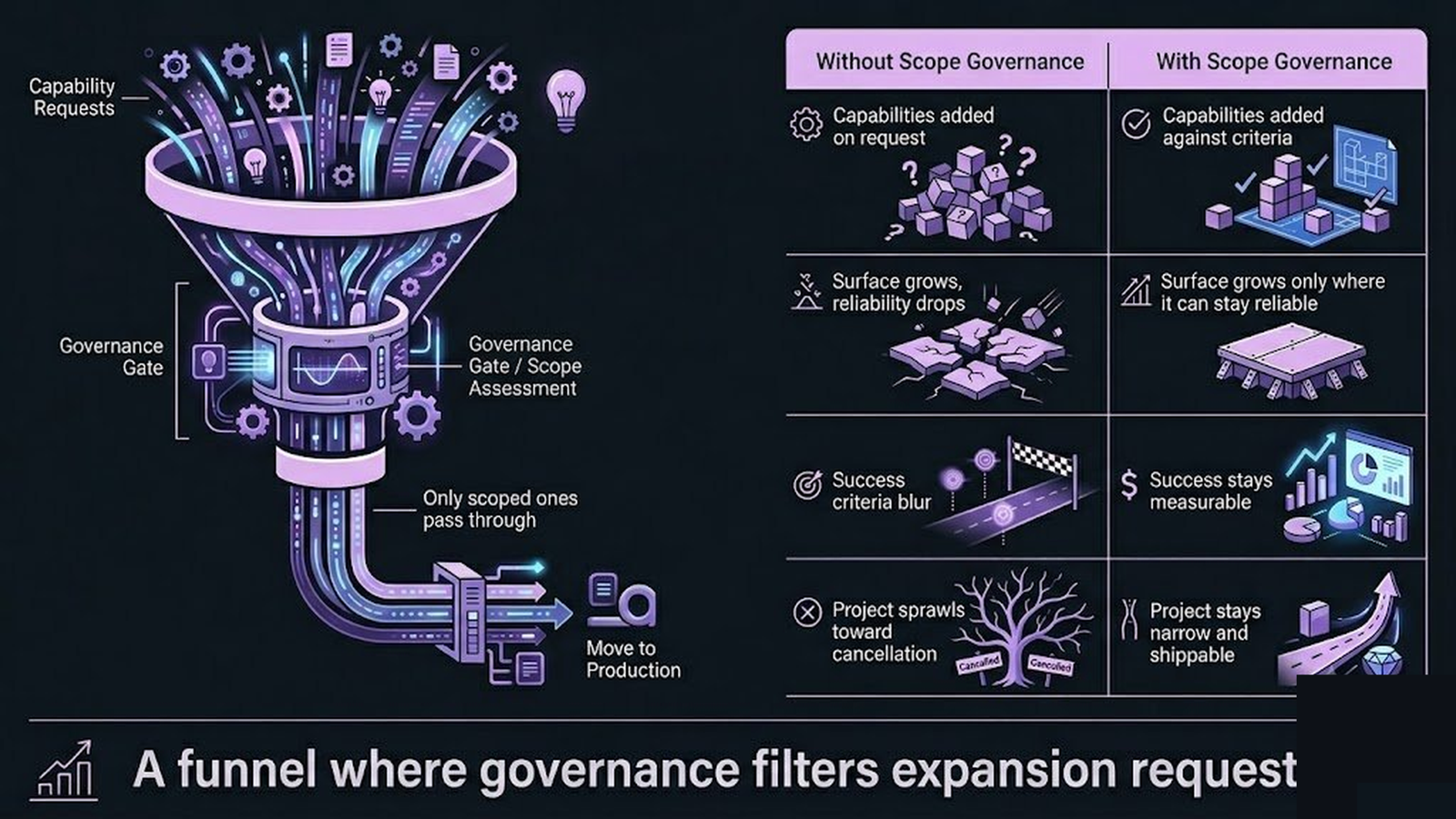
What does scope governance actually do?
It makes expansion a decision, not a default. New capabilities arrive as proposals that must clear written criteria: is this within the agent's purpose, is the added risk controllable, does the value justify the surface it adds? A governance body, not the loudest stakeholder, decides. And the agent's boundary is documented, so "can it do X" has an answer that is a policy, not a guess. The effect is an agent that grows on purpose, in steps it can stay reliable through, instead of one that accretes capability until it collapses under its own surface.
| Without scope governance | With scope governance |
|---|---|
| Capabilities added on request | Capabilities added against criteria |
| Surface grows, reliability drops | Surface grows only where it can stay reliable |
| Success criteria blur | Success stays measurable |
| Project sprawls toward cancellation | Project stays narrow and shippable |
Scope creep is a class, not a slip: each capability multiplies the surface and a more capable model will not rescue a sprawl, since MIT NANDA found only 5% of pilots reach it. (arXiv:2604.06185)
The Pattern Intelligence Layer is where scope becomes an enforced boundary. What the agent is permitted to do and the criteria any expansion must meet, are tracked at the pattern level, so creep is a decision a governance body makes rather than a drift that happens. Reliability at the pattern level is what keeps an agent narrow enough to ship and valuable enough to keep.
Frequently asked questions
Isn't a more capable agent better than a narrow one?
Only if it stays reliable and breadth is where reliability drops, as WildToolBench's sub-15% shows. The pilots that delivered value were narrow and integrated, not do-everything.
How does governance avoid just blocking progress?
By making expansion a criteria-based decision, not a veto. Additions that meet purpose, controllable risk and value pass; the ones that only add surface do not.
Who decides scope?
A governance body against written criteria, not the loudest stakeholder. That is what keeps scope a deliberate choice instead of an accumulation.