


Key facts.
- The Cloud Security Alliance's agentic AI guidance defines the identity, access and threat controls that let an agent be trusted with real authority, the absence of which keeps it confined. source
- METR finds the reliably-completable task length for frontier models is on the order of tens of minutes and doubling only about every seven months, evidence that autonomy is bounded today and the controls have to grow before it widens. source
- MIT NANDA's "State of AI in Business 2025" tied measurable impact to the small share of pilots that succeeded, underlining that governed, trusted autonomy is what turns capability into value (reported). source
Why does the "governance as bureaucracy" framing get it backwards?
Because it assumes the default state is an agent doing useful work and governance is friction added on top. The real default is an agent nobody will trust with anything that matters, because there is no way to bound what it does, attribute who is accountable or reconstruct what happened when it goes wrong. Governance is what changes that default. The approval gate is what lets the agent touch money. The audit trail is what lets it operate in a regulated process. The named owner is what lets a second team depend on it. Every one of those is the thing that grants authority, not the thing that withholds it.
A more capable model makes this more true, not less. METR's time-horizon work shows reliable autonomy is still measured in tens of minutes and rising only slowly, which means more autonomy is on the table only as the controls that bound it mature and the failure of an unsupervised long run gets more expensive, not less. The teams that scale are the ones whose governance grew alongside the capability, so each increase in what the agent does autonomously came with a matching increase in how it is bounded and observed. Strip the governance out and the agent does not run faster; it stops at the first review it cannot pass.
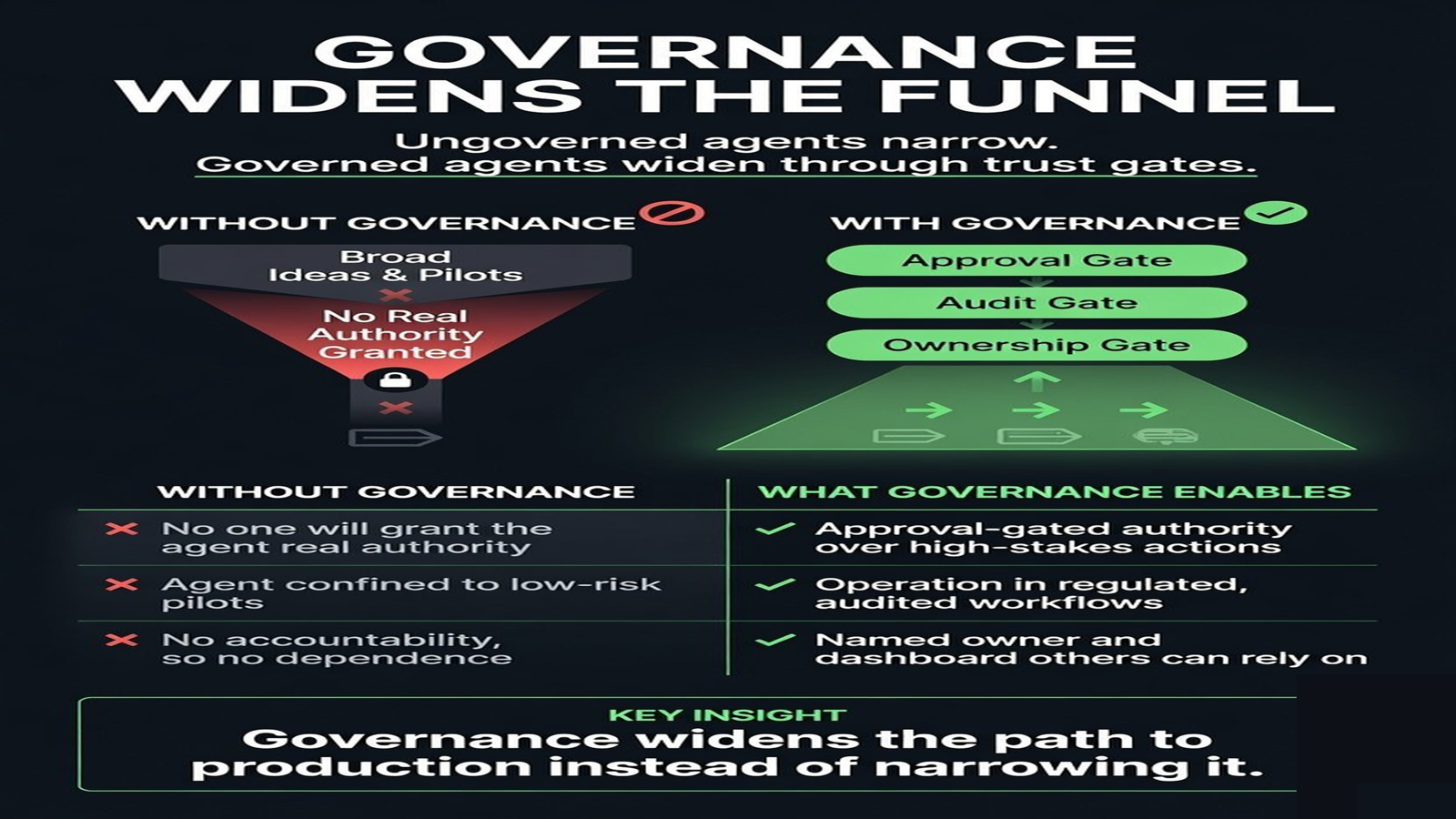
What does governance actually enable?
It enables the specific permissions a useful agent needs. Authority over irreversible actions, gated by approval. Access to sensitive data, bounded by least privilege and logged. Operation in a regulated workflow, backed by an audit trail. Dependence by other teams, anchored by a named owner and a dashboard. Each is a capability the business wants and a risk the business has to manage and governance is the mechanism that lets you have the capability by managing the risk. That is the opposite of bureaucracy, which adds process without adding capability.
| Without governance | What governance enables |
|---|---|
| No one will grant the agent real authority | Approval-gated authority over high-stakes actions |
| Agent confined to low-risk pilots | Operation in regulated, audited workflows |
| No accountability, so no dependence | Named owner and dashboard others can rely on |
The Pattern Intelligence Layer is where governance becomes an enabler in practice. Boundaries, approval gates and audit trails are enforced at the pattern level, so granting an agent more authority is a controlled, reversible step rather than a leap of faith. Reliability at the pattern level is what lets a program expand what its agents do without expanding what it has to fear.
Frequently asked questions
Doesn't governance slow the team down?
It slows the path to ungoverned autonomy, which was never going to ship anyway. The path to trusted, expandable autonomy is faster with governance than without it.
Why does more capability need more governance?
Because agents reliably handle longer, higher-stakes tasks over time, so the cost of an unsupervised failure rises. The controls have to grow with the autonomy.
Where is the enabling effect most visible?
At every trust gate: money, sensitive data, regulated workflows, cross-team dependence. Governance is what gets the agent through each one.