


Key facts.
- Measuring Agents in Production (arXiv:2512.04123) reports that 68% of production agents run at most ten steps before human intervention and 74% rely primarily on human evaluation, with reliability ranked the top challenge.source
- METR (arXiv:2503.14499) finds the 50%-completion task length for frontier models is on the order of tens of minutes and has been doubling about every seven months, so long-horizon reliability remains limited.source
- The CSA and Google Cloud State of AI Security and Governance survey reports governance maturity as the strongest predictor of AI readiness, with only about 26% of organizations holding full AI security governance.source
Why does governance, not capability, sort the winners?
Because the binding constraint in production is keeping a working agent dependable under real conditions and that is a governance problem. The practitioners surveyed in Measuring Agents in Production did not scale by handing the agent more autonomy. They scaled by keeping it short, supervising it and evaluating it, which are governance choices. The reason is structural: reliability degrades as horizons lengthen, and METR quantifies how slowly that ceiling rises. So the teams that succeed are not the ones who waited for a model that could run unsupervised for an hour. They are the ones who built controls that make a ten-step supervised agent trustworthy enough to depend on every day.
This is why a model upgrade does not move a stalled program into the group that ships. The CSA survey makes the correlation explicit at the organization level: governance maturity, not model adoption. Is the strongest predictor of readiness and only about a quarter of organizations have it. The agents that scale belong to the organizations that did the governance work, defining who owns the agent. What it is allowed to do, how it is measured and how often it is reviewed. The ones that stall are usually capable enough. What they lack is the control structure to keep being trusted past the demo.
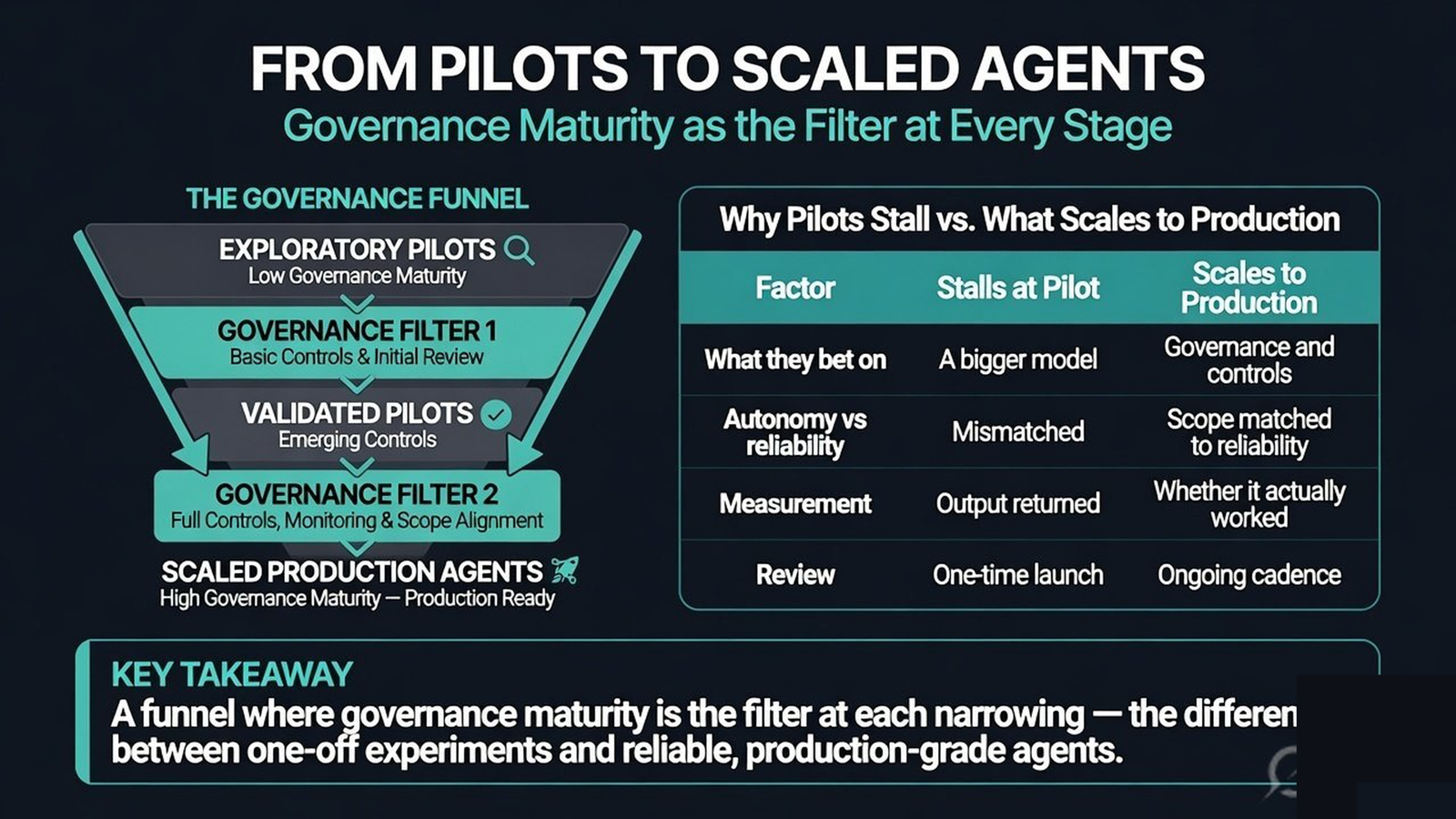
What governance carries an agent past the pilot?
A named owner accountable for the agent in production, so trust has someone to attach to. Defined boundaries on what it may do autonomously, so its scope matches its reliability. Measurement of whether it is actually working, not just whether it returned output, so degradation is visible. And a review cadence, so the controls keep pace as usage grows and the model changes. Measuring Agents in Production describes working programs doing exactly this: short tasks, human evaluation, controllable approaches. That is governance functioning as the thing that lets a working agent keep working. Is the whole game past the pilot.
| Factor | Stalls at pilot | Scales to production |
|---|---|---|
| What they bet on | A bigger model | Governance and controls |
| Autonomy vs reliability | Mismatched | Scope matched to reliability |
| Measurement | Output returned | Whether it actually worked |
| Review | One-time launch | Ongoing cadence |
Measuring Agents in Production, 306 practitioners across 26 domains, found reliability, not model quality, the top challenge, agents kept short and supervised; a bigger model lifts what an agent tries, governance beats rework. (arXiv:2512.04123)
The Pattern Intelligence Layer is where that governance becomes operational. Ownership, boundaries and whether the agent is actually working are tracked at the pattern level. A working pilot has the controls it needs to keep working under real volume. Reliability at the pattern level is what carries an agent from the demo into the minority that sustains production.
Frequently asked questions
Isn't a more capable model the real driver for scaling?
It helps but it is not the deciding factor. METR shows long-horizon reliability rises slowly and practitioners scale by keeping agents short and supervised, which are governance choices, not model upgrades.
What does governance actually change in production?
It keeps a working agent trusted under real volume by giving it an owner, boundaries, measurement and review, so degradation is caught and scope matches reliability.
Why do capable pilots still stall?
Usually because there is no control structure to sustain trust past the demo. The CSA survey ties readiness to governance maturity, which most organizations lack.