


Key facts.
- The Berkeley Function-Calling Leaderboard's multi-turn evaluation shows leading models completing roughly half or fewer of multi-step tool tasks, so broad ungoverned authority is unsafe. source
- Anthropic's multi-agent research system reported a 90.2% improvement over a single agent on its internal eval while using about 15x the tokens, showing that more authority pays off only when its cost and risk are managed. source
- The EU's Digital Operational Resilience Act (Regulation 2022/2554) ties operational authority in finance to risk management and oversight, an example of governance enabling rather than blocking high-stakes automation. source
Why does governance expand rather than restrict authority?
Because the limit on what you can safely let an agent do is set by how well you can catch and contain its mistakes and governance is what raises that limit. An ungoverned agent has to be kept narrow, because every action it takes is unmonitored and every error runs unchecked, so you grant it only what you can afford to have go wrong silently. Add boundaries, approval gates and monitoring and the calculation changes: now a sensitive action escalates, a violation alerts and a mistake is contained, so you can extend the agent's scope into territory that would have been reckless before. BFCL's multi-turn numbers are why this is not theoretical, leading models still miss a large share of multi-step tasks, so the agent will err and governance is what lets it err safely instead of dangerously.
A more capable model does not remove the need for this, it raises the ceiling on the authority worth granting. Anthropic's multi-agent result is the pattern: a large performance gain was available, but it came with a 15x token cost, so the value only materializes when the cost and risk are governed. Authority that pays off is authority that is bounded, gated and watched. DORA encodes the same logic at the regulatory level for financial operations, tying the ability to run critical automation to demonstrated risk management. Governance is not the price of using an agent more, it is the mechanism that makes using it more possible.
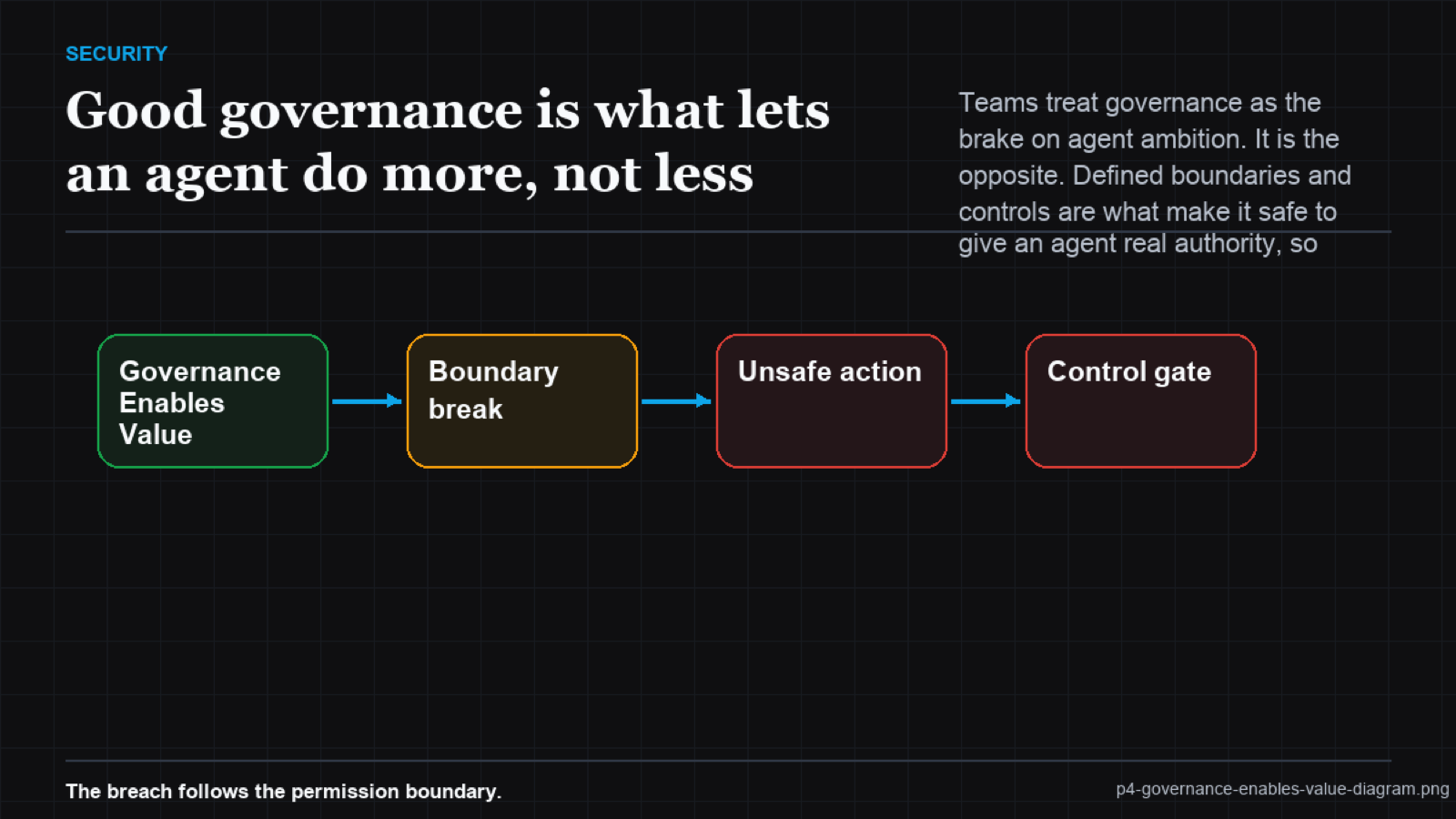
How does governance turn capability into authority?
By making mistakes catchable, it lets you grant scope you otherwise could not. Boundaries define where the agent may act, so you can widen them deliberately rather than leaving them implicit. Approval gates let sensitive actions through under human review, so the agent can touch high-stakes work without acting unilaterally. Monitoring surfaces violations and degradation, so an expanded scope does not mean expanded blind spots. And measurement shows the value is real, so the authority is justified by outcome rather than hope. This is why the agents doing the most consequential work tend to be the most governed: the governance is what made it responsible to give them that work. Capability is the raw material; governance is what turns it into authority you can stand behind.
| Question | Ungoverned agent | Governed agent |
|---|---|---|
| Safe scope | Narrow, by necessity | Wider, by design |
| Sensitive actions | Avoided or risky | Gated and allowed |
| Mistakes | Run unchecked | Caught and contained |
| Authority basis | Hope | Demonstrated control |
Boundaries, gates and monitoring make real authority safe to grant and on BFCL multi-turn leading models clear only around half; a more capable model enlarges the authority at stake, so govern more, not less. (source)
The Pattern Intelligence Layer is where governance becomes the enabler of authority. Boundaries, gates and outcomes are tracked at the pattern level, so an agent's scope can be widened with the confidence that a violation is caught and the value is measured. Reliability at the pattern level is what lets you give an agent more to do, not less.
Frequently asked questions
Doesn't governance slow the agent down?
It adds checks, but it removes the need to keep the agent artificially narrow. The net effect is more usable authority, because mistakes are now catchable.
Why can't a capable model just be trusted with broad authority?
Because BFCL multi-turn scores show even leading models miss many multi-step tasks. The agent will err, so the question is whether the error is caught, which is governance.
Is more authority always worth it?
Only when its cost and risk are managed. Anthropic's 90.2% gain came at 15x tokens, so the value is real but conditional on governing the cost and the risk.