


Key facts.
- MIT NANDA's "State of AI in Business 2025" found only about 5% of enterprise GenAI pilots delivered measurable impact, with adoption, integration and trust separating success from stall (reported).source
- Deloitte's State of Generative AI in the Enterprise found the AI skills gap is seen as the biggest barrier to integration, with education the top way companies adjusted talent strategy, evidence that the human side decides whether agents succeed.source
- ISO/IEC 42001:2023 requires leadership, defined organizational roles and a culture of accountability for an AI management system, the human dimension of deploying AI, not only technical controls.source
Why does an agent deployment trigger resistance?
Because it changes how people work and people resist change they did not shape and cannot see into. If an agent appears in a workflow with no named owner, no stated boundary and no visible way to raise a concern. The people around it fill the gaps with worry: it will take my job, it will make a mistake I get blamed for, nobody can tell me what it is allowed to do. That worry is reasonable and it stalls adoption regardless of how good the agent is. MIT NANDA's finding that only about 5% of pilots reached measurable impact is in large part a human-adoption story. Deloitte's enterprise survey names the AI skills gap as the biggest barrier to integration, a human factor rather than a technical one.
A more capable model does not address any of this, because the resistance is about legibility and accountability, not accuracy. Governance is what supplies them. A named owner answers "who is responsible." Documented boundaries answer "what will it do to my work." A visible review process answers "where does my concern go." ISO/IEC 42001 builds the human dimension, leadership. Roles and a culture of accountability, into its management-system requirements for exactly this reason: deploying AI is a change to an organization and change that people can see, question and influence is change they adopt. Governance, used this way, is not bureaucracy layered on the agent. It is the thing that makes the agent something people are willing to work with.
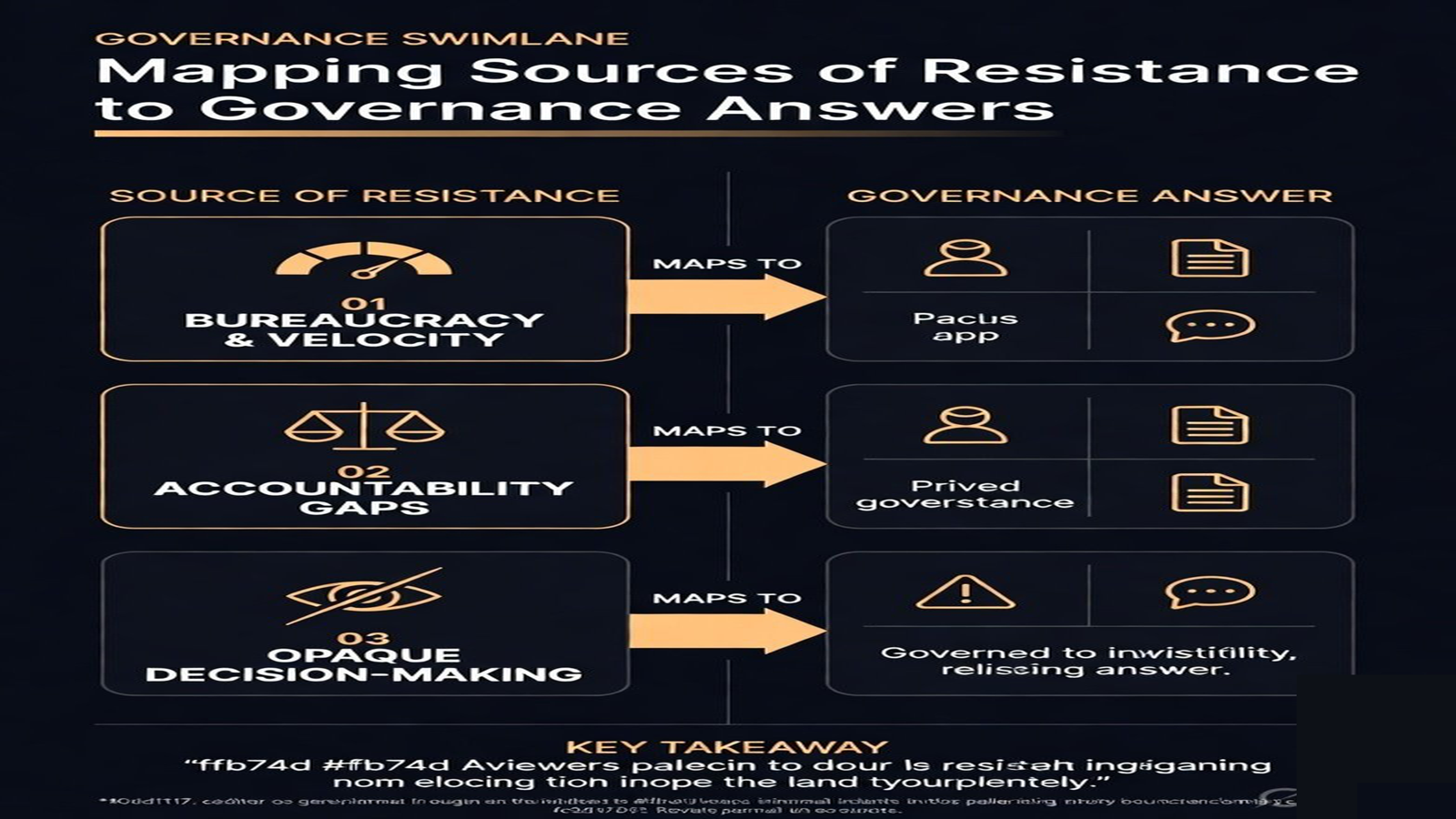
How does governance reduce resistance?
By answering the questions resistance is made of. "Who is accountable?" gets a named owner. "What will it do?" gets documented boundaries. "What if it is wrong?" gets approval gates and exception handling. "Where do I raise an issue?" gets a review process people can actually reach. Each answer replaces a worry with a fact and a workforce that has facts about an agent. Rather than fears about it, is a workforce that adopts it.
| Source of resistance | Governance answer |
|---|---|
| "Who is responsible for it?" | Named owner |
| "What is it allowed to do?" | Documented boundaries |
| "What if it makes a mistake?" | Approval gates + exception handling |
| "Where do I raise a concern?" | Visible review process |
An upgrade moves the benchmark, not a nervous workforce: MIT NANDA found adoption, not model quality, separated the pilots, so resistance is late rework. (source)
The Pattern Intelligence Layer is where governance becomes the change-management layer too. Ownership, boundaries and review are tracked at the pattern level. The agent is legible to the people it affects and their concerns have a real destination. Reliability at the pattern level is what turns an agent from an automation people resist into one they trust enough to use.
Frequently asked questions
Isn't adoption a training problem, not a governance one?
Training helps, but resistance is mostly about accountability and boundaries. Governance answers who owns the agent and what it may do, which is what makes people willing to use it.
Why does a better model not solve adoption?
Because resistance is about legibility and trust, not accuracy. People adopt an agent they can see into and question, regardless of its benchmark scores.
What's the single most useful governance element for adoption?
A named owner with a visible review process. It tells people the agent is accountable and their concerns have somewhere to go, which dissolves most of the resistance.