


Key facts.
- ISO/IEC 42001:2023 is the AI management system standard, built to integrate AI governance into an organization's existing management systems and continual-improvement cycle not sit beside them.source
- The NIST AI Risk Management Framework's Govern function aims to connect AI risk to enterprise-wide governance, accountability and culture, not to a standalone AI team.source
- The CSA and Google Cloud State of AI Security and Governance survey found governance maturity is the strongest predictor of AI readiness, with only about 26% of organizations holding full AI security governance, the gap an isolated governance silo fails to close.source
Why does a separate AI governance silo fail?
Because governance only works when it sits on the paths where decisions and changes actually happen and in an enterprise those paths already exist. Change control gates deployments. Identity and access management grants permissions. Legal reviews data handling and contracts. Risk committees weigh exposure. Stand up an AI governance group that is not wired into any of those and it becomes a document nobody consults. Agents get deployed through the change process, granted access through IAM and shipped past a governance function that had no hook into the pipeline. The CSA and Google Cloud survey found governance maturity is what separates ready organizations from the rest and only about a quarter have it. Is what happens when oversight is parallel to the real workflow rather than part of it.
A more capable model does not remove the alignment problem, because the problem is organizational, not technical. ISO/IEC 42001 is built around this insight: it specifies an AI management system that integrates with the management systems a company already runs. AI governance inherits the teeth of existing processes. NIST's Govern function does the same. Tying AI risk to enterprise accountability and culture rather than to a lone AI team. The agents that stay governed are the ones whose oversight rides on change control, IAM, legal review and risk governance the organization already enforces. That happens because those are the controls with authority behind them.
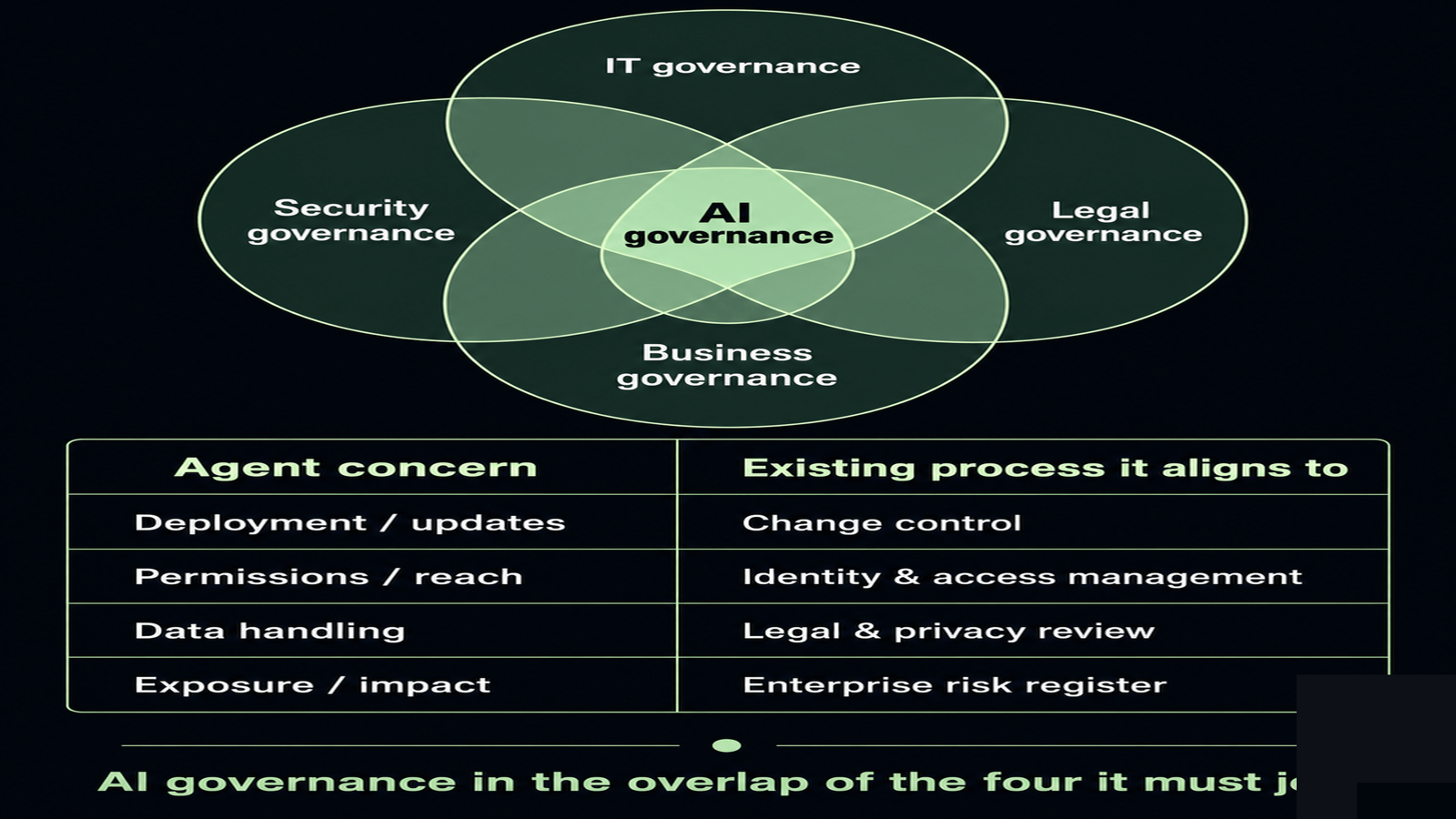
How do you align AI governance with what exists?
Map each agent control to the enterprise process that should own it. Deployment and change of an agent ride change control. The agent's permissions live in identity and access management. Its data handling clears legal and privacy review. Its risk sits on the risk committee's register. New AI-specific concerns, autonomy boundaries, model drift, get added to those processes rather than handled in isolation. The result is governance with the same authority the rest of the enterprise already respects. Is the only kind that holds.
| Agent concern | Existing process it aligns to |
|---|---|
| Deployment / updates | Change control |
| Permissions / reach | Identity & access management |
| Data handling | Legal & privacy review |
| Exposure / impact | Enterprise risk register |
The Pattern Intelligence Layer is where AI governance connects to the governance you already run. Agent controls map to change, access, legal and risk processes at the pattern level. Oversight inherits the authority of the systems the enterprise already enforces rather than living in a silo it routes around. Reliability at the pattern level is what makes AI governance stick where standalone AI governance slides off.
Frequently asked questions
Why not build a dedicated AI governance function?
Dedicated expertise is fine; a disconnected silo is not. If AI governance is not wired into change control, IAM, legal and risk, the rest of the organization routes around it.
What does ISO/IEC 42001 add here?
It specifies an AI management system designed to integrate with existing management systems, so AI governance inherits the cycles and authority a company already operates.
Where do AI-specific risks go?
Into the existing processes, as new items: autonomy boundaries into change control, model drift into risk, data handling into legal, so they get the same enforcement as everything else.