


Key facts.
- ISO/IEC 42001:2023 establishes requirements for AI management systems, including explicit documentation of AI actions, accountability mechanisms, and risk controls for automated decision-making at the enterprise level (ISO/IEC 42001:2023).
- EU AI Act Article 14 requires human oversight for high-risk AI systems, including the ability to override or pause AI actions - a requirement that most agent deployment frameworks don't natively satisfy.
- NIST AI RMF 1.0's GOVERN function explicitly addresses accountability, with controls requiring that AI system actions be attributable to specific authorization decisions and auditable post-hoc.
- Enterprise AI deployments without explicit approval workflows for high-risk tool calls face two risks: regulatory compliance failures when auditors can't reconstruct what the agent did, and operational failures when agents take actions that exceed their intended scope without anyone noticing until the impact surfaces.
- Tiered approval models, where low-risk tool calls proceed automatically while high-risk calls route to human review, provide governance without blocking the agent's primary value - handling the routine cases at scale.
What enterprise governance actually requires
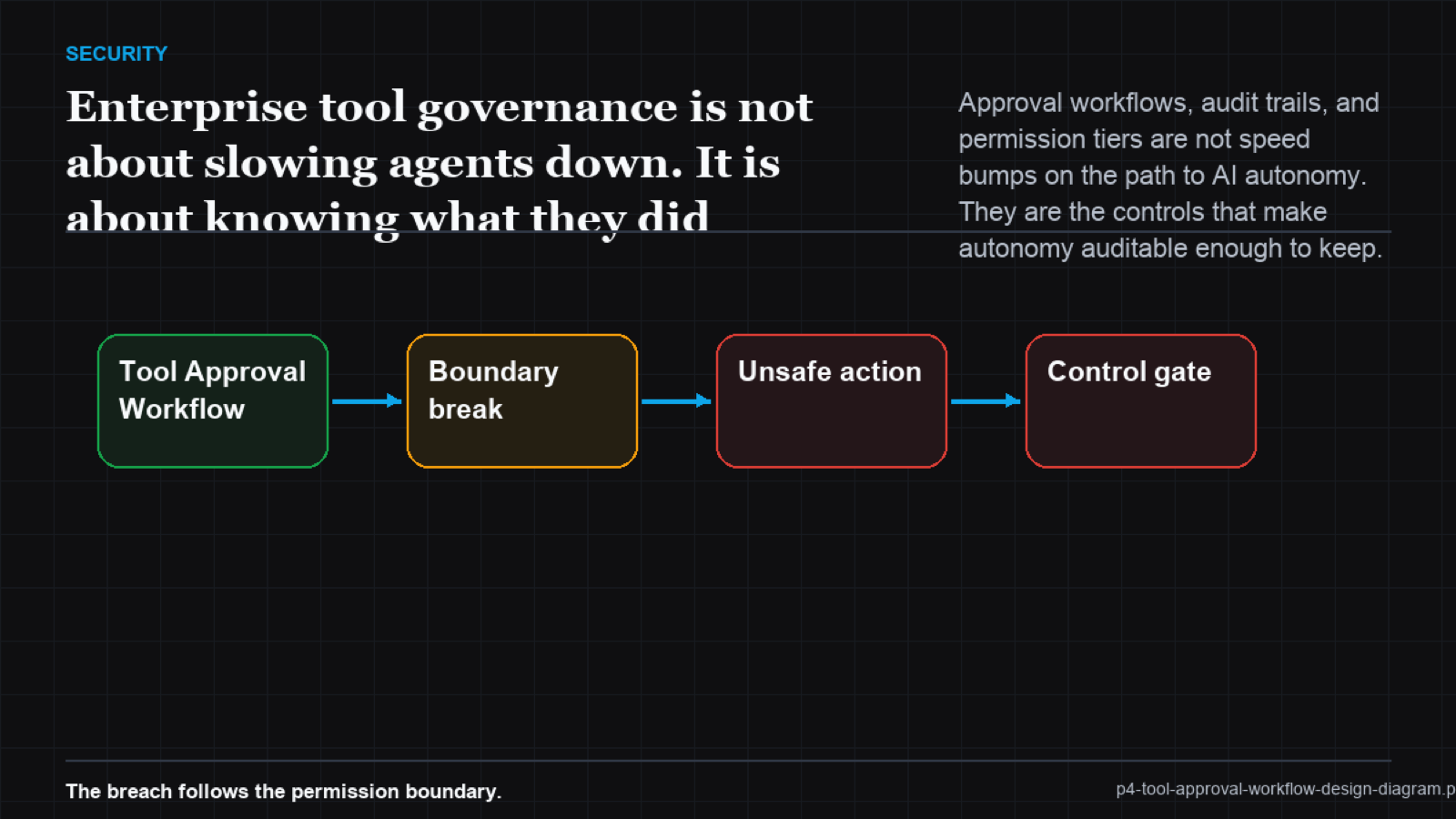
Three things, distinct from security controls. A permission tier model: tool calls classified by risk level, read-only, reversible write, irreversible write, high-value transaction, each with a different authorization requirement. An approval workflow for high-tier calls: the agent surfaces the proposed action, a human approves or rejects, agent executes only on approval. And a complete audit trail: every tool call logged with the authorization that permitted it, the parameters used, and the outcome.
None of these are primarily about preventing attacks. They're about accountability. When a regulator asks "what did your AI agent do on March 15th?" the governance controls produce an answer. Without them the answer is "we don't know", which is itself a compliance finding.
Designing approval workflows that don't kill agent value
The most common mistake: same approval requirements for every tool call regardless of risk. That creates bottlenecks on routine actions, reading customer records, generating reports, that slow the agent without meaningful risk reduction. A tiered model fixes it. Low-risk reads proceed automatically with logging. Medium-risk reversible writes proceed with post-hoc review. High-risk irreversible writes require pre-execution approval. The agent stays fast on routine tasks. Governance lands where the risk actually is.
Tool governance tiers for enterprise agents
| Tier | Tool call type | Authorization requirement | Audit requirement |
|---|---|---|---|
| Tier 1 (low risk) | Read-only, no PII | Role-based permission, no approval | Sampled logging |
| Tier 2 (medium risk) | Reversible write, PII involved | Role-based permission, post-hoc review | Full logging, 30-day retention |
| Tier 3 (high risk) | Irreversible write, financial action | Pre-execution human approval | Full logging, approval chain, 7-year retention |
| Tier 4 (regulated) | High-value transaction, regulated data | Dual approval, compliance officer | Immutable log, regulatory format |
VibeModel's Pattern Intelligence Layer learns which tool call patterns in your deployment have historically triggered escalations, compliance reviews, or incident responses. Instead of static tier classifications that may not match your actual risk distribution, the pattern layer surfaces which specific tool call signatures warrant higher governance controls, based on your own outcome data. The tier model becomes adaptive, not fixed.
Frequently asked questions
Will a more capable agent make governance optional?
ISO/IEC 42001 makes audit trails deployability; a more capable agent with none is still less deployable. (ISO/IEC 42001:2023)
How does EU AI Act Article 14 specifically affect agent tool governance?
Article 14 requires that high-risk AI systems allow competent persons to effectively oversee AI operation, including intervening, interrupting, or pausing the system. For agents, this means high-risk tool calls must have a human-in-the-loop mechanism that's reachable before the action completes, not just auditable after the fact.
What constitutes a sufficient audit trail for regulatory purposes?
At minimum: the specific tool called, the parameters used, the authorization that permitted the call, the timestamp, the agent session identifier, and the outcome. For financial actions: add the business justification for the action and the identity of any human who approved it.
Can we apply governance to third-party agent frameworks or only to ones we build ourselves?
Both, but the approach differs. For third-party frameworks, governance is applied at the tool wrapper layer (which you control) rather than inside the framework. Every tool call that exits the framework passes through your governance layer before reaching the external API.