


Key facts.
- MIT's NANDA State of AI in Business 2025 found roughly 5% of generative AI pilots delivered measurable impact, despite many performing impressively in narrow demos. source
- On tau-bench, GPT-4o-class agents complete under half of tasks and pass^8 reliability, succeeding across eight repeats, falls to about 25% in the retail domain, so one success hides deep inconsistency. source
Why does a narrow win create risk?
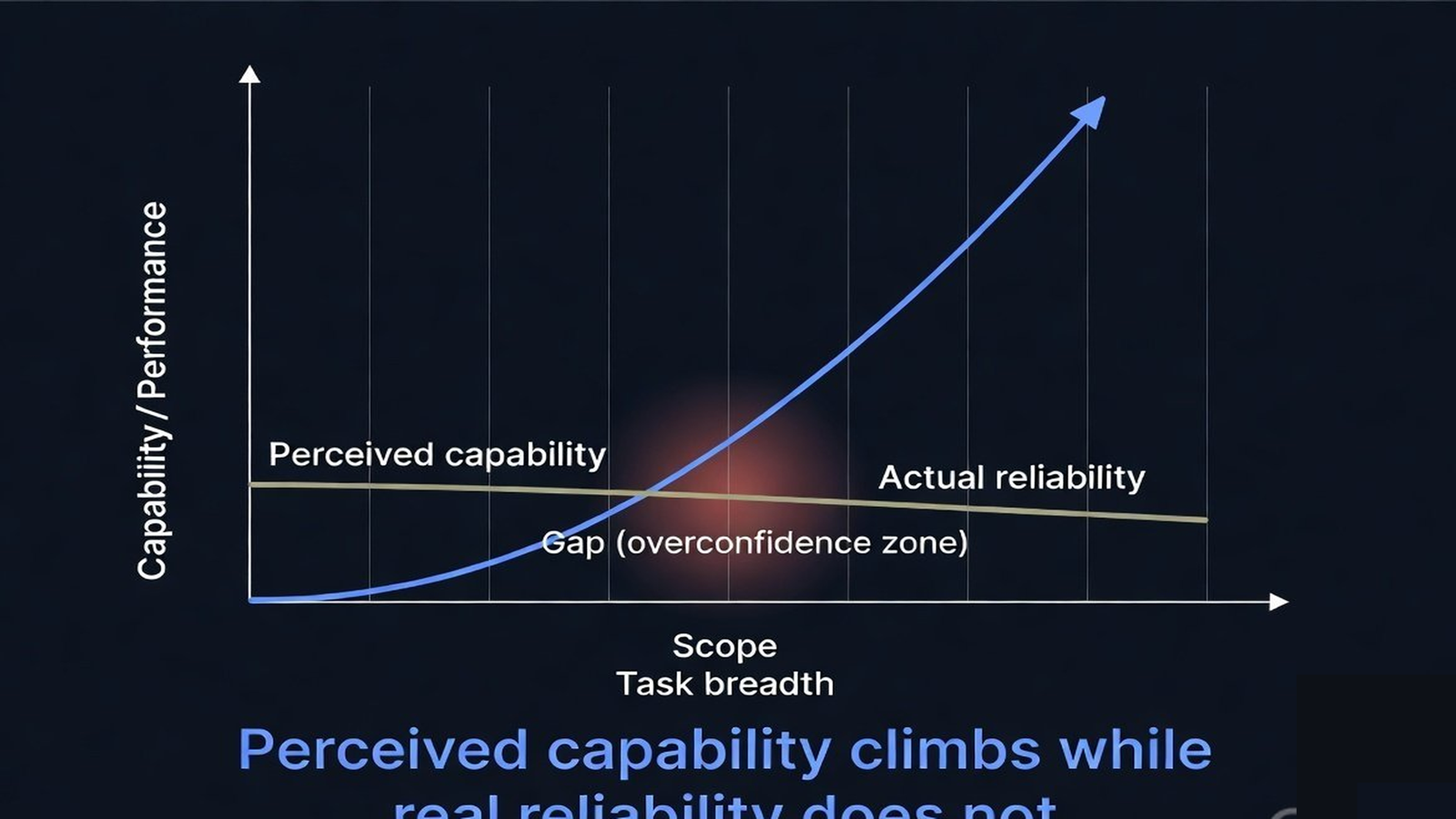
A clean early success is intoxicating and that is the problem. The agent nails a tightly scoped task in the demo, everyone sees magic and the natural next move is to assume that magic generalizes. It rarely does. The tau-bench result is the antidote: an agent can succeed once and still be unreliable, with its chance of repeating that success across eight tries collapsing to around a quarter. The narrow win measured the agent on its best case under ideal conditions. Reading it as a license to expand everywhere extrapolates from the one place the agent is strong into all the places it is not.
The MIT base rate is the macro version of the same story. Pilots demo well and then 95% fail to show measurable impact, in large part because the narrow, controlled success did not survive contact with real scope and variability. Overconfidence is the mechanism: a good demo gets read as a proven system, the scope expands on enthusiasm and the agent is pushed past the boundary of what it actually demonstrated.
How do you keep a win from breeding overconfidence?
| Reading of a narrow win | Overconfident | Disciplined |
|---|---|---|
| What it proves | The agent is capable | This case works |
| Next move | Expand everywhere | Expand to the next defined case |
| Evidence used | One impressive run | Repeated reliability |
| Outcome | Joins the 95% | Scales on proof |
The cure for overconfidence is reliability you can actually measure, which is what VibeModel provides as the Pattern Intelligence Layer. Instead of a single dazzling run, you get evidence that the agent handles a pattern the same correct way every time, so a win is something you can trust and build on and expansion becomes a deliberate step into the next proven case rather than a leap powered by a good demo.
Frequently asked questions
Is a narrow win bad?
No, it is the right way to start. The danger is reading it as proof the agent generalizes, when it only proved the narrow case.
Why does pass^8 matter?
Because production runs a task many times. An agent that succeeds once but only a quarter of the time across eight tries is not reliable enough to expand on.
How do you expand safely?
Into the next clearly defined case, backed by repeated reliability evidence, not by extrapolating from one impressive demo.