


Key facts.
- Most organizations now run AI agents in production, yet observability is consistently rated the lowest-maturity part of the AI stack, and a large share name it the most urgent investment for the coming year. source
- The classic failure: an agent passes every eval, demos flawlessly, then hallucinates in production, retries a failed call hundreds of times, and burns tokens before anyone notices. source
- Traditional monitoring is blind to agents. Existing stacks were built for deterministic systems, dashboards stay green while the agent silently fails. source
- The tools and standards to fix this already exist (OpenTelemetry GenAI conventions), so this is a priority gap, not a capability one. source
Why does a good demo cause teams to underinvest?
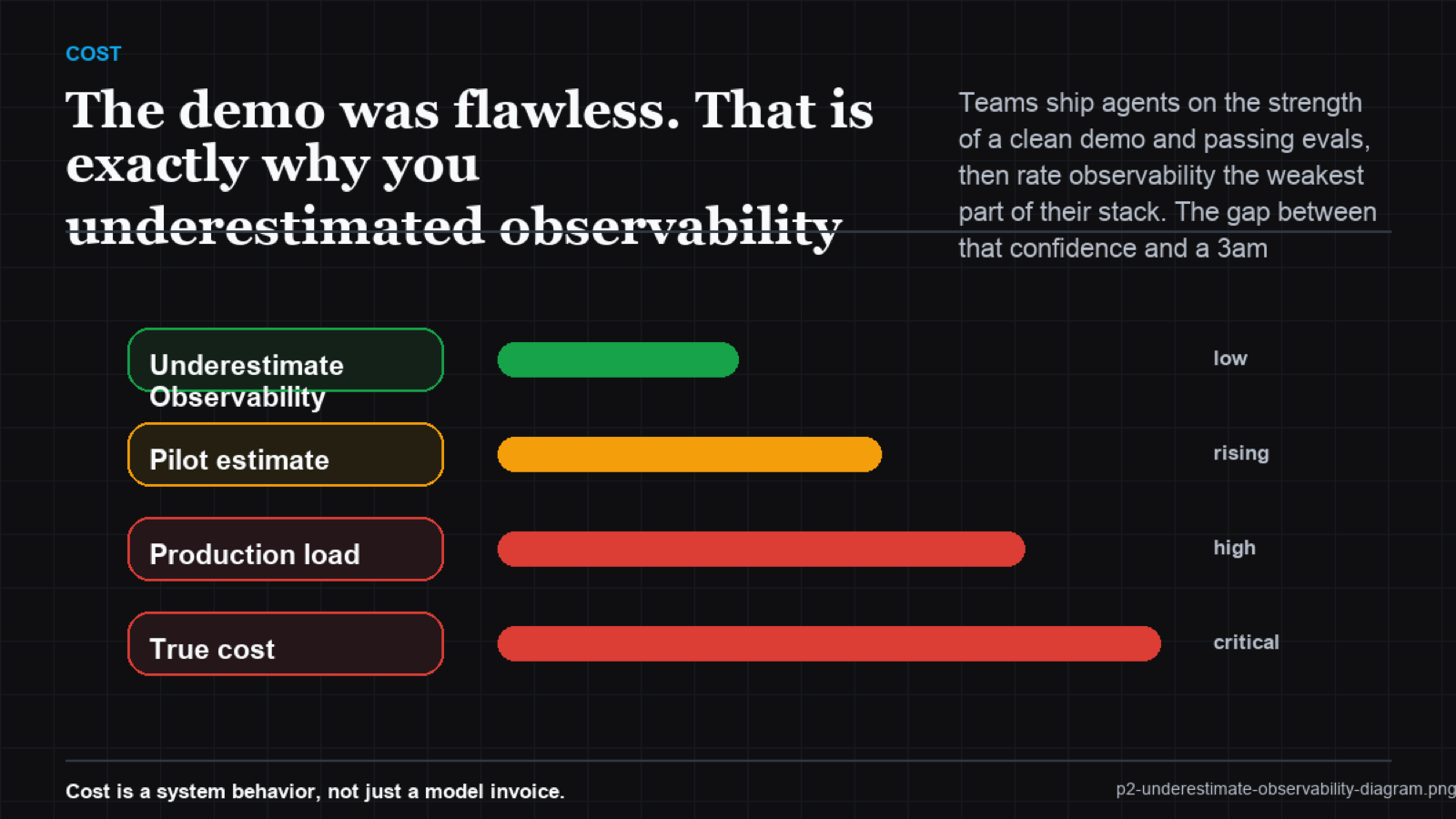
A demo is a best case. An eval suite is a known case. Production is neither. The demo shows clever reasoning reaching a successful outcome, that feels like proof. The evals pass, that feels like coverage. Together they create the illusion of production-readiness. On the strength of that illusion, teams ship with monitoring limited to basic infrastructure metrics or simple LLM call logs. The surveys show the result plainly: technical deployment outpaces operational visibility. Teams are running agents in production while rating their ability to see what those agents are doing as the weakest part of their stack. The confidence was real. It was just calibrated to the demo, not the deployment.
Then production does what production does. The inputs are messier than the eval set, the agent hits a case nobody tested, and the failure is silent because it's semantic, not a crash. With only infra metrics watching, nothing fires until the symptom is large enough for a human to stumble on. That's how a quietly looping agent runs up a token bill at 3am with a green dashboard the whole time.
Why can't traditional monitoring catch this?
Traditional observability assumes deterministic behavior: same input, same path, failures throw errors, status codes tell you whether it worked. Agents break all three. The path is non-deterministic, failures are often silent (a plausible wrong answer, not an exception), and a 200 response can sit on top of a bad decision. The stack you already own watches latency, error rates, and resource use, none of which see the reasoning where the failure lives. The fix is agent-aware observability: reasoning traces, semantic checks, drift and cost signals. The tooling and standards exist today. This is a priority problem, not a capability one.
| What you saw | What it implied | What production needed |
|---|---|---|
| Flawless demo | The system works | Visibility into the messy, untested cases |
| Passing evals | Good coverage | Monitoring of reasoning, not just outcomes |
| Green infra dashboard | Healthy system | Detection of silent semantic failures |
| A capable model | Reliability | Agent-aware observability around it |
The flawless demo is the trap: on GAIA a plugin GPT-4 scores ~15% where humans hit ~92%, so the clean run hides how far an upgrade stays from reliable at scale. (source)
Closing this perception gap is the whole premise of a Pattern Intelligence Layer. Reliability at the pattern level means the observability the demo hid is treated as part of the system from day one, agent behavior is visible where it actually fails, not only where a deterministic monitor happens to look. The demo will always look ready. The teams that scale don't mistake that for the work being done. They budget for seeing the agent clearly before production forces the lesson at 3am.
Frequently asked questions
Our demo and evals are great. Why isn't that enough?
A demo is a best case and evals are known cases. Production is neither. They build confidence calibrated to the demo, not to the messy inputs and silent failures you'll actually meet.
We already have monitoring. Why add more?
Existing stacks were built for deterministic systems. They watch latency, errors, and resources. They can't see an agent's reasoning, which is where the failures live. You need agent-aware observability.
Is this a tooling gap?
No. The standards and tools (like OpenTelemetry GenAI conventions) exist today. The gap is perception and priority: deployment is outpacing the visibility teams choose to build.