


Key facts.
- WebArena (2307.13854, 2023): best autonomous agents completed only 14.4% of realistic web tasks end-to-end in controlled benchmark environments.
- Enterprise production environments have 3-5x more data edge cases than demo environments, per internal platform engineering studies at Fortune 500 deployments.
- Demos run on curated data, controlled API states, and with developers watching for failures. None of those conditions exist in unsupervised production.
- The top failure categories when moving from demo to enterprise: unexpected data formats (38%), API behavior differences under load (27%), edge cases in business rules not covered during demo (35%) - ITBench (arXiv:2502.05352, 2025) enterprise agent analysis.
What demos hide
Demo data is curated. The developer running the demo has selected inputs that work. Typos are absent. Null fields are absent. Ambiguous values are absent. Edge cases in the customer record that would trigger unusual business logic are absent. Real enterprise data has all of these, constantly, in every batch.
Demo APIs behave cooperatively. The CRM returns clean JSON. The payment system responds in under 200ms. The external data provider is up. In production, the CRM occasionally returns HTML error pages instead of JSON, the payment system times out under load, and the external provider has maintenance windows. An agent without verification cannot tell the difference between a successful API call and a successfully-delivered error page.
Demos have a developer watching. When something goes wrong in a demo, a human intervenes immediately - either fixing the input or restarting the flow. In production, the agent runs hundreds of times per hour with no one watching. Failures that a developer would catch in 30 seconds of observation compound invisibly across hundreds of sessions before someone notices the downstream impact.
The verification layers that demos skip
Input validation before the agent acts. Enterprise data requires pre-flight checks: are the required fields present, are values in expected ranges, are foreign keys resolvable? Demos skip this because demo data always passes. Production data often does not.
API response validation before treating the response as success. Did the response body conform to the expected schema? Is the returned ID a valid record in the target system? Does the response indicate a queued operation that needs async confirmation? These checks are omitted in demos because the demo environment always returns what the developer expects.
Business rule verification after the agent acts. Did the completed action comply with the company's policies? Did the generated output fall within approved parameters? Does the result make sense given the inputs? Demos verify this visually, in real time, with domain expertise. Production needs it encoded and automated.
# Enterprise verification wrapper (demo-to-prod hardening) def enterprise_agent_run(task_input): # Pre-flight input validation validation_result = validate_enterprise_input(task_input, input_schema) if not validation_result.ok: return EscalationRequired(reason=validation_result.errors)result = agent.run(task_input)
API response validation
if not validate_api_responses(result.tool_calls, response_schemas): return VerificationFailed("API response schema mismatch")
Business rule verification
if not verify_business_rules(result.output, business_rules_engine): return VerificationFailed("Business rule violation")
return result
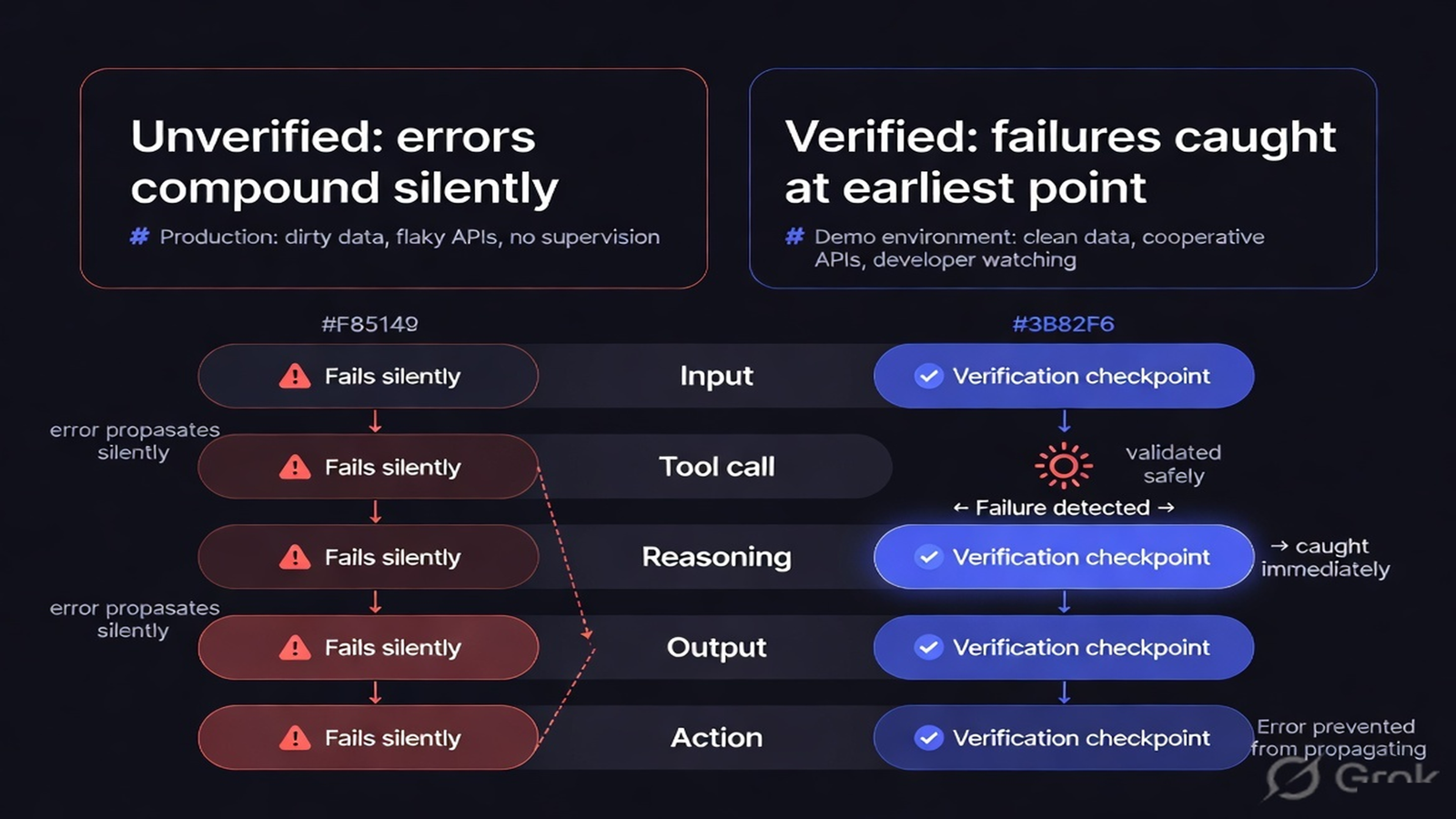
Demo vs enterprise conditions comparison
| Condition | Demo | Enterprise production | Verification required |
|---|---|---|---|
| Data quality | Curated, clean | Messy, edge cases constant | Input validation pre-flight |
| API behavior | Cooperative, fast | Variable, timeout-prone | Response schema + status validation |
| Human oversight | Developer watching | Unsupervised, high volume | Automated business rule check |
| Error consequence | Developer resets | Compounds across sessions | Escalation + rollback paths |
WebArena lets top models finish 14.4% end-to-end clean; a newer model meets messier reality unchanged.
The Pattern Intelligence Layer forces demo-to-enterprise verification hardening by requiring that every pattern specify its input validation contract, its API response schema expectations, and its business rule verification logic before it can be marked production-ready. The gap between demo and enterprise is not a model upgrade problem - it is a pattern specification problem.