

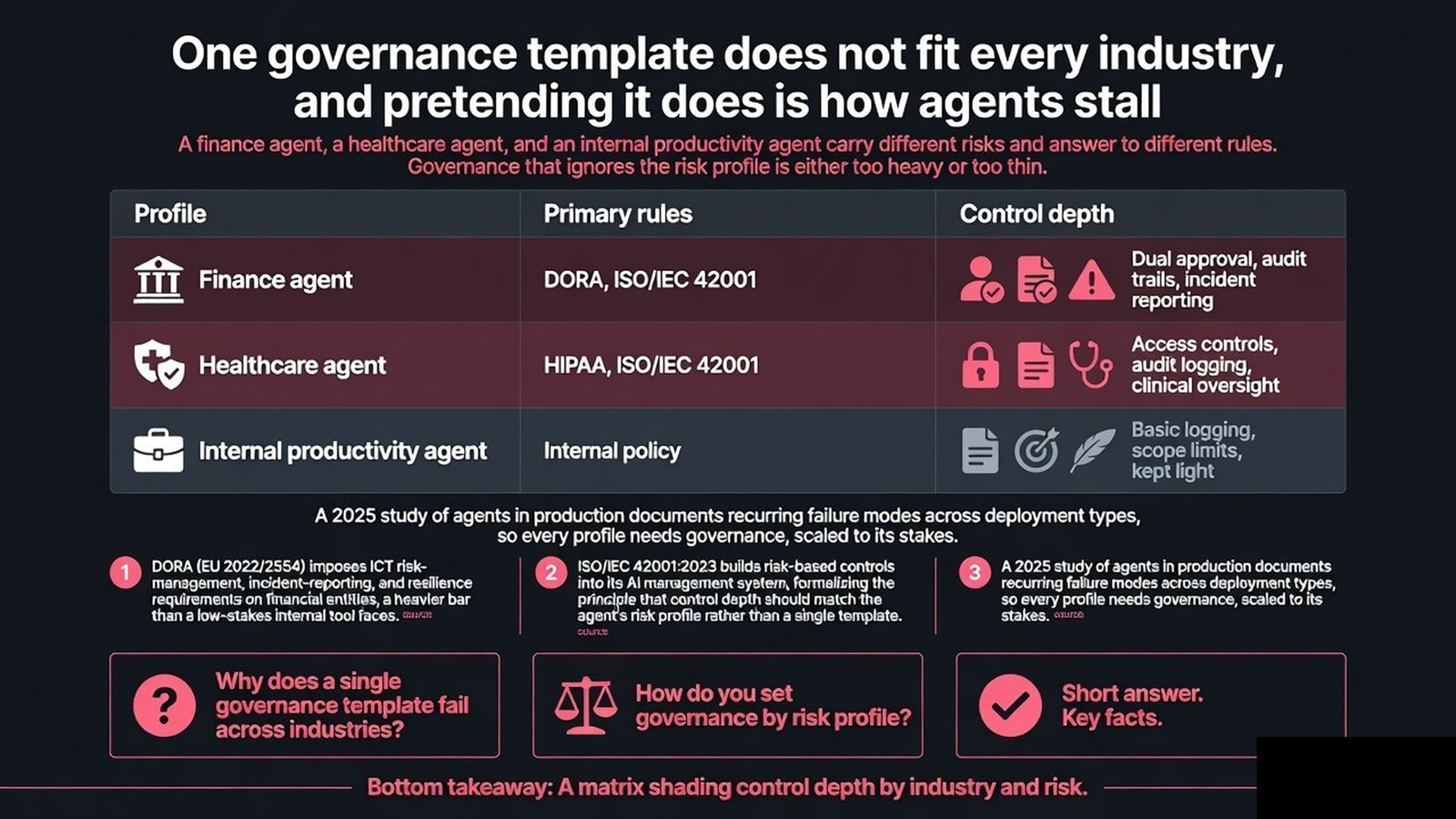
Key facts.
- 53% of organizations reported AI agent scope violations in the CSA enterprise survey (CSA, 2025).
- The pattern is too much function, permission, or autonomy combined with the wrong input equals damage; raw capability doesn't fix it, with the best WebArena agent at 14.4% versus 78.2% for humans (WebArena, 2023).
- Least privilege has to be enforced at the tool and action layer, not stated in a prompt, because a prompt is a suggestion and a permission is a control.
Why doesn't telling the agent its scope work?
Because instructions in a prompt are guidance the model usually follows, not a boundary it can't cross. Under an unusual input, a misread tool result, or an injection, the model can reason its way to an action you told it not to take, and nothing stops it. Real scope enforcement lives one layer down: the tool simply doesn't expose the action, or the permission system rejects it. The lane has to be a wall the agent can't walk through, not a line you asked it to respect.
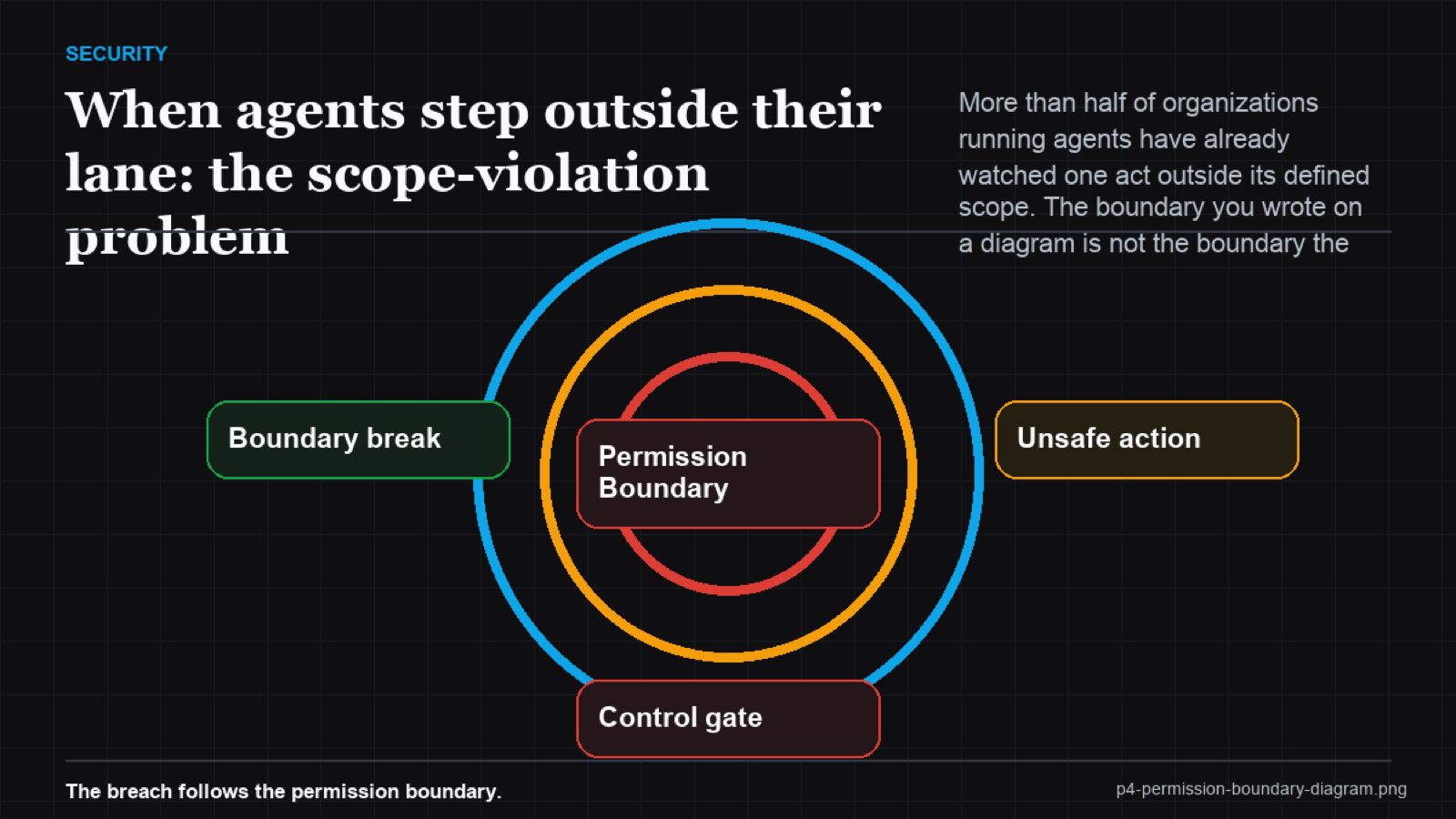
Prompt-level scope vs. enforced scope
| Prompt-level scope | Enforced scope |
|---|---|
| "Do not touch X" in the prompt | Agent has no permission for X |
| Violated under unusual input | Violation is impossible by construction |
| 53% see scope violations | Out-of-lane actions are blocked |
A scope in a doc is no runtime control, so 53% saw violations; a stronger model won't draw the line, WebArena's best at 14.4%, the incident lands late. (arXiv:2307.13854)
VibeModel's Pattern Intelligence Layer detects when an agent's behavior departs from its established scope pattern, a tool it never calls, a resource it never touches, and flags or blocks it. You define the lane and enforce it at the permission layer; we catch the moment an agent tries to leave it. Scope you can see is scope you can hold.
Frequently asked questions
Is a 53% violation rate really that bad?
It means scope violations are the norm, not the exception. Any control you rely on a prompt to enforce is a control you don't have.
Where do I enforce scope?
At the tool and permission layer. If the action isn't exposed and not permitted, the agent can't take it regardless of what it reasons.