


Key facts.
- Over 40% of agentic projects are at risk of cancellation by 2027, with cost and inadequate controls among the drivers (Gartner, reported).
- 53% of organizations reported agent scope violations, the symptom of too much autonomy without enforcement (CSA, 2025).
- The resolution is graduated autonomy: free rein on reversible low-impact actions, gates on irreversible high-impact ones.
- Lock it down and it's a form, leave it open and you inherit 2025; a stronger model won't resolve it, BFCL near 77%, so autonomy is exposure unless gated. (Gartner, reported)
Why does picking a corner fail?
Because both corners are wrong. Full lockdown destroys the value you deployed the agent for, and teams abandon it. Full autonomy hands the agent enough rope to cause an incident, and teams abandon it after the incident. The escape is to stop treating autonomy as a single dial. Scope it by consequence: the agent moves freely where mistakes are cheap and reversible, and pauses for a human exactly where they are not. That keeps the speed and removes the catastrophe.
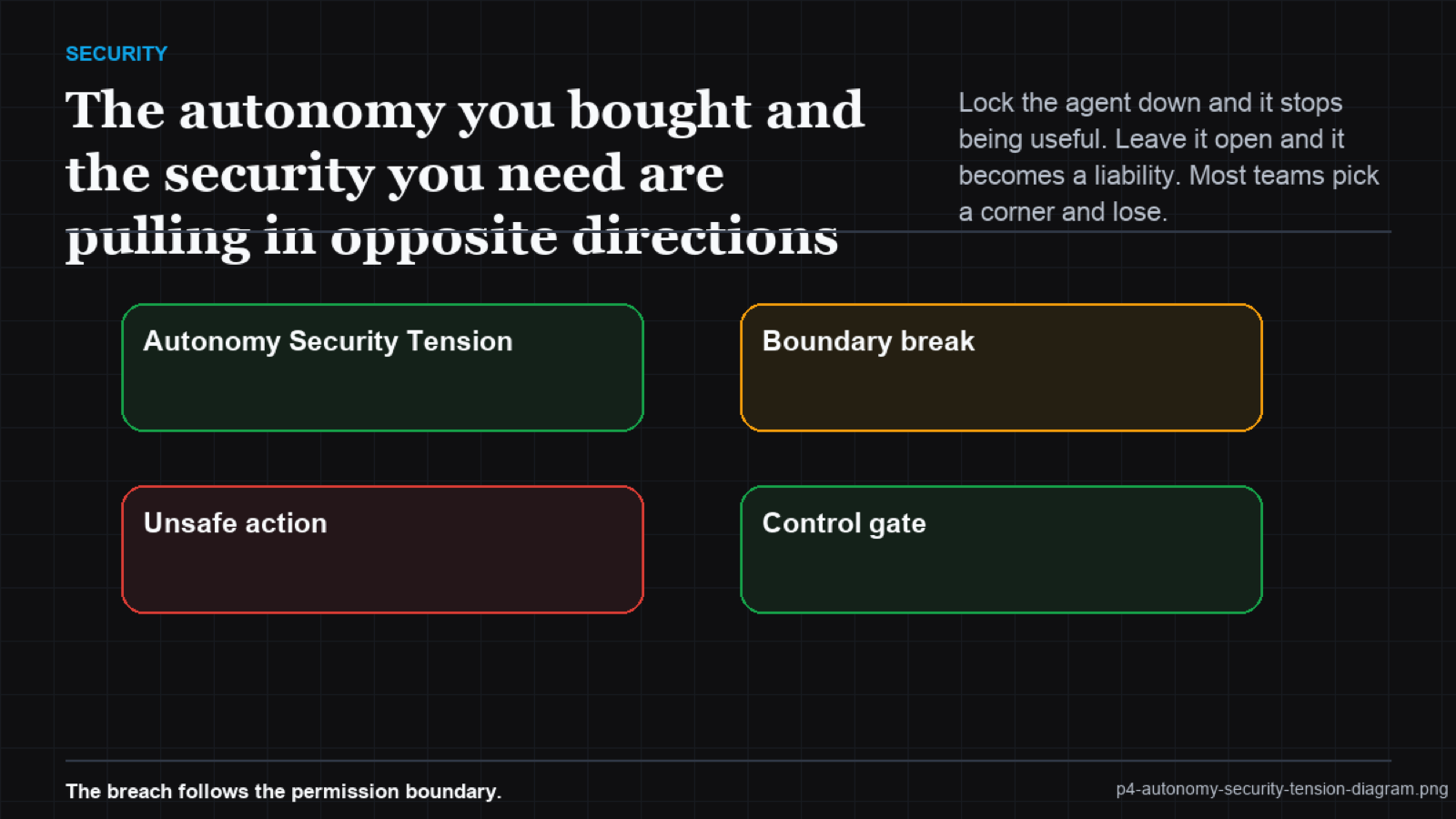
Binary choice vs. graduated autonomy
| Binary choice | Graduated autonomy |
|---|---|
| Lock everything or nothing | Autonomy scaled to consequence |
| Useless or unsafe | Fast where safe, gated where not |
| Project abandoned either way | Project ships and holds |
VibeModel's Pattern Intelligence Layer lets you set graduated autonomy with confidence: it watches behavior so the agent can run freely on low-risk patterns while high-risk ones are caught and gated. You decide where the line sits by blast radius; we keep the agent on the right side of it. Autonomy and security stop fighting when you stop treating them as one switch.
Frequently asked questions
Where do I draw the line?
At irreversibility and impact. Reversible, low-impact actions get autonomy; irreversible or high-impact ones get a gate. Let consequence decide.
Won't graduated autonomy be complex to manage?
Less than managing an incident or a cancelled project. A clear consequence-based policy is simpler than it sounds and far cheaper than the alternatives.