


Key facts.
- Policymakers increasingly treat autonomous financial agents as critical digital infrastructure requiring governance and supervisory intervention when unsafe behavior emerges.source
- Agents that can autonomously trigger financial operations create real risk if a prompt-injection attack can influence them.source
- Purpose-built agent payment infrastructure now ships with programmable guardrails: session caps, transaction limits, operation allowlists, multi-party approvals, and detailed audit logs.source
- Safe deployment means letting the agent act autonomously while keeping a human able to intervene on consequential actions.source
Why does a high-stakes agent need a different control class?
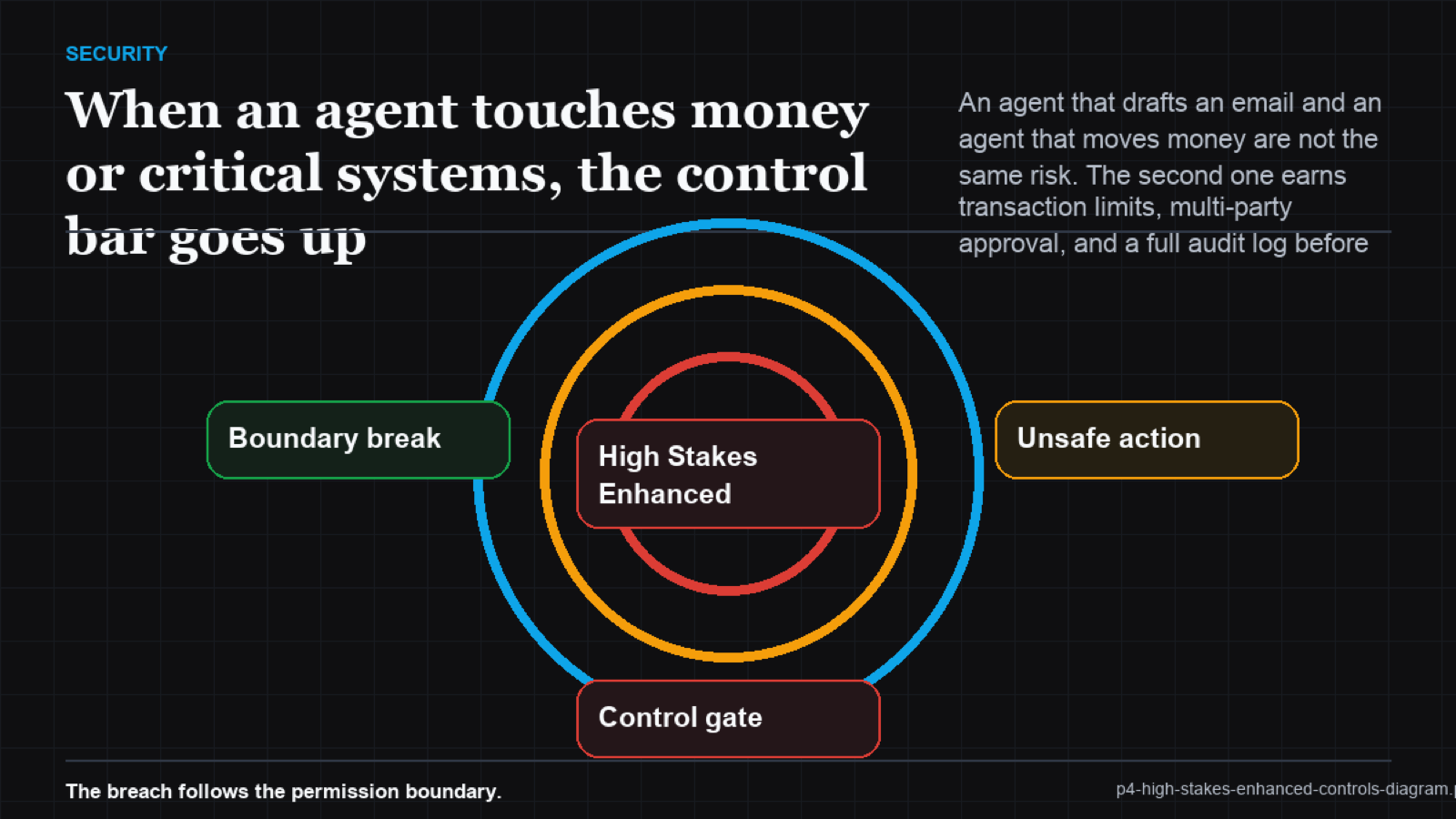
Because the cost of a wrong action isn't symmetric. A bad summary wastes a few seconds. A bad transfer moves real money, and you may not get it back. When the downside is large and irreversible, you can't rely on the agent reasoning correctly every time, because it won't. An injected instruction, a hallucinated parameter, or a misread tool result is enough, and on a payment agent that's enough to cause harm. So the control has to sit on the action: limit what a single action can do, require a second party to approve the consequential ones, and log everything so the action is reconstructable after the fact.
this is why purpose-built payment infrastructure for agents now ships exactly these controls. Transaction limits cap the blast radius of any one action. Allowlists constrain where value can go. Multi-party approval puts a human in the path of the actions that matter. None of that's optional once money is in scope.
How do you decide which actions get the high bar?
Rank actions by reversibility and impact. Read-only and easily-undone actions can run with logging. Actions that spend money, change permissions, or touch critical systems get limits and approval gates. The line isn't the domain, it's the consequence: a customer-support agent that issues refunds needs the same gate on the refund action that a finance agent needs on a transfer.
| Action class | Example | Control bar |
|---|---|---|
| Read-only | Look up an order | Logging |
| Reversible write | Update a draft | Logging plus scope |
| Consequential | Issue refund, change access | Limits plus approval gate |
| Irreversible / high-value | Move money, alter infra | Limits, allowlist, multi-party approval, full audit |
An agent that moves money fails irreversibly, so it earns a higher bar a stronger model doesn't lower, since an injection can steer it into a transfer. (source)
A Pattern Intelligence Layer is what makes this tiering a property of the system rather than a per-agent special case. Reliability and security at the pattern level mean each action is gated by its consequence, with limits, approvals, and audit applied around the agent on every run, independent of which model reasons about the task. The agent that moves money meets the high bar automatically, because the bar lives in the pattern, not in a hope about the model.
Frequently asked questions
Doesn't an approval gate kill the point of automation?
No. You gate only the consequential actions, not every step. The agent runs autonomously up to the line, and a human confirms the few actions that are expensive to undo.
Is this only for finance?
No. The bar tracks consequence, not industry. Any agent that issues refunds, changes permissions, or touches critical systems needs the high-stakes controls.
What single control caps the blast radius fastest?
A transaction or action limit. It bounds how much damage any one action can do, even if the agent is injected or wrong.