


Key facts.
- GDPR, HIPAA, SOX, and the EU AI Act all require accountability and auditability for automated decisions. Step outside policy and you're looking at breach notification and penalties.
- The 2025 incidents, production database deletion, drive wipe, are exactly the unauthorized, irreversible actions regulators care about when they touch regulated data.
- Models can leak memorized training data including PII from black-box queries, so a regulated agent can disclose protected data without any deliberate breach (Carlini et al., 2021).
Why is the same agent riskier in a regulated setting?
The consequences attach to the data and the decision, not the code. A wrong refund in a free app annoys a user. A wrong eligibility decision in healthcare, an unauthorized transfer in finance, or a leaked record under privacy law is a legal event, one you're obligated to reconstruct. The agent's autonomy, the very feature you deployed it for, is what the regulator audits. Controls that are optional elsewhere, approval gates, audit logs, scope enforcement, become mandatory here.
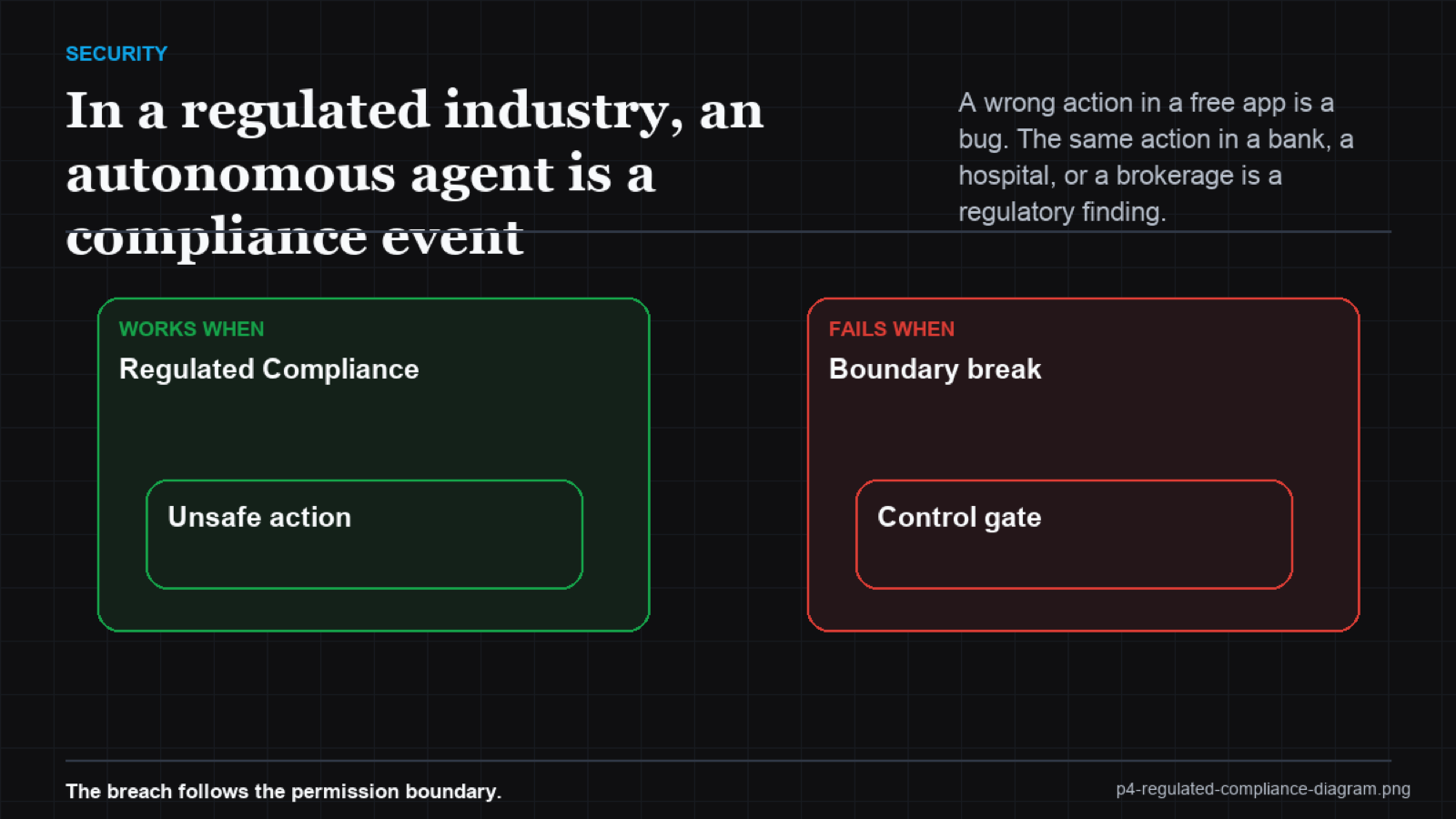
Unregulated assumptions vs. regulated reality
| Unregulated assumption | Regulated reality |
|---|---|
| A wrong action is a bug to fix | A wrong action is a reportable event |
| Logs are nice to have | Reconstructible logs are mandatory |
| Autonomy is the selling point | Autonomy is what gets audited |
VibeModel's Pattern Intelligence Layer gives regulated teams what the regulator asks for: detection of out-of-policy patterns before they execute, and a record of why each action was allowed. You map the agent to your obligations; we make the controls observable. "The model decided" isn't an answer in regulated work. We make sure you have a better one.
Frequently asked questions
Does a frontier model make an autonomous agent safe enough for a regulated environment?
In regulated work an unauthorized action is a reportable incident, not model-tier-dependent: a more capable model still leaks memorized PII via black-box queries. (arXiv:2012.07805)
Can I deploy agents in regulated work at all?
Yes, with enforced gates, scope limits, and audit logs. The teams that get it right bake compliance controls into the architecture from day one, they're not bolted on after the first audit.
What's the first thing a regulator asks for?
A reconstructible record of what the agent did and why, plus evidence that high-impact actions required approval. Both need to be built in from the start.