


Key facts.
- GDPR Article 22 restricts solely automated decisions with significant effect and grants a right to human intervention, directly constraining autonomous agent decisions about people. source
- HIPAA governs the use and disclosure of protected health information and SOX governs internal controls over financial reporting, so an agent touching either inherits strict, auditable requirements. source
- tau2-bench (arXiv:2506.07982), a dual-control benchmark, reports overall agent success in the mid-30s percent across its domains, evidence that unilateral action on regulated matters fails often. source
Why are these regimes a barrier to autonomy specifically?
Because they were written to keep consequential decisions accountable to a person, which is exactly what an autonomous agent removes. GDPR Article 22 is the clearest case: it gives individuals a right not to be subject to a solely automated decision that significantly affects them and a right to obtain human intervention. An agent that decides a person's claim, eligibility or standing on its own is, by default, the thing the article restricts. HIPAA and SOX work differently but land in the same place: they impose strict, auditable controls on how health data and financial reporting are handled, so an agent acting in those domains inherits requirements to log, control and account for what it does. The barrier is not that the agent is inaccurate; it is that the agent is autonomous and autonomy is what these regimes are built to bound.
A more capable model does not lower the wall, because the obstacle is legal accountability rather than performance. A confident, fluent wrong decision is in some ways worse under a compliance regime, because it is harder to catch and still attributable to your organization. The reliability evidence makes the regimes' stance reasonable: tau2-bench, which tests agents in a setting where both the agent and the user act on a shared state, found overall success in the mid-30s percent across its domains, so an agent left to act unilaterally on regulated matters will be wrong often enough that requiring human accountability is not bureaucratic caution, it is a sound control. The agents that clear these reviews are the ones designed with the human-accountability and auditability the regimes demand, built in from the start rather than retrofitted when the review stalls.
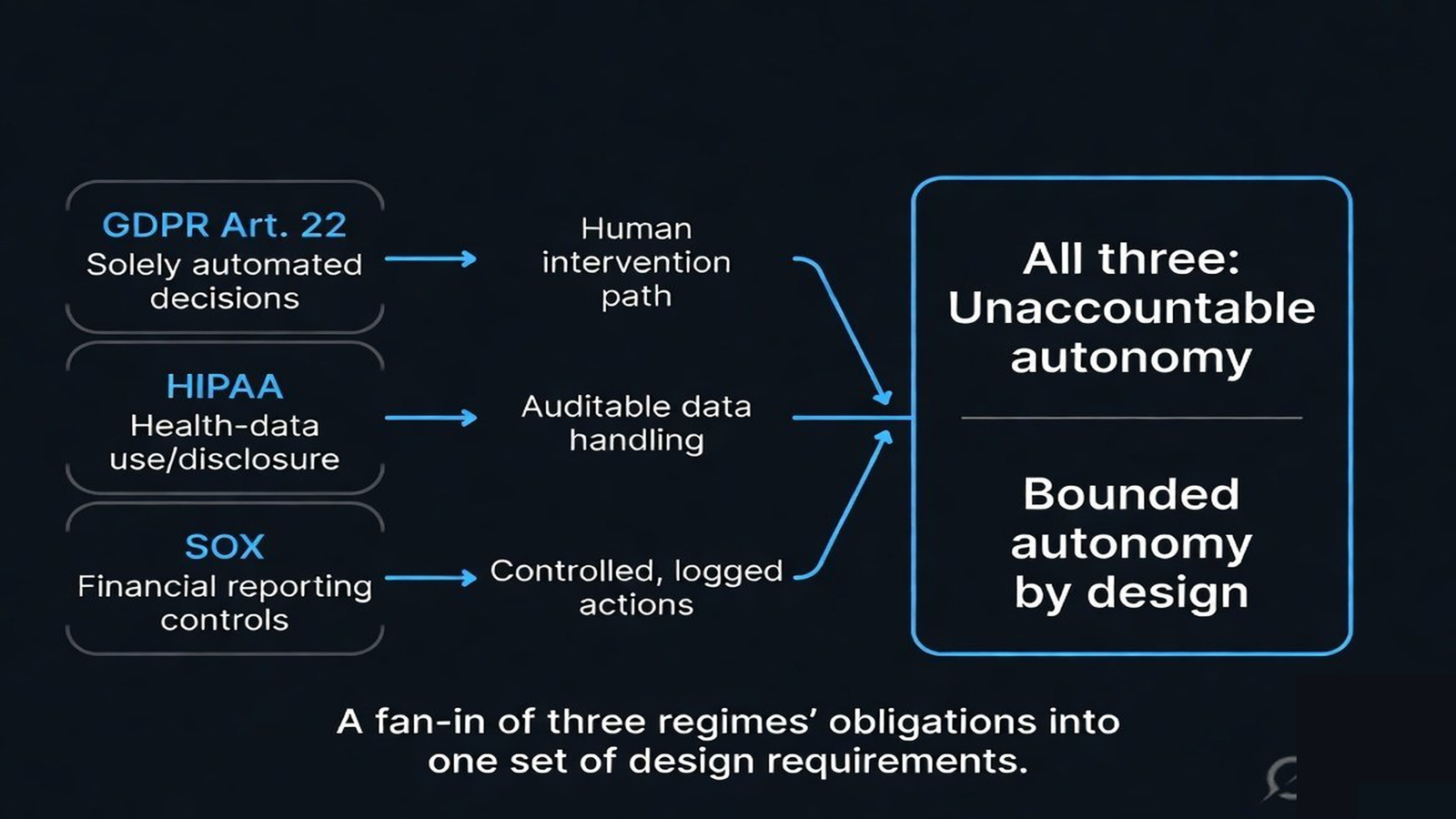
What does designing for these regimes require?
Human accountability on significant decisions, so the agent escalates rather than deciding alone where GDPR Article 22 applies. Auditability of data handling, so HIPAA's use-and-disclosure and SOX's control requirements can be demonstrated rather than asserted. A reconstructible record of what the agent did and why, so a regulator's question has an answer. And a defined boundary between what the agent does autonomously and what requires a person, so autonomy is bounded by design rather than challenged by review. These are the same controls good governance calls for generally, sharpened by legal force in regulated settings. Built early, they turn the compliance review from the place an agent waits into the gate it passes, because the agent already does what the regimes require.
| Regime | What it constrains | Design requirement |
|---|---|---|
| GDPR Art. 22 | Solely automated decisions | Human intervention path |
| HIPAA | Health-data use/disclosure | Auditable data handling |
| SOX | Financial reporting controls | Controlled, logged actions |
| All three | Unaccountable autonomy | Bounded autonomy by design |
GDPR's human review, HIPAA's health-data controls, and SOX's reporting controls all collide with an agent that decides alone; a more capable model does not solve it, the obstacle is legal accountability, so design for it up front. (arXiv:2506.07982)
The Pattern Intelligence Layer is where compliance obligations become enforced design. Human-accountability gates, auditable data handling and reconstructible records are tracked at the pattern level, so a regulated agent does what GDPR, HIPAA, and SOX require by construction rather than by promise. Reliability at the pattern level is what turns a compliance wall into a gate the agent is built to pass.
Frequently asked questions
Is compliance really a bigger barrier than the technical build?
Often yes. The technical demo clears quickly; the compliance review is where autonomous agents wait, because autonomy collides with rules that keep significant decisions accountable to a person.
Does a more accurate model satisfy GDPR Article 22?
No. The article restricts solely automated decisions regardless of accuracy and grants a right to human intervention. The requirement is accountability, not performance.
How do I avoid the compliance review stalling my agent?
Design for it early: human-accountability gates, auditable data handling and reconstructible records, so the agent already meets the regimes' requirements when the review begins.