


Key facts.
- Measuring Agents in Production (arXiv:2512.04123) surveyed 86 deployed agent systems and found 68% keep the agent to ten or fewer steps before a human checkpoint, evidence that designed-in human oversight is how real agents ship, not a fallback. source
- A Cloud Security Alliance survey of agentic AI adoption reports that organizations treat human approval and named oversight roles as prerequisites for letting an autonomous agent act in a governed environment. source
- On WebArena, the best evaluated agent reached about 14.4% end-to-end task success against a human baseline near 78.2%, evidence that unsupervised action on real workflows fails often. source
What does a real human oversight model look like?
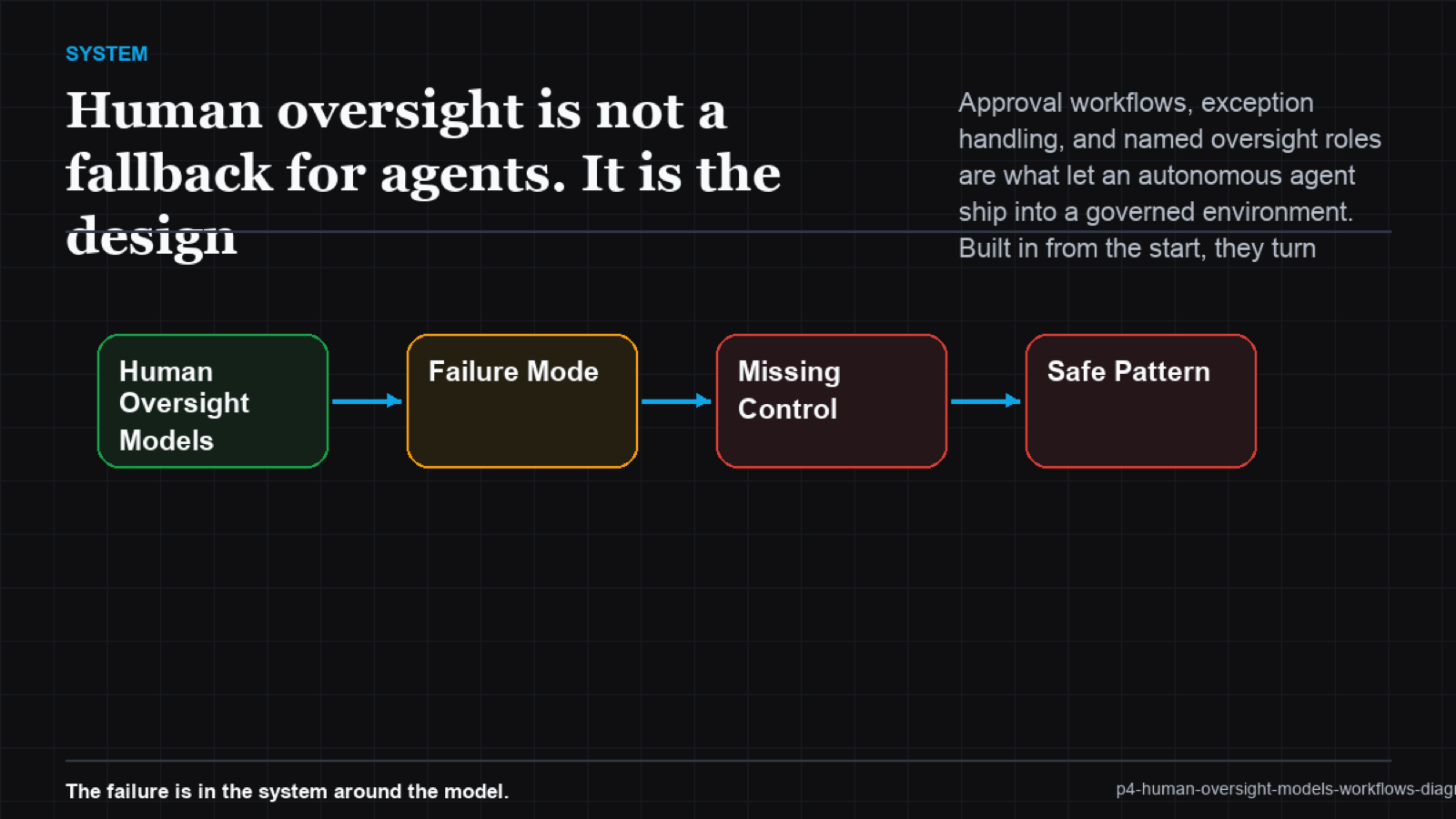
It has three moving parts and none of them is "a human watches a dashboard." The first is an approval workflow: for any action above a consequence threshold, the agent proposes and a person commits. The second is exception handling: when the agent's confidence drops, when an input is out of distribution or when a tool returns something the agent cannot reconcile, the path routes to a human rather than to a guess. The third is a named role with the authority to override, the training to interpret the agent's output and the standing to decide the agent should not act at all. The Cloud Security Alliance adoption work points to exactly these capabilities as prerequisites for governed deployment, because oversight that exists only on paper is not oversight.
The reason this is design and not decoration is the agent's own error rate. WebArena put leading agents on realistic web tasks and the best one finished about 14% of them end to end, while people finished roughly 78%. An agent that wrong needs a person in the loop on the consequential cases and a more capable model narrows the gap without closing it. The teams that ship treat oversight as part of the agent's architecture from day one, so the approval and exception paths are first-class, fast and gated by consequence rather than bolted on after a near-miss.
How do you keep oversight from becoming the bottleneck?
Gate by consequence, not by default. Low-stakes, reversible actions run autonomously; high-stakes or irreversible ones get an approval step; genuinely uncertain ones get routed to a person through exception handling. That keeps the human in the loop where their judgment is worth the latency and out of it where it is not. Designed this way, oversight is fast on the cases that do not need it and present on the cases that do, which is the opposite of a blanket review queue that stalls everything equally.
| Action type | Oversight model | Why |
|---|---|---|
| Low-stakes, reversible | Autonomous, logged | Cost of error is small |
| High-stakes or irreversible | Approval workflow | Person commits the action |
| Low confidence / out of distribution | Exception to a human | Route uncertainty, do not guess |
| Policy boundary hit | Block + named owner alerted | Accountability is assigned |
The Pattern Intelligence Layer is where oversight becomes enforced design. Approval thresholds, exception routes and named accountability are tracked at the pattern level, so the agent escalates the consequential case by construction rather than by hoping a person was watching. Reliability at the pattern level is what turns human oversight from a bottleneck into the property that makes an autonomous agent deployable.
Frequently asked questions
Isn't human oversight just an admission the agent isn't ready?
No. Measuring Agents in Production found most deployed teams keep a human checkpoint regardless of capability and the WebArena gap shows why: even leading agents fail most real tasks, so oversight on consequential actions is sound engineering, not a confession.
Where should a human actually sit in the loop?
On consequential or irreversible actions and on uncertain inputs. Gate by consequence so oversight is present where judgment matters and absent where it only adds latency.
What makes oversight effective rather than nominal?
A person who can interpret the output, override it and decline to act, plus an exception path that routes uncertainty to them. Oversight that cannot stop the agent is not oversight.