


Key facts.
- WildToolBench evaluated 57 LLMs on 256 real-world tool-use scenarios. No model achieved session accuracy above 15%; most fell well below on complex multi-step scenarios (WildToolBench, arXiv:2604.06185, 2026).
- The Berkeley Function Calling Leaderboard (BFCL) shows top models scoring above 85% on controlled single-call function calling - the gap relative to multi-turn real-world benchmarks is substantial (BFCL v4, gorilla.cs.berkeley.edu).
- Measuring Agents in Production (arXiv:2512.04123) found that production agentic deployments require extensive engineering scaffolding beyond the base model: error handlers, retry logic, output parsers, and monitoring, each adding failure surface.
- WildToolBench identified three real-world challenges absent from standard benchmarks: compositional tasks requiring orchestration of multiple tools, implicit user intent spread across conversation turns, and instruction transitions between task modes.
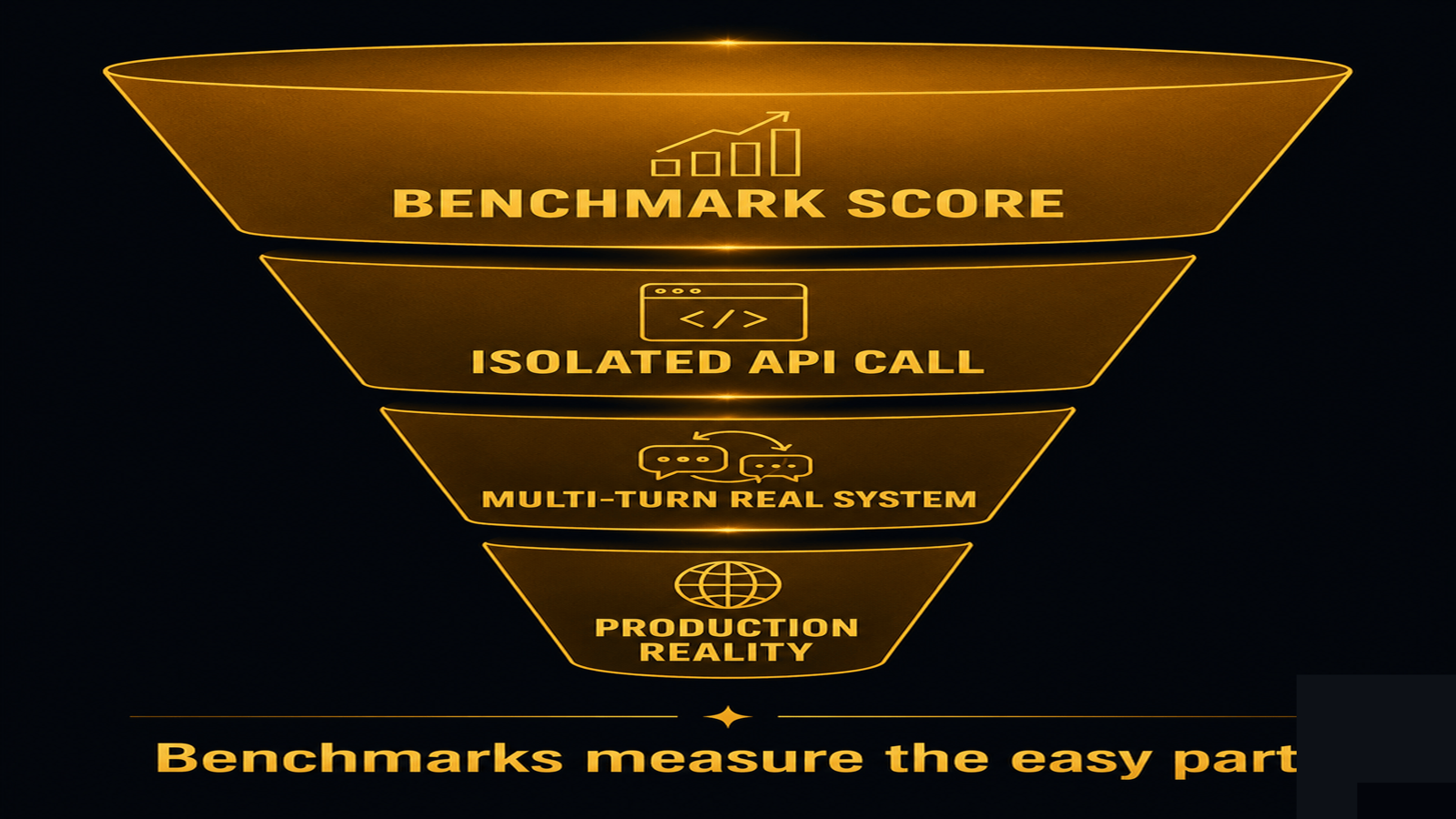
- The gap between single-call and multi-turn tool accuracy is not a model intelligence issue. It reflects the difference between an isolated API call and a stateful, context-sensitive, schema-dependent production integration.
Why the benchmark score is the wrong number
Function-calling benchmarks typically measure a model's ability to produce a correctly formatted JSON call given a tool schema and a prompt. That is a useful signal. It is not what your agent does. Your agent runs in a session that has accumulated ten prior turns of context, calls a tool that returns an error on 3% of invocations, and needs to decide whether that error is retryable, fatal, or a reason to escalate. No benchmark measures that sequence.
WildToolBench was specifically designed to surface this gap. Its scenarios involve implicit intent, mid-session instruction shifts, and multi-tool orchestration - the elements that define real customer interactions. The result: frontier models that score well on BFCL still fail most of the time on real sessions. The benchmark is not lying. It is measuring something different from what you need.
The engineering gap and what closes it
The teams I see shipping reliable tool-calling agents invest heavily in three areas that benchmark scores do not reward. First, comprehensive error taxonomy: they catalog every way a tool call can fail and write explicit handling for each. Second, output parsing and validation: they never pass raw tool output to the model without checking it against an expected schema. Third, session-level observability: they trace every tool call, every response, and every branch point so failures are diagnosable. None of this changes the model. All of it changes the production reliability.
What to measure instead of the model card
| Metric | What it measures | Benchmark equivalent | Production relevance |
|---|---|---|---|
| Session accuracy | Full multi-turn task completion rate | Rarely tested | High |
| Single-call accuracy | Correct JSON output given clean input | BFCL, HammerBench | Low without scaffolding |
| Error recovery rate | % of tool failures handled without task abort | None standard | Critical |
| Schema drift tolerance | Performance when tool schema changes | None standard | High in enterprise |
WildToolBench held 57 frontier models under 15 percent session accuracy; the next release leaves it, scaffolding closes it. (arXiv:2604.06185)
VibeModel's Pattern Intelligence Layer starts from session-level failure patterns rather than single-call accuracy. By learning which tool call sequences precede session failures - regardless of how each individual call scored - it surfaces the engineering investments with the highest production impact. The model card is the starting point. The pattern map is where production reliability is actually built.
Frequently asked questions
Should I use BFCL scores to choose a model for tool calling?
As a starting signal, yes. As a deployment decision, no. Run candidate models on your own tool schemas and your own session scenarios with realistic error rates. The gap from benchmark to production is real and model-specific.
Why do multi-turn tasks fail so much more than single-call tasks?
Session state accumulates uncertainty. Each turn adds context that the model must reconcile with its current task. Tool errors in early turns contaminate later reasoning. The compounding effect of small per-turn degradation produces large per-session failure rates.
Will this gap close as models improve?
Partially. Better models reduce single-call errors. But multi-turn orchestration, schema drift handling, and error recovery are architectural problems that benefit from model improvements only at the margins. The engineering layer remains load-bearing regardless of model generation.