

Key facts.
- The MAST taxonomy analyzed 200+ annotated traces across 7 frameworks (AutoGen, ChatDev, CrewAI and others) and found 14 distinct failure modes in 3 categories: specification, inter-agent misalignment, task verification (MAST, 2025).
- Inter-annotator agreement reached a Cohen's Kappa of 0.88, so these aren't subjective labels, they're reproducible failure patterns (MAST repo).
- Gartner reports over 40% of agentic AI projects are at risk of cancellation by 2027, with cost, unclear value, and inadequate controls cited as drivers (reported).
Why does adding agents make things worse, not better?
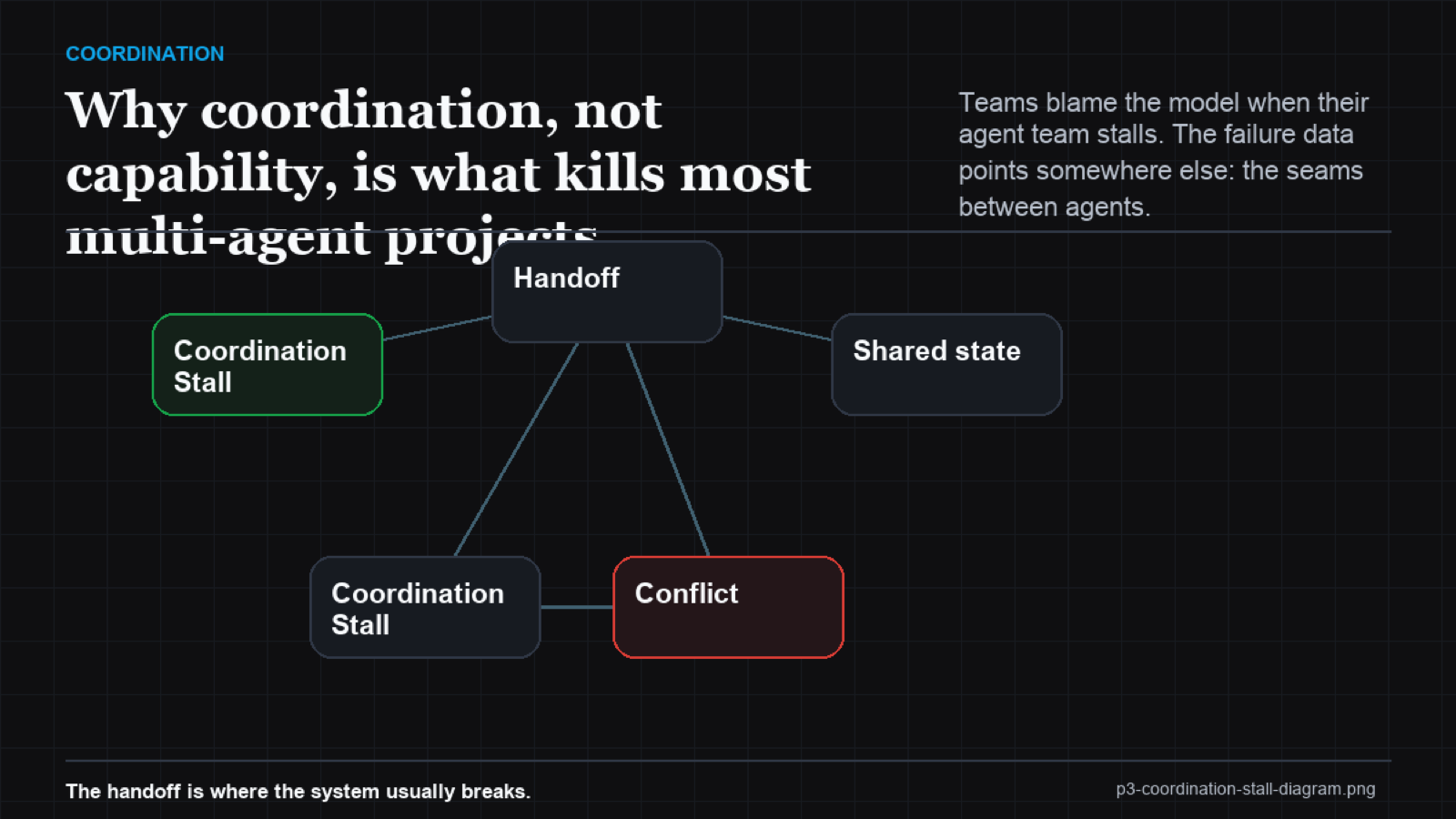
Every team that ships a single agent assumes the next step up is to add more agents. It feels like hiring. In practice you aren't hiring, you're building a distributed system where each node is non-deterministic. The MAST work is blunt about this: most failures happen at the boundaries. One agent specifies a task loosely, the next interprets it differently, and nobody verifies the result before it propagates. The model never had a bad day. The handoff did.
this is why "our agent is smart enough" is the wrong frame. Smart agents with sloppy coordination produce confident, wrong, expensive outcomes faster than a single agent would.
What separates the projects that ship?
| Stalls | Ships |
|---|---|
| Treats agents as smart coworkers | Treats agents as services in a distributed system |
| Trusts each handoff implicitly | Verifies every inter-agent output |
| Monitors agents individually | Monitors the interactions between them |
| Hopes a better model fixes drift | Builds pattern-level checks that catch drift early |
this is the work VibeModel does as the Pattern Intelligence Layer. We watch the patterns at the seams, specification gaps and unverified handoffs, and catch them before they compound into a cancelled project. Coordination reliability is a layer you build. Not a model you wait for.
Frequently asked questions
Does scaling the base model rescue a stalled multi-agent setup?
Benchmarks prove coordination, not capability, stalls these; a stronger base model inherits sub-half tau-bench reliability, at rework. (arXiv:2503.13657)
Is this just a small-model problem?
No. The tau-bench result is on GPT-4o-class agents, and the MAST failures span frontier-backed frameworks. Coordination failure is structural. Not a capability gap. Not something a bigger model fixes.
So should I avoid multi-agent entirely?
No. You should treat it as distributed systems engineering, start with 2-3 agents, and verify every handoff. The teams that do this ship.