


Key facts.
- MAST analyzed 200+ traces across 7 frameworks (AutoGen, ChatDev, CrewAI and others), defining 14 failure modes in 3 categories (MAST, 2025).
- Inter-annotator agreement reached a Cohen's Kappa of 0.88, and the team released MAST-Data with 1,600+ annotated traces plus an LLM-as-judge pipeline (MAST repo).
- The three categories, specification, inter-agent misalignment, and verification, give you a checklist to design against before you ship.
How to actually use the taxonomy
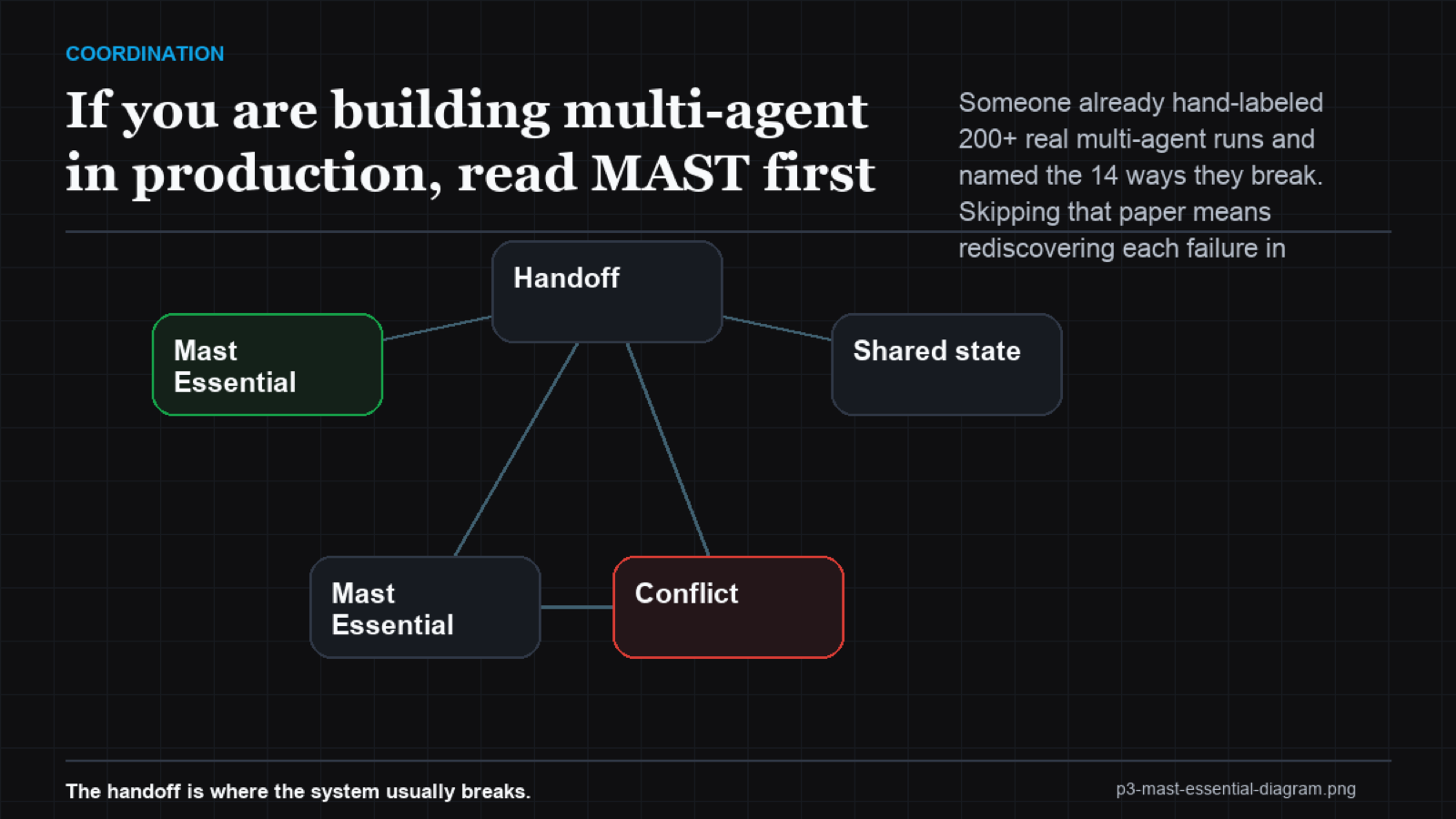
Run it as a pre-mortem. Before you launch, walk each of the 14 modes and ask what your design does about it. Do agents share a goal spec? Do handoffs get verified? Is progress tracked where every agent can read it? Then wire the LLM-as-judge pipeline into your evals so those failure modes get detected continuously, not just reviewed once at design time. The paper did the expensive labeling work. You get to start from a map instead of a blank page.
Without the map vs. with it
| Without MAST | With MAST |
|---|---|
| Discover failures one incident at a time | Design against 14 known modes up front |
| No shared vocabulary for failures | A named, reproducible taxonomy |
| Evals miss coordination failures | LLM-as-judge detects them continuously |
VibeModel's Pattern Intelligence Layer runs this kind of taxonomy in your live system. The failure modes MAST names are the patterns it watches for. The paper gives you the map; we keep you on it as traffic grows. Read MAST, then make its failure modes things your stack catches automatically.
Frequently asked questions
Won't a more capable model just route around these coordination failures?
MAST maps 14 failure modes because faults live in coordination, not the model, and a better model inherits them: WebArena's best clears 14.4% versus 78.2%. (MAST)
Is MAST tied to one framework?
No. It spans 7 frameworks precisely so the taxonomy generalizes. The failure modes show up regardless of which library you use.
What if I only have two agents?
Still read it. Several modes apply to a single handoff, and you will want the vocabulary before you scale.