


Key facts.
- MAST analyzed 200+ annotated multi-agent traces across 7 frameworks (AutoGen, CrewAI, ChatDev, and others) and identified inter-agent misalignment as a top-level failure category with specific sub-modes: conflicting subgoal selection, incompatible planning assumptions, and misaligned termination conditions (MAST, arXiv 2503.13657, 2025).
- Tran and Kiela showed that under equal thinking-token budgets, single-agent LLMs match or beat multi-agent systems on multi-hop reasoning across Qwen3, DeepSeek-R1-Distill-Llama, and Gemini 2.5, grounded in the Data Processing Inequality: every inter-agent handoff can only lose information, never add it (Tran and Kiela, arXiv 2604.02460, 2026).
- GPT-4o-class agents on tau-bench complete fewer than half of real tool tasks, and hold that rate across 8 repeated runs less than a quarter of the time, demonstrating that stronger models don't resolve the coordination failures that misalignment creates (tau-bench, arXiv 2406.12045).
What misalignment looks like in a production trace
Agent A is tasked with researching a customer's recent orders to prepare a refund recommendation. Agent B, triggered in parallel, is tasked with communicating the resolution to the customer. Agent A's research takes longer than expected, so Agent B begins drafting a communication based on its own inference of what the resolution should be. The customer receives a message about a resolution that Agent A's research would have contradicted. The workflow completed. The outcome was wrong.
This isn't a hallucination problem. Both agents were factually grounded and followed their instructions. The problem was that their instructions allowed each to operate on an independent model of the world that hadn't been reconciled. Misalignment doesn't require bad agents, it requires agents that haven't synchronized their assumptions.
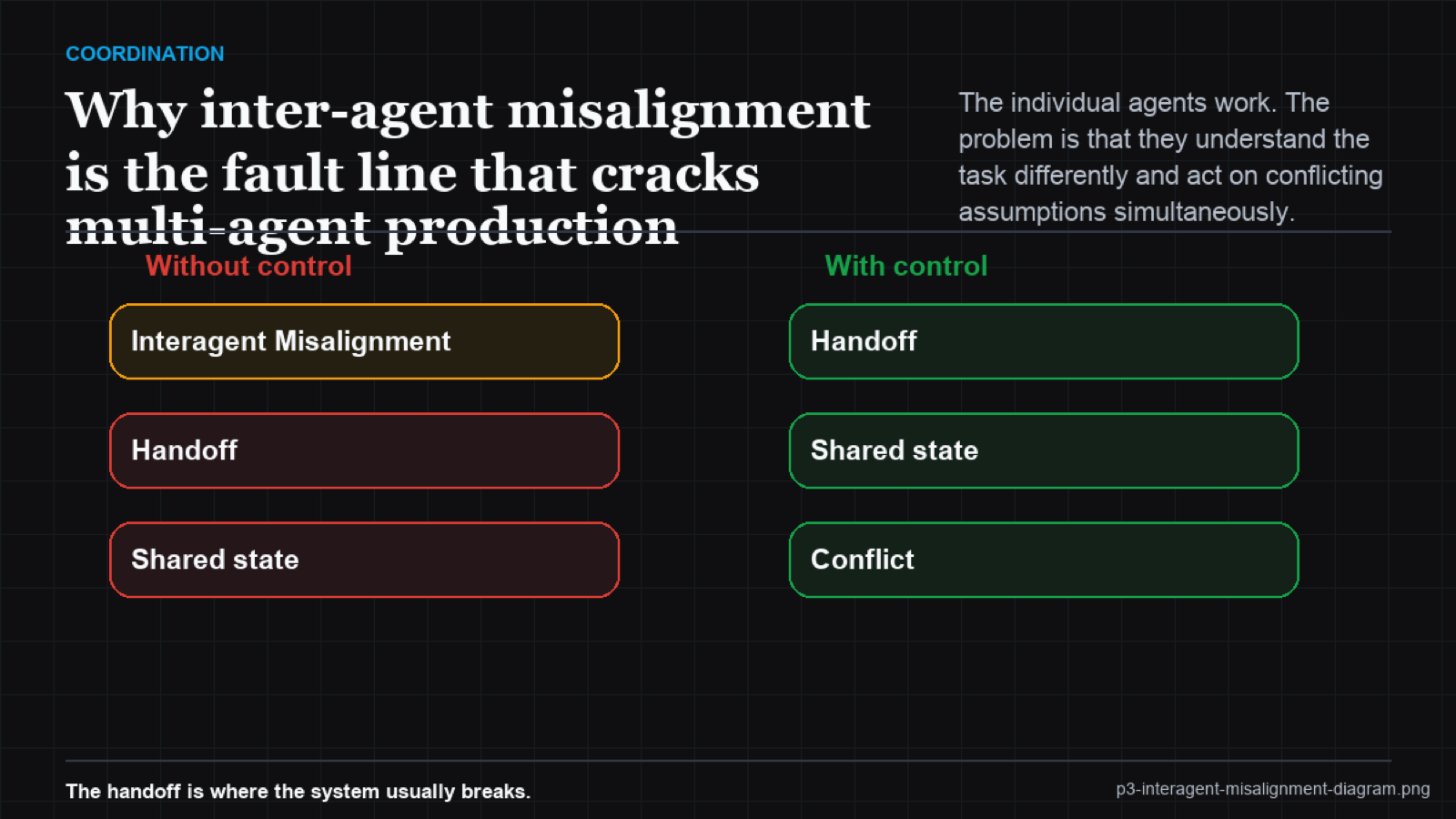
Specification gap vs. execution gap
| Specification gap | Execution gap |
|---|---|
| Roles overlap or leave coverage gaps | Agent acts outside its defined scope |
| Task decomposition is ambiguous | Agents decompose the same task differently |
| Success criteria not shared | Agents disagree on when the task is done |
| Escalation paths not defined | Neither agent escalates a conflict |
Inter-agent misalignment is a top failure class; smarter agents inherit it, since handoffs only lose information, and the rework spans the fleet. (arXiv:2503.13657)
The Pattern Intelligence Layer monitors for the signature of misalignment before it produces conflicting actions. VibeModel checks whether agents' active assumptions about the shared task are consistent, at the pattern level, before execution diverges. Alignment isn't a model property. it's an infrastructure problem with an infrastructure solution.
Frequently asked questions
Does this mean I need a consensus mechanism between my agents?
Not necessarily a formal one. What you need is a shared state object that each agent reads before acting, and a reconciliation step when agents' intended next actions conflict. That can be as simple as a task-state document that each agent checks and updates.
What if I just make the agents communicate more with each other?
More communication reduces alignment failures but introduces coordination overhead and new failure modes. The Tran-Kiela finding is relevant here: under equal token budgets, every additional inter-agent exchange can only lose information. Design for minimal necessary communication, not maximum.