

Even with frontier models in every seat, the most common way multi-agent systems break is at the seam between agents.Across 1,642 production traces, inter-agent misalignment was the single largest failure category at 36.9%, with information withholding and ignored inputs among its modes (MAST, arXiv:2503.13657, 2025).

Key facts.
- Inter-agent misalignment is the single largest failure category in multi-agent systems at 36.9%, with information withholding and ignored inputs among its modes (MAST, arXiv:2503.13657, 2025).
- Verification itself is a major failure source, 21.3%, and even successful runs contain verification gaps, so handoffs are rarely checked (MAST).
- Errors compound across steps, so an unverified handoff early in a chain corrupts every agent downstream: with even a small per-step error rate, long-horizon reliability collapses without per-step checks (MAKER, arXiv:2511.09030, 2025).
Why is verification harder across agents than within one?
Because there's no single final state to verify, the failures are distributed across boundaries. In a single-agent loop you can at least check the end result; in a multi-agent system, one agent's output, a plan, a partial dataset, an assumption, becomes the next agent's input directly, and each handoff is a place where something can be wrong without anyone checking. The downstream agent lacks the context to know what the upstream agent should have provided or confirmed, so it can't tell an incomplete handoff from a complete one. It just proceeds. this is why inter-agent misalignment is the largest failure category, at 36.9%, with modes like information withholding and ignored inputs, and why verification failures sit alongside it (MAST). The error isn't in any single agent; it's in the unguarded seam between them.
Why does an unchecked handoff become a confident mistake?
Because the receiving agent treats its input as ground truth. When an upstream agent hands over a result, the downstream agent has no contract telling it what a valid handoff looks like and no theory of mind for what the sender knew, so it accepts whatever it gets and reasons forward confidently. An upstream omission, for example failing to pass a required format detail, becomes a downstream agent repeatedly taking a wrong action without ever diagnosing why, exactly the kind of information-withholding cascade catalogued in multi-agent failure traces (MAST). And because errors compound across steps, that one unverified handoff doesn't stay contained, it corrupts every agent after it, with each step adding confidence to a conclusion built on a flaw nobody checked (MAKER).
# Verify at the handoff, not just at the end. Contract the boundary.
handoff = upstream_agent.produce()
assert validate(handoff, HANDOFF_SCHEMA) # structure + required fields present
assert checks_pass(handoff, task_invariants) # objective-level, not just "does it parse"
if handoff.missing_info: request_clarification(upstream_agent)
downstream_agent.consume(handoff) # only verified input flows on
How do you verify across handoffs?
Make every boundary a checked contract instead of an implicit trust. Define an explicit schema for each handoff and validate it before the receiving agent consumes it, so a missing or malformed field fails at the seam. Verify at two levels, low-level structure and execution, and high-level task objectives and invariants, because a handoff that parses can still be objectively wrong. Use shared, verifiable state, a blackboard or a state machine, that agents read and write through validation, rather than passing raw outputs hand to hand. Have a downstream agent that detects missing information request clarification instead of guessing. And keep verification at each handoff, not only at the end, since the end state is distributed and may never be observable as a whole. The error then stops at the boundary it occurred on.
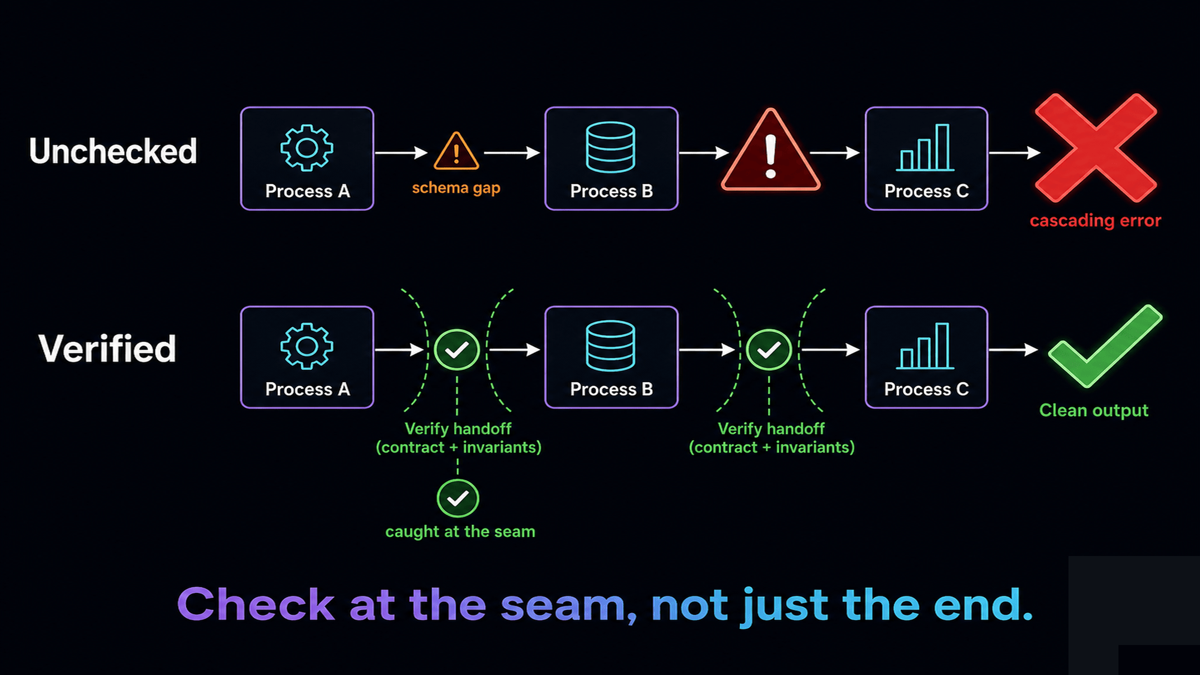
Unchecked handoff versus verified handoff
| At the boundary | Unchecked handoff | Verified handoff |
|---|---|---|
| Input trust | Accepted as ground truth | Validated against a contract |
| Missing information | Guessed, proceeds wrong | Clarification requested |
| Error location | Distributed, surfaces late | Caught at the seam |
| Check depth | Does it parse? | Structure + objective invariants |
| Propagation | Compounds downstream | Contained at the handoff |
The pattern is that a multi-agent system has no single end state to verify, so an unchecked handoff turns one agent's incomplete output into the next agent's confident, propagating mistake. Contract each boundary, verify structure and objectives before consumption, share verifiable state, and have agents ask rather than guess, and the error is caught at the seam instead of inherited. Putting verification at every handoff rather than trusting the chain is reliability at the pattern level, which is what VibeModel builds as the Pattern Intelligence Layer.
Frequently asked questions
Do better models make multi-agent handoffs safe to leave unchecked?
Pass an unchecked baton and one agent's guess becomes the next one's fact; a more capable downstream agent compounds it. (arXiv:2503.13657)
Why doesn't checking the final output catch these?
Because in a multi-agent system the failures are distributed across handoffs and there may be no single observable final state. By the time a wrong result appears, the flawed handoff is several agents back. Verify at each boundary, not just the end.
Isn't a parse check at the handoff enough?
No. A handoff can be structurally valid and objectively wrong, a complete-looking output missing a critical detail. Verify both structure and task-level invariants before the next agent consumes it.
what's the highest-value change?
An explicit handoff contract plus a rule that a downstream agent requests clarification when required information is missing, instead of guessing. That stops information-withholding cascades, the largest multi-agent failure mode.