


Key facts.
- Compounding math: end-to-end reliability = (1 - per-step error) ^ unchecked steps. Decays fast as chain depth grows.
- MAST names task verification as one of three top-level failure categories across multi-agent runs (MAST, 2025).
- A verifier between agents is typically cheaper than the generator it checks, so the layer pays for itself in caught errors (process verification work).
Why doesn't a strong final-step check catch everything?
Per-step error compounds, ten unchecked agents under 60%, harder to catch in capable ones; an upgrade inherits the variance, and a check layer cuts the cost. (arXiv:2503.13657)
Because by the final step the error has already propagated and transformed. An agent four hops back emitted a subtly wrong value, and every agent since built on it confidently. A single end-of-pipeline check sees a plausible answer with no way to know it rests on a corrupted intermediate. Verification has to sit between the agents, at each handoff, so the bad value is caught where it enters, not after four agents have laundered it into something that looks fine.
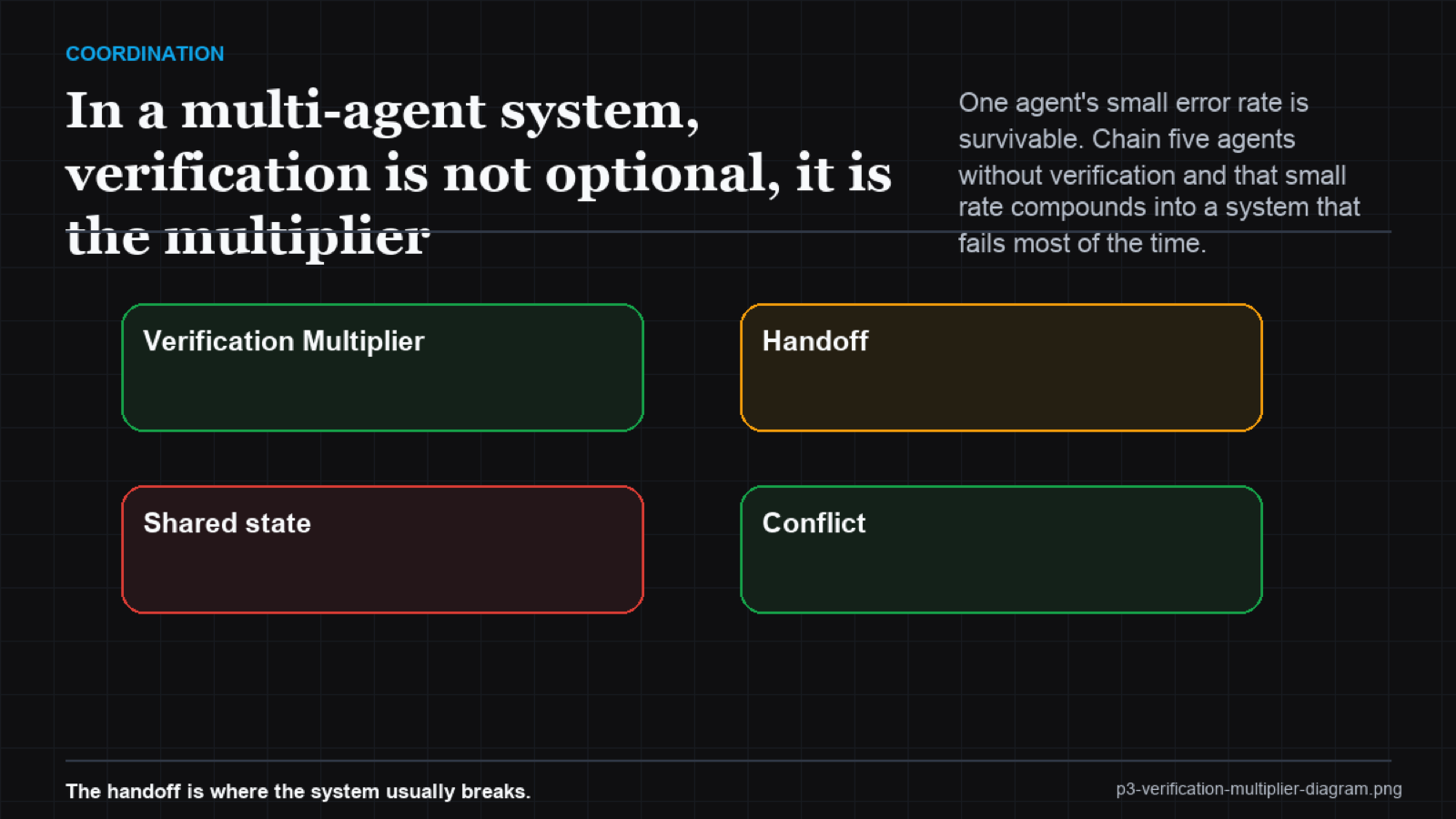
Unchecked chain vs. verified chain
| Unchecked chain | Verified chain |
|---|---|
| Error compounds silently | Error caught at each handoff |
| Final check sees laundered output | Per-boundary check sees raw output |
| Reliability falls with depth | Reliability stays roughly flat |
this is the core of what VibeModel does. The Pattern Intelligence Layer is a verification layer that recognizes when a handoff output departs from the expected pattern, so a corrupted intermediate is stopped at the boundary instead of multiplied down the chain. The verifier is cheaper than the rework. Use one between every agent.
Frequently asked questions
Won't a verifier per handoff add latency?
A little. it's far less than the cost of a compounded failure reaching a customer, and a lightweight pattern check is fast.
Can the verifier itself be an LLM?
It can, and often a cheaper one suffices because checking is easier than generating. Pattern-level checks are cheaper still.