


Key facts.
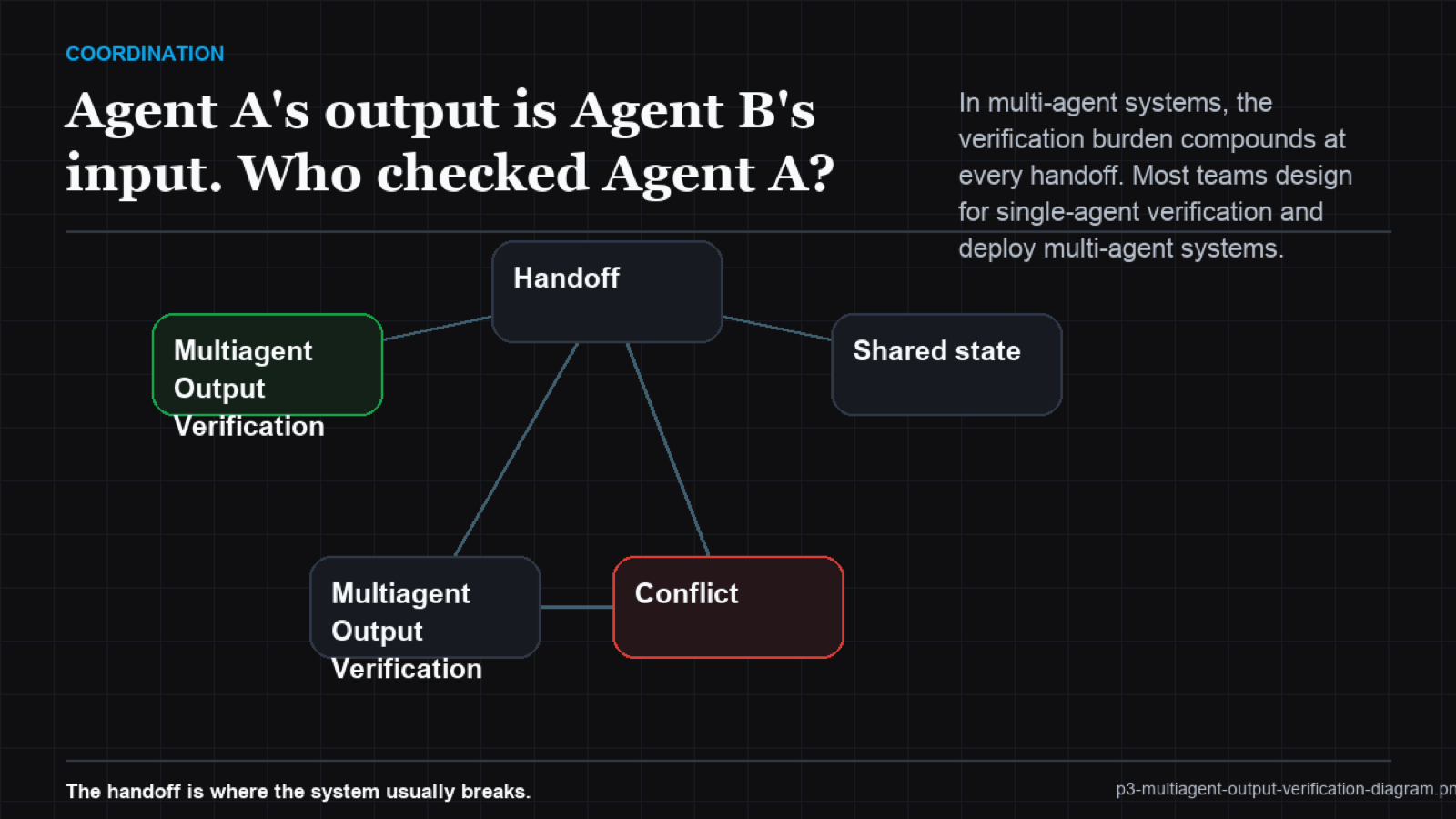
- MAST (arXiv:2503.13657) evaluated multi-agent task completion systems and documented inter-agent error propagation as the highest-severity failure mode: errors in upstream agent outputs compound rather than isolate when passed unchecked to downstream agents (MAST, arXiv:2503.13657).
- MAST's taxonomy classifies multi-agent failures as intra-agent (contained within one agent's session) and inter-agent (crossing handoff boundaries), finding that inter-agent failures have substantially higher remediation cost because they require identifying the source agent in a chain of contaminated outputs.
- Verification at handoff boundaries reduces inter-agent error propagation by containing failures at their source, but requires knowledge of what the upstream agent was supposed to produce - a specification that most multi-agent architectures don't explicitly define between agents.
- The same trust model problem applies to multi-agent verification as to multi-agent security: if agent B trusts agent A's output unconditionally (the way it might trust a tool response from a known API), an error in agent A's output corrupts agent B's execution without any alert. If agent B treats agent A's output as untrusted input (the way it would treat user input), it applies validation before consuming it.
- Output contracts - explicit specifications of what each agent promises to produce, against which downstream agents validate incoming data - are the structural solution to inter-agent verification, but require upfront agreement across agent boundaries that most multi-agent teams skip in development.
Why multi-agent verification is harder than single-agent verification
Single-agent verification has a clear reference point: the original task specification. You check the agent's output against what you asked it to do. In a multi-agent system, the intermediate agents have no user-facing task specification - they've a handoff from the previous agent. If that handoff itself is wrong, the intermediate agent's "correct" behavior (correct relative to the incorrect input) still produces incorrect output. Verifying intermediate agent outputs requires knowing what the handoff should contain, which requires defining output contracts at every agent boundary before the system is built.
Most multi-agent teams don't define output contracts during development. The agents are designed to "work together," which in practice means each agent is designed to produce whatever the next agent needs as a general description, not as a verifiable specification. When error propagation occurs, the verification gap isn't just "no verification" - it's "no specification to verify against."
Output contracts as the foundation of multi-agent verification
An output contract between agents specifies: the format of the handoff data (schema), the semantic requirements of the handoff data (business rules), the completeness requirements (minimum content the downstream agent needs to proceed), and the error indicators (signals in the handoff that indicate the upstream agent encountered a problem). With these four elements defined, the receiving agent can validate the incoming handoff before consuming it, and surface a specific error if any element is missing or violated. Without them, the receiving agent can't distinguish a correct handoff from a corrupted one.
Multi-agent verification requirements by handoff type
| Handoff type | Contract elements required | Verification method | Error isolation mechanism |
|---|---|---|---|
| Data extraction output | Schema, completeness, confidence score | Schema check + completeness count | Missing fields trigger retry, not pass-through |
| Analysis output | Conclusion format, evidence citations, confidence | Citation validation, range check on confidence | Low-confidence output routes to human review |
| Action plan output | Action format, prerequisite checks, reversibility flags | Action schema + prerequisite verification | Missing prerequisites halt plan before action |
| Status report output | Completion status, error list, remaining steps | Status code validation, error list completeness | Incomplete status triggers upstream investigation |
VibeModel's Pattern Intelligence Layer learns the handoff patterns across your multi-agent system that are most predictive of downstream failures. By analyzing which upstream agent output characteristics correlate with errors in downstream agents, it identifies which output contract elements are missing or poorly specified at each handoff boundary. That gives the multi-agent engineering team a specific list of output contracts to define and verification checks to add, rather than the general advice to "add verification at handoffs."
Frequently asked questions
Should downstream agents trust upstream agents differently from how they trust external tools?
In most architectures, downstream agents should treat upstream agent outputs as untrusted input - applying the same validation they would apply to any external data source. this is more conservative than treating upstream agents as trusted peers, but it's the correct security posture: an upstream agent can be compromised, can contain bugs, or can receive corrupted input that it passes downstream. Validation at every boundary prevents these contamination paths.
Is output contract validation the same as the "schema validation" described for single-agent systems?
Related but broader. Schema validation is one component of an output contract. The contract also includes semantic requirements (the extracted entity list must contain at least one item), completeness requirements (all required sections are present), and error indicators (the upstream agent's explicit error signals). Schema alone catches structural failures; the full contract catches the semantic and completeness failures that schema validation misses.
How do we version output contracts when agent prompts or capabilities change?
Semantic versioning on contracts with compatibility rules: breaking contract changes (removing required fields, changing types) require a major version bump and coordination between the upstream and downstream agent teams. Non-breaking additions (optional fields, new error codes) can be minor version bumps. Both agents should log the contract version used in each handoff to enable post-hoc debugging of cross-version contamination.