


Key facts.
- RLSR research on the generator-verifier gap: generating correct outputs is hard (36% accuracy) but verifying them is cheap (96% accuracy). Most multi-agent coordination skips the verification step, meaning every inter-agent message introduces an unverified failure point (RLSR, arXiv 2505.08827).
- GhostCite showed that 13 leading LLMs fabricate content (in this case citations) at 14-95% rates, the same fabrication risk applies to inter-agent messages, where agents generate plausible-sounding status updates that may not reflect actual state (GhostCite, arXiv 2602.06718, 2026).
- RULER long-context benchmarks show that even within a single agent, information reliability degrades as context length increases, inter-agent messages that arrive late in long orchestration sessions are structurally less reliably processed than early messages (RULER, arXiv 2404.06654).
The reliability math of inter-agent communication
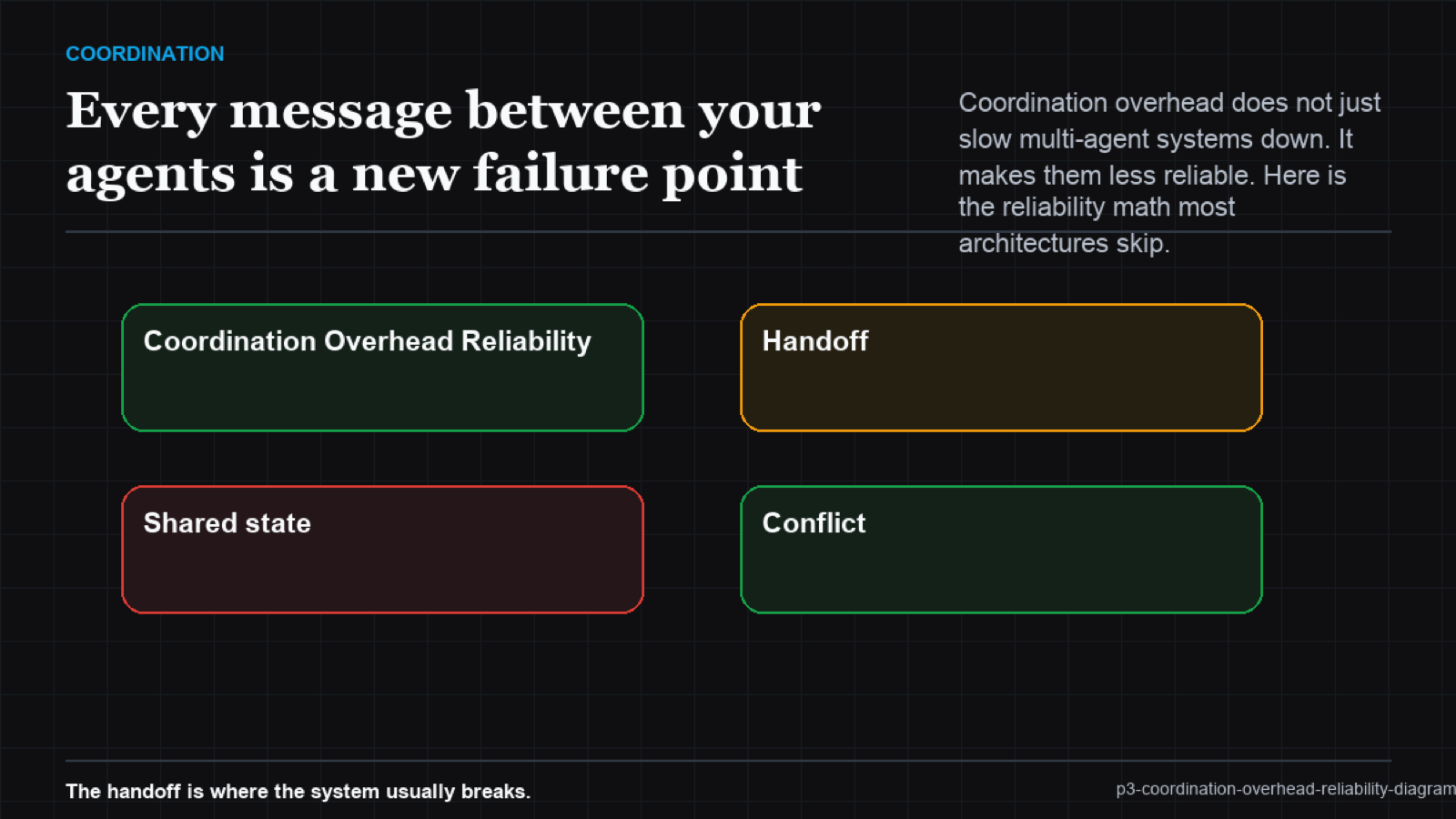
If each inter-agent message is correctly generated and correctly interpreted 90% of the time, a two-agent workflow with four messages has a coordination reliability of 0.9^4 = 65.6%. A five-agent workflow with fifteen messages has a coordination reliability of 0.9^15 = 20.6%. This is independent of how reliable each individual agent is. The coordination overhead itself is the failure source, and it compounds with every message added to the system.
Most teams build multi-agent systems without accounting for this. They measure individual agent accuracy, see 85-90% on their test cases, and ship. The coordination layer is the part that was never tested, and it is the part that fails in production.
Reliability-preserving coordination patterns
| Reliability-degrading | Reliability-preserving |
|---|---|
| Natural language status updates between agents | Typed, schema-validated status messages |
| All-to-all communication | Hub-and-spoke through orchestrator |
| Messages consumed without verification | Each message verified against expected schema before consuming |
| No acknowledgement of receipt | Explicit ack with a state hash the sender can verify |
Every inter-agent message is a standing failure point fleet-wide; a bigger model inherits the skipped check, adding latency and retry cost. (arXiv:2505.08827)
VibeModel monitors coordination reliability as a first-class metric. The Pattern Intelligence Layer tracks message failure rates across the inter-agent communication graph, not just whether agents ran, but whether their communications were valid, timely, and consumed correctly. Coordination overhead is manageable. Unmonitored coordination overhead is the hidden failure rate compounding in your production system right now.
Frequently asked questions
Does reducing message count improve reliability?
Yes, directly. Fewer messages means fewer multiplication points in the reliability calculation. The design principle is minimum necessary communication: share only what the next agent cannot derive from the shared state store, and verify what you do share.
Can I just use a message queue to make inter-agent communication reliable?
A queue guarantees delivery. It does not guarantee that the delivered message is correct, or that the receiving agent interprets it as intended. Delivery reliability and semantic reliability are different problems. You need both.