


Key facts.
- MAST's inter-agent misalignment category includes ignored input, reasoning-action mismatch, and task derailment, the exact shapes of redundant and skipped work (MAST, 2025).
- Anthropic reported early subagents "distracting each other with excessive updates" and exploring redundantly until prompts were tightened (Anthropic Engineering).
- Without shared progress state, there is no single source of truth about which subtasks are done, so agents both duplicate and orphan work.
- No shared model of who did what is a class failure fleet-wide; a bigger model inherits it, since one prompt gives 80 outputs, and retries pile up. (arXiv:2503.13657)
Why don't the agents just notice the duplication?
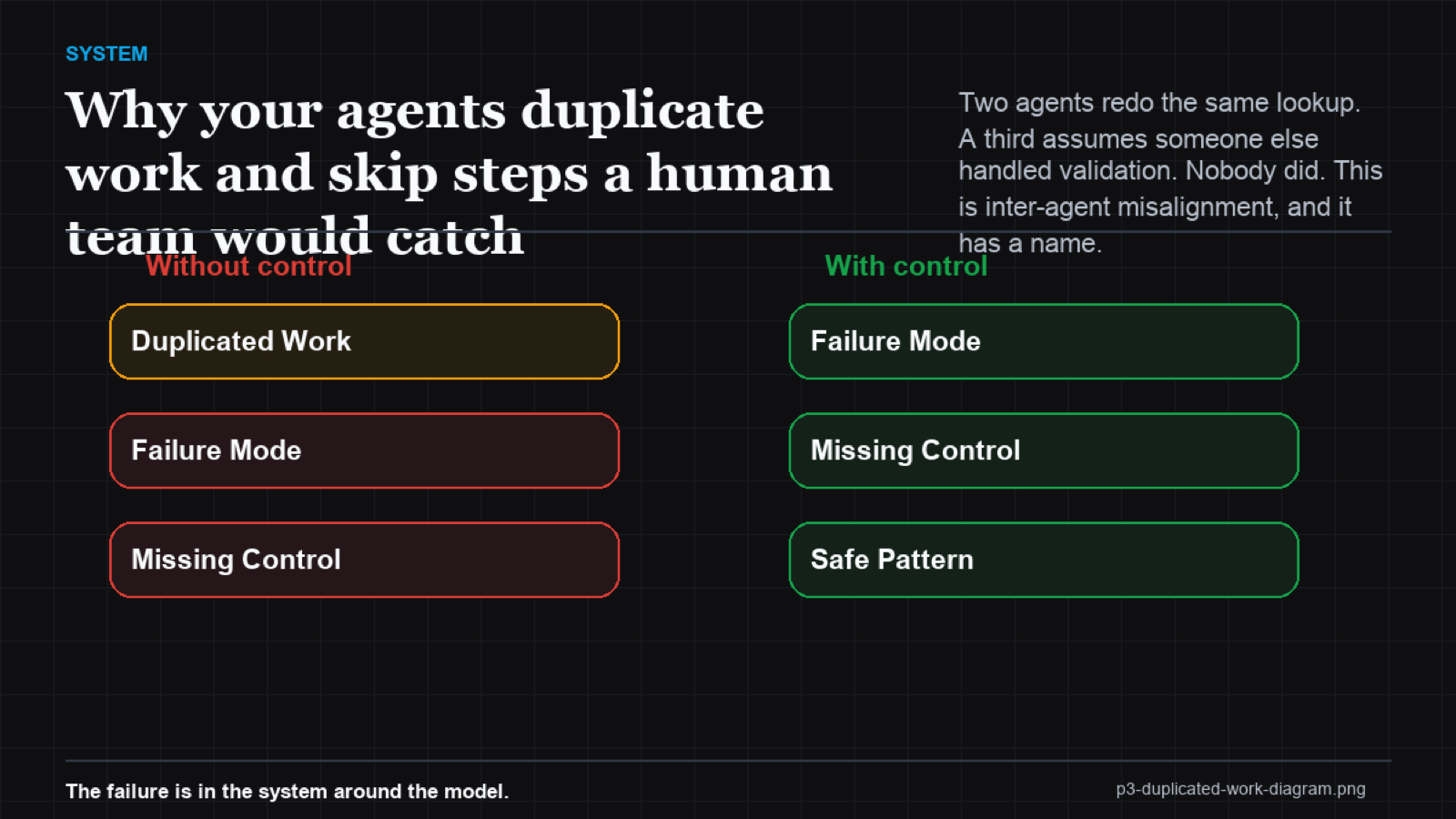
Because each agent sees its own context, not the team's. A human team has a standup, a shared doc, a glance across the desk. A naive agent team has none of that. When two agents are handed overlapping scopes, both will helpfully do the work, and neither will know the other did. When a step sits between two scopes, both assume it belongs to the other. The model is behaving reasonably given what it can see. The problem is what it cannot see.
The fix is shared state, not a smarter agent
The teams that beat this give agents a shared, authoritative record of progress and a clear scope contract. Done subtasks are marked done where every agent can read it. Boundaries are explicit, so the gap between scopes has an owner. This is plain distributed-systems hygiene applied to agents.
VibeModel's Pattern Intelligence Layer is built to catch the misalignment pattern directly: when two agents converge on the same work, or a step falls through a scope gap, that is a recognizable pattern, and recognizing it early is cheaper than reconciling the mess later. You design the scopes; we watch the seams.
Frequently asked questions
Won't a shared chat history fix this?
Rarely. Long shared histories add noise and token cost, and agents still miss the relevant line. A structured progress store beats a chat log.
Is duplicated work just a cost problem?
No. Skipped steps are the dangerous half. A duplicated lookup wastes tokens; a skipped validation ships a wrong result.