


Key facts.
- WildToolBench tested 57 LLMs across 256 real tool-use scenarios with multi-step composition requirements. No model exceeded 15% session-level accuracy, and the three primary failure drivers included state management across turns and compositional task orchestration, both require agents to share progress state (arXiv 2604.06185, ICLR 2026).
- RULER benchmarks on long-context faithfulness show that agents processing the same document independently produce inconsistent extractions, meaning parallel agents without shared state can actively contradict each other on the same factual question (RULER, arXiv 2404.06654).
- NoLiMa research on context compression shows that when agents work from independent compressed summaries of the same source, fact coverage diverges significantly compared to agents sharing a single structured representation (NoLiMa, arXiv 2502.05167).
What redundant work actually looks like
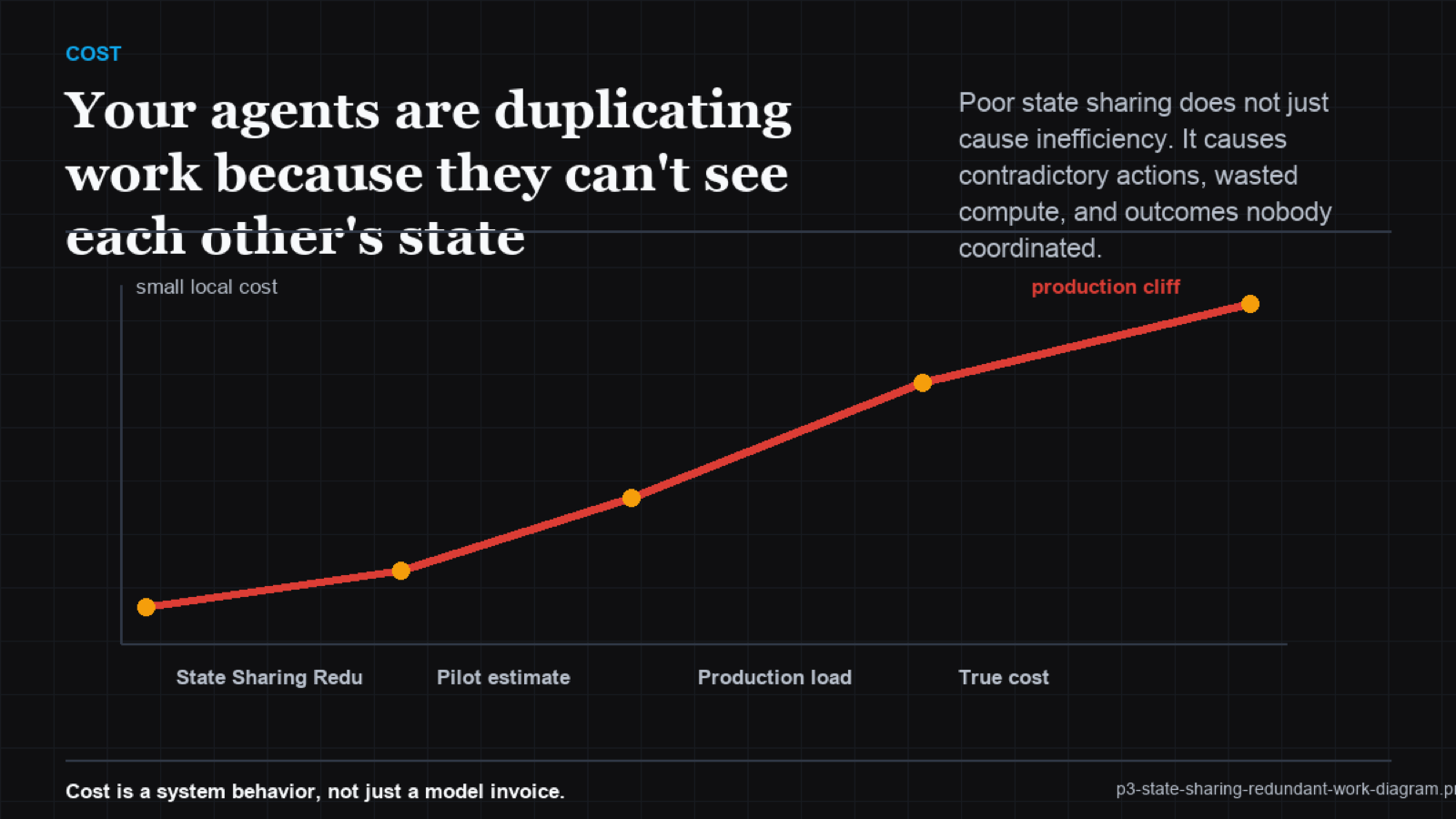
Blind state hides in the pilot: no model clears 15% session accuracy, so an upgrade inherits duplicated work and retries. (arXiv:2604.06185)
Agent A is tasked with customer data enrichment. Agent B is tasked with contract preparation. Both need the customer's current subscription tier. Agent A queries the CRM. Agent B, not knowing Agent A already did this, also queries the CRM. Both get the same data. The tokens and the API call were paid twice. At low scale this is waste. At high scale it is a meaningful cost line and a race condition waiting to happen, what if the subscription tier changes between Agent A's query and Agent B's?
This is the visible version. The invisible version is when two agents act on the same resource with conflicting instructions. Agent A drafts and sends a follow-up email. Agent B, not knowing the email was sent, drafts and queues another one. The customer receives two emails with inconsistent content. No agent failed. No exception was thrown. The coordination infrastructure was simply missing.
State sharing patterns that work
| No shared state (fails) | Shared state store (works) |
|---|---|
| Each agent queries source independently | One agent fetches, stores in shared context; others read from store |
| No record of what has been done | Task manifest updated after each completed step |
| Agents act on same resource concurrently | Resource lock or turn-taking protocol per resource |
| State lives in each agent's context window | State lives in a shared persistent store agents read and write |
VibeModel monitors for the redundancy pattern, the same query issued by multiple agents in the same session, or the same resource accessed without coordination, at the pattern level. The Pattern Intelligence Layer surfaces this before it becomes a cost spike or a contradictory action in production. Shared state is not a distributed systems luxury. It is the minimum viable coordination infrastructure for any multi-agent system with more than two agents.
Frequently asked questions
Does a shared state store become a bottleneck?
At high agent counts, yes, if not designed carefully. The pattern that scales is a write-once cache with agent-specific read access: one agent writes a resource result to the store, others read it without re-fetching. Write contention is minimal; read parallelism is high.
What if agents need different views of the same state?
Design the shared store with a common raw-data layer and agent-specific view projections. Agents share the underlying facts but can compute their own derived representations from them. This is cheaper than having each agent re-fetch the raw data independently.