


Key facts.
- ConflictBank benchmarked 14 LLMs on scenarios containing conflicting factual information. All models showed significant performance degradation when input context contained contradictions, mirroring what happens when two agents hold inconsistent views of shared workflow state (ConflictBank, arXiv 2408.12076, 2024).
- Self-preference bias research (arXiv 2410.21819) confirms that when agents encounter conflicting information, they systematically favor the interpretation consistent with their own prior outputs, meaning sync failures compound, because each agent resolves the conflict in favor of its own cached state rather than the updated canonical state.
- TRAIL observability framework identifies state divergence across agent instances as a distinct monitoring category requiring dedicated instrumentation, standard trace-based monitoring cannot detect it without explicit state comparison checkpoints (TRAIL, arXiv 2505.08638).
The three state sync failure modes
Read-before-write: Agent A reads the order status as "pending." Agent B writes "confirmed" one millisecond later. Agent A acts on "pending," applying a discount only available to unconfirmed orders. The discount is applied to a confirmed order. The database is now inconsistent. Neither agent was wrong given its read. The architecture did not enforce read ordering.
Stale cache: Agent A caches the customer's subscription tier at session start. The tier changes mid-session due to an upgrade. Agent A continues applying the old tier's limits. Agent B, which read later, applies the new tier's permissions. The same customer gets different treatment within the same workflow session.
Write-write conflict: Agent A and Agent B both update the same record in parallel. The last write wins. The first write is lost. The losing agent has no idea its update was overwritten and proceeds on the assumption that its update holds.
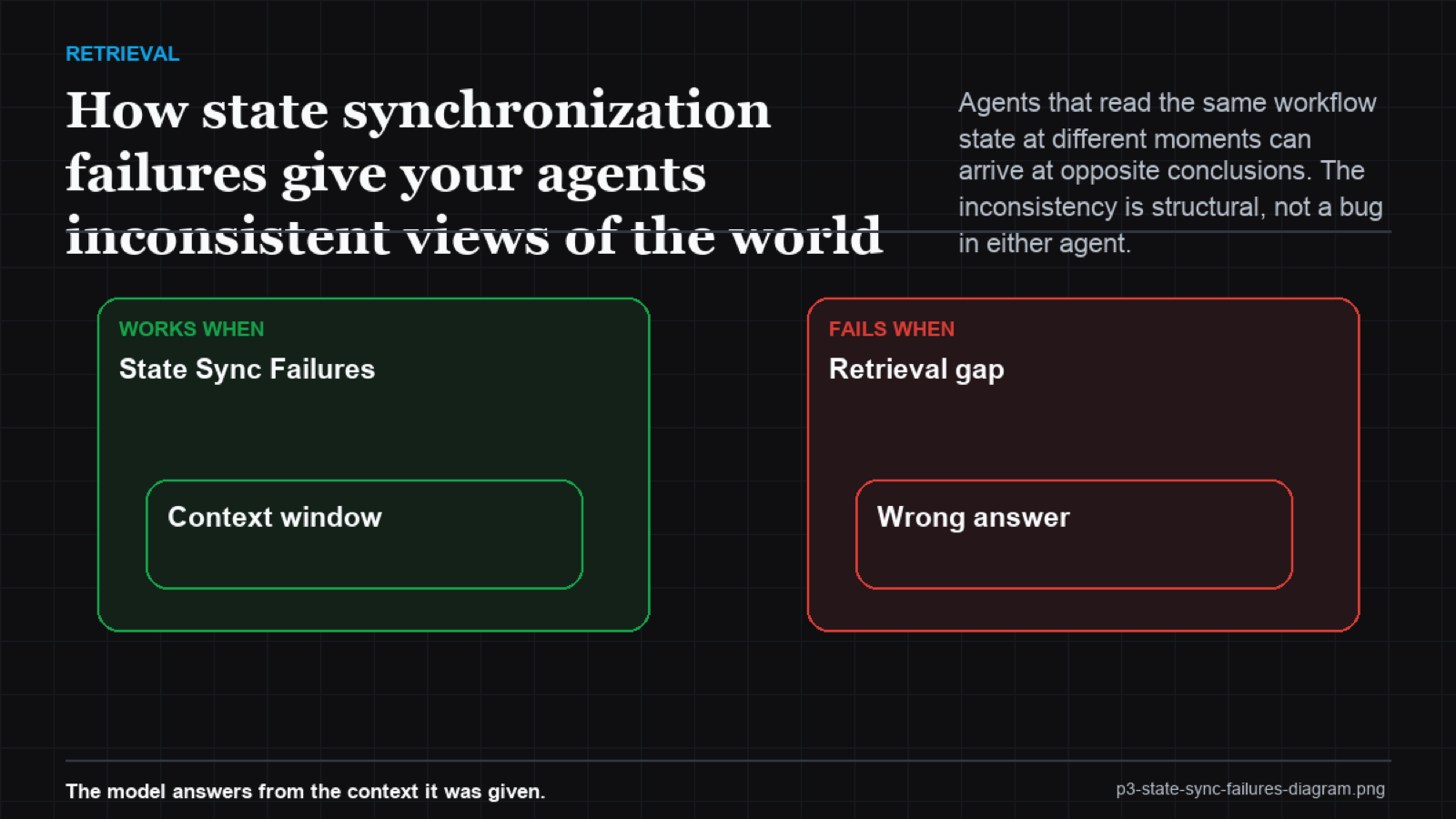
VibeModel tracks state consistency as a coordination health signal. The Pattern Intelligence Layer monitors whether agents' active beliefs about shared workflow state are consistent with the canonical state at the moment they act. When they diverge, the pattern is flagged before the inconsistent action reaches a system of record. Distributed state consistency is a solved problem in software engineering. It needs to be a first-class concern in agentic systems too.
Frequently asked questions
Can I just use optimistic locking for shared state?
Optimistic locking prevents write-write conflicts, but it does not prevent read-before-write or stale-cache problems. You need versioned state with read-time validation: agents must check that the state version they read on is still current before they act on it.
What if the state changes faster than agents can synchronize?
That is the signal that your workflow needs explicit coordination gates rather than continuous synchronization. Break the workflow into phases where state is frozen for a defined period, each agent acts within that frozen window, then state is reconciled before the next phase begins.