


Key facts.
- MINJA showed that adversarial injection of just 5 memory entries into an agent's memory store significantly degrades planning and action quality, demonstrating how fragile shared memory is to even small inconsistencies (arXiv 2503.03704, 2025) (MINJA, arXiv 2503.03704).
- Lost-in-the-Middle research showed that models routinely fail to use information placed in the middle of long contexts, in a multi-agent workflow where early session history appears in the middle of later agents' contexts, the early context is systematically underweighted (Liu et al., arXiv 2307.03172).
- Barnett's RAG failure taxonomy identifies "outdated or stale information in context" as a distinct failure point, the same category applies when an agent's view of the shared conversation is stale relative to another agent's view (Barnett et al., arXiv 2401.05856).
How the inconsistency emerges without any obvious failure
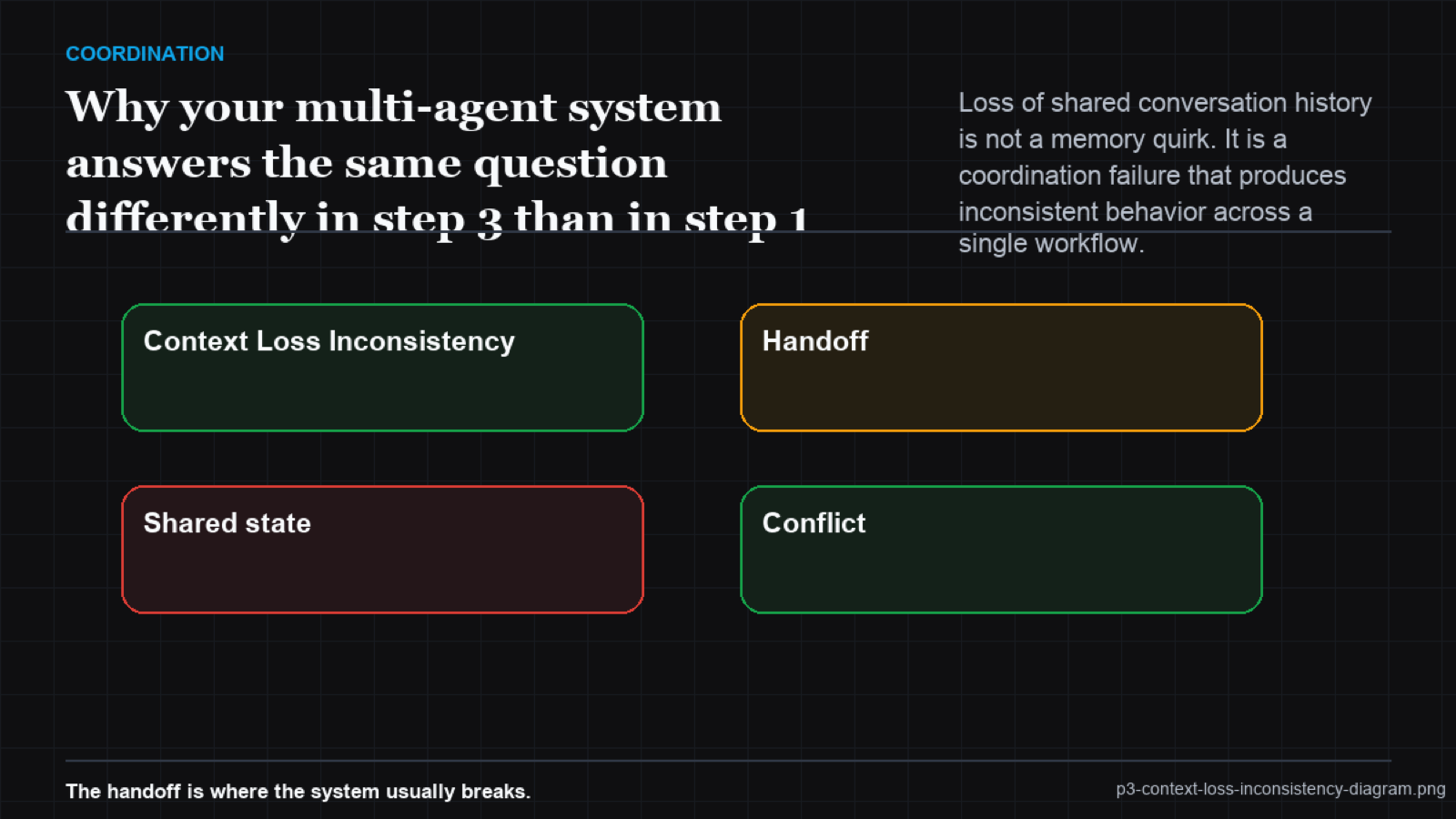
At step 1, the orchestrator receives a full session context and determines the customer's account tier is "Enterprise." At step 3, a second agent receives a summarized handoff that describes the customer as "a large account", the tier label was dropped in the summary. That agent applies standard pricing. The customer expected Enterprise pricing. Both agents were correct given their context. The context was inconsistent.
This pattern appears constantly in workflows where the conversation history is maintained per-agent rather than in a shared store. Each agent starts with a snapshot of the world at the moment it was instantiated. If the shared world changes, or if the snapshot was incomplete, subsequent agents operate on a different version of history. There is no error. The workflow completes. The output is inconsistent.
Architectural patterns that prevent context divergence
| Diverges | Stays consistent |
|---|---|
| Context passed as free-text summary per agent | Context maintained in typed, versioned shared store |
| Each agent summarizes for the next | Each agent reads from canonical store, writes delta |
| History truncated to fit context window | History indexed; agents query what they need |
| No consistency check between agents | Reconciliation step when agents' facts conflict |
Divergent memory makes step 3 differ from step 1 as a class; a newer model inherits it, with no canonical version until rework. (arXiv:2503.03704)
VibeModel detects context divergence as a pattern: when two agents in the same workflow make claims about the same entity that contradict each other, the Pattern Intelligence Layer flags it before those claims drive conflicting actions. Consistent context is not an LLM problem, it is an architecture problem. The solution is an architecture, not a better prompt.
Frequently asked questions
Should every agent in the workflow have access to the full session history?
Selective access works better than full access. Full history overwhelms context windows and introduces Lost-in-the-Middle degradation. Structure the shared store so each agent queries only the fields relevant to its task, and always receives the canonical value for those fields rather than a summary of earlier conversation about them.
What if agents are running in parallel?
Parallel agents need a merge step before any of their outputs are consumed by a downstream agent. The merge step reconciles their views of any shared facts and produces a single canonical record. Without the merge, parallel execution guarantees context divergence.