

Key facts.
- ConflictBank demonstrates that knowledge conflicts across sources degrade LLM answers, the technical consequence of data fragmented across silos. source
- Barnett's "Seven Failure Points of Retrieval-Augmented Generation" catalogues how integration and retrieval across systems fail in real deployments. source
Why do organizational silos break agents?
An agent inherits every silo contradiction; a bigger model still degrades on ConflictBank, so reconciling first beats the late rework. (arXiv:2408.12076)
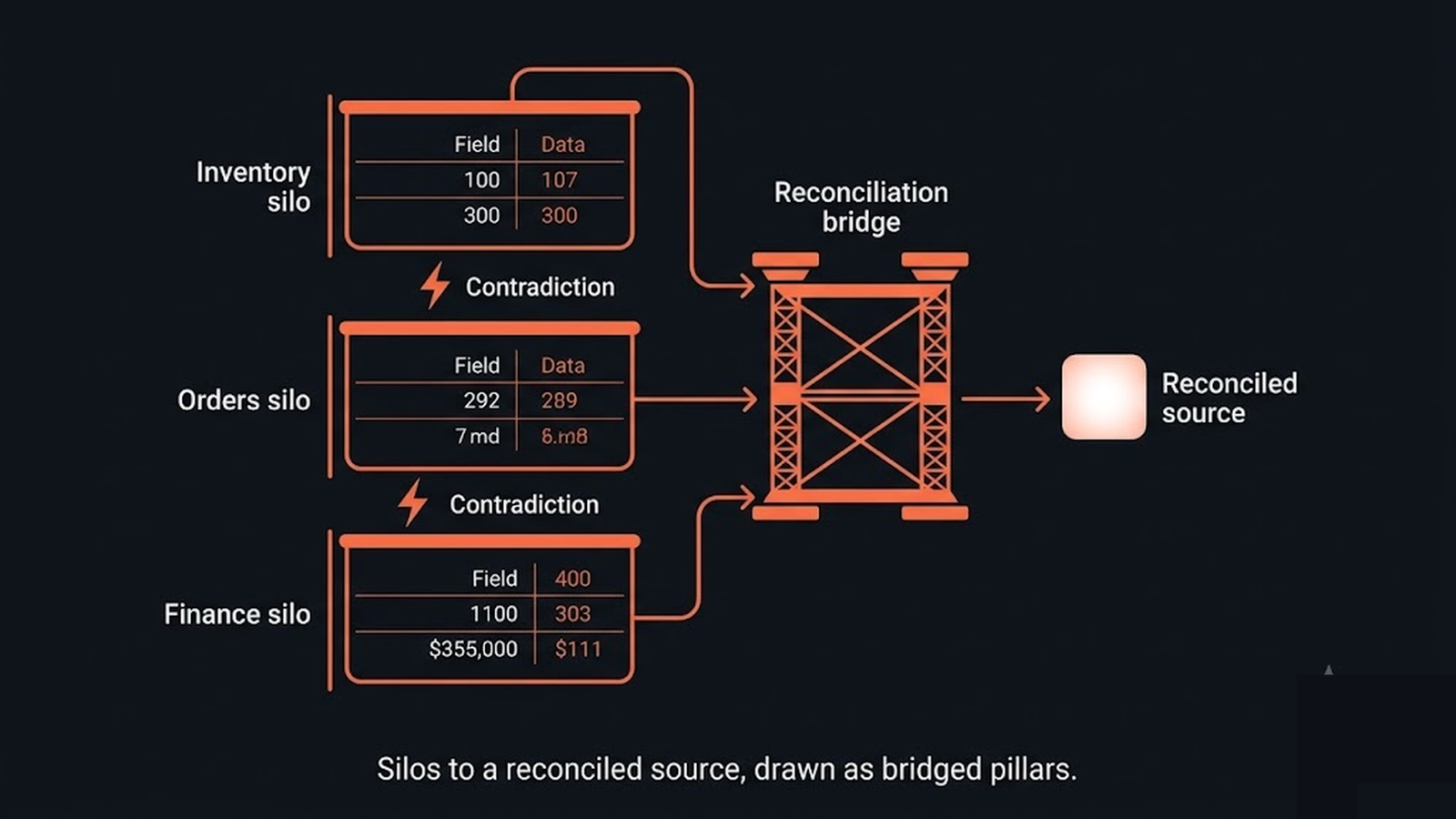
An organization split into silos stores the same reality in incompatible ways: sales has one definition of an active customer, finance another, support a third and none of them reconcile. A human moving between those teams learns to translate. An agent does not; it retrieves whatever each silo holds and tries to reason over the contradictions, and ConflictBank shows exactly what happens, answer quality degrades when the sources disagree. The org chart's seams become the agent's broken inputs. Worse, the agent surfaces the contradictions confidently, so a problem the silos hid from each other becomes a wrong answer delivered to a customer.
The Barnett failure points add the integration layer: even getting the data out of each silo and into the agent is a chain of places things break, from retrieval to ranking to consolidation. The lesson is that you cannot solve this at the model. You solve it upstream, by connecting the silos and resolving the conflicts so the agent answers from one coherent picture rather than refereeing a fight between systems that were never designed to agree.
What has to happen before the agent relies on the data?
| Condition | Siloed | Reconciled |
|---|---|---|
| Definitions | Conflict across teams | Agreed and consistent |
| Retrieval | Per-silo, fragmented | Integrated, ranked |
| Agent answer | Refereeing contradictions | From one coherent picture |
Reconciling silos is about making the agent's view of a situation consistent, which is the heart of what VibeModel does as the Pattern Intelligence Layer. When the agent handles a given situation through one reconciled pattern rather than whatever each silo happens to return, the contradictions get resolved before they reach the answer and the org chart's old seams stop showing up as the agent's confident mistakes.
Frequently asked questions
Can the model just handle conflicting data?
No. ConflictBank shows knowledge conflicts degrade answers. The reconciliation has to happen upstream, not inside the model.
Is this a data problem or an org problem?
Both. Siloed organizations produce siloed, conflicting data, so fixing the agent means addressing the organizational seams that created the fragmentation.
Where do integrations usually break?
Across the chain Barnett documents: retrieval, ranking and consolidation. Each silo you add is more places for the data to fail before it reaches the agent.