


Key facts.
- Tran and Kiela demonstrated across Qwen3, DeepSeek-R1-Distill-Llama, and Gemini 2.5 that single-agent systems match or outperform multi-agent setups under equal token budgets. The theoretical basis is the Data Processing Inequality: every handoff between agents can only lose information, never add it (Tran and Kiela, arXiv 2604.02460, 2026).
- Berkeley Function-Calling Leaderboard (BFCL) evaluations show that leading models calling multi-step tool sequences frequently misinterpret intermediate results, a finding that scales to execution agents misinterpreting a planning agent's output (BFCL, UC Berkeley).
- tau2-bench in dual-control environments (agent plus user both taking tool actions) found that misaligned execution, where the agent executes something inconsistent with the stated plan, was a primary driver of session failure, not just tool unavailability (tau2-bench, arXiv 2506.07982, 2025).
Where the reasoning-action mismatch actually happens
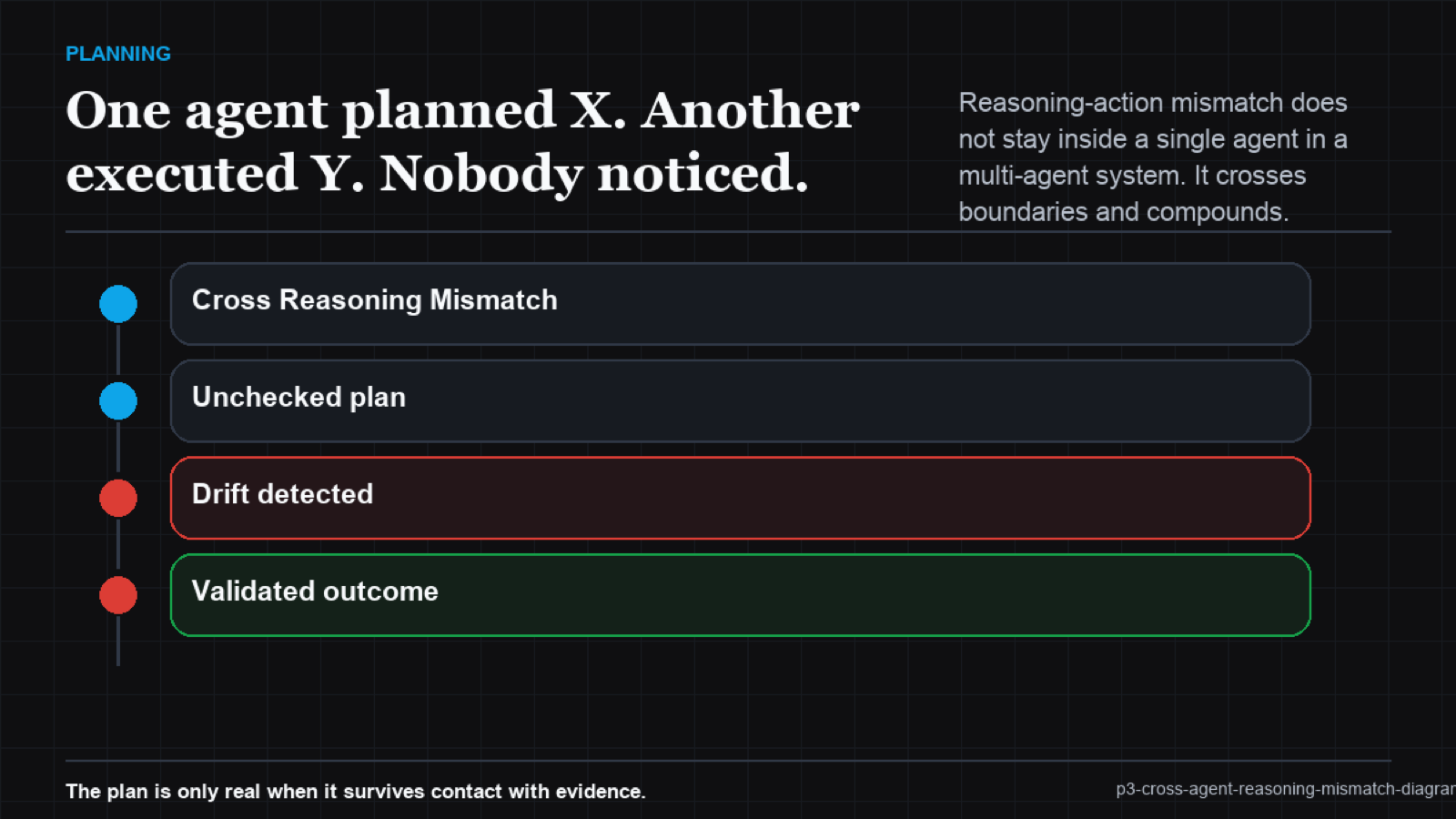
The planning agent produces a step-by-step plan. It has full context: the customer's account, the constraint that certain actions require approval, the preferred communication channel. It plans accordingly: "Draft email to customer. Route for approval. Send after approval confirmed." The execution agent receives the plan summary. It knows the three steps. It does not know the constraint that drove step 2, the approval requirement. It executes step 1, skips step 2 (no obvious reason to wait), and executes step 3. The email goes without approval. The planning agent's reasoning was sound. The execution agent's action was wrong. The mismatch lived in the gap between what was planned and what was transmitted.
What crosses boundaries intact vs. what gets lost
| Crosses intact | Gets lost at handoff |
|---|---|
| Explicit action steps | The reasoning behind each step |
| Named entities (customer, resource) | Constraints and conditions on those entities |
| The final goal | The intermediate checkpoints the planner intended |
| Positive instructions (do this) | Negative instructions (do not do this without X) |
VibeModel monitors for the pattern where an execution agent's action sequence does not match the constraint structure of the plan it received. The Pattern Intelligence Layer does not just trace whether steps were taken, it checks whether the conditions the planner embedded in those steps were honored. That is the layer where reasoning-action mismatch is caught before it becomes an unauthorized action.
Frequently asked questions
Would a better planning model keep execution on plan?
Planner and executor diverge by design as handoffs lose information; a frontier model inherits the gap as production rework. (arXiv:2604.02460)
Should I just put the full planning context in the execution agent's prompt?
For short plans, yes. For complex multi-step plans, full context often overwhelms the execution agent and introduces Lost-in-the-Middle degradation on the constraints. Structure the handoff: pass the plan as a typed object where each step carries its own constraints as fields, not as prose embedded in the reasoning.
What if the execution agent needs to adapt the plan mid-execution?
Adaptation is fine, but it should be flagged to the planner, not silent. Build a confirmation loop: if the execution agent deviates from the plan, it surfaces the deviation to the orchestrator before continuing. Silent adaptation is where the mismatch hides.