


Key facts.
- Among deployed agents, 68% execute at most ten steps before human intervention and 70% rely on prompting off-the-shelf models, a deliberately constrained design. source
- Single-agent setups match or beat multi-agent ones under equal token budgets on multi-hop reasoning, because every handoff can only lose information, never add it. source
- Reliability, not capability, is the top development challenge reported by production teams, which is why they trade ambition for control. source
Why does the simpler planner win?
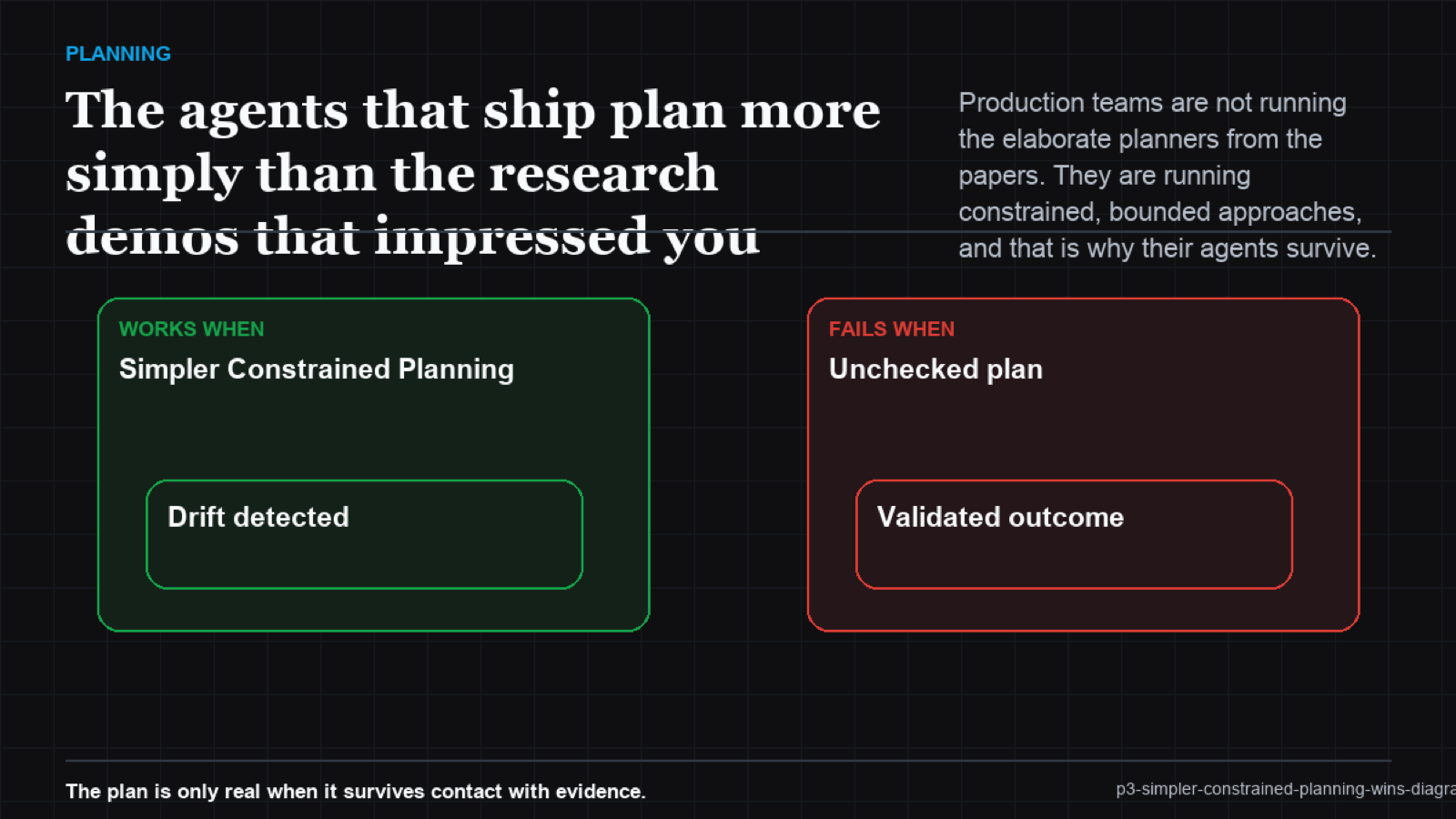
Because every degree of freedom you give a planner is a degree of freedom for it to fail. A short, bounded plan has fewer steps to compound errors across, fewer places to drift and a human checkpoint close enough to catch what it gets wrong. An elaborate autonomous planner has more of all three. The research demo optimizes for showing what is possible, which rewards autonomy and length. Production optimizes for what keeps working on Tuesday, which rewards the opposite. Tran and Kiela make the structural version of this point: under an equal budget, a single agent matches or beats a multi-agent system on multi-hop reasoning, because each inter-agent handoff can only lose information. The fancier architecture often subtracts reliability for the privilege of looking sophisticated.
This is not an argument against ambition. It is an argument for earning it. Start bounded, prove the agent reliable in its small space and widen the scope only as the reliability holds. The teams that invert this, starting elaborate and trying to stabilize later, are the ones whose pilots stall.
What does conservative planning look like in practice?
Short plans. Bounded step counts. Human checkpoints before consequential actions. Off-the-shelf models with tight prompts instead of bespoke multi-stage planners. The agent is allowed to do a small, well-characterized job extremely reliably and the scope grows on evidence, not on hope. It is less impressive in a demo and far more valuable in production, which is the trade the shipping teams have already made.
| Approach | Demo appeal | Production survival |
|---|---|---|
| Elaborate autonomous planner | High | Often stalls on reliability |
| Bounded, constrained planner | Modest | Ships and holds |
Tran and Kiela: one agent matches multi-agent at equal budget, since each handoff loses data; the upgrade adds rework. (arXiv:2512.04123)
This is the bet VibeModel makes as the Pattern Intelligence Layer. We model the patterns of the bounded, reliable plan that production rewards, so you start where the shipping teams ended up, with scope you can trust and widen, rather than ambition you have to walk back.
Frequently asked questions
Is multi-agent always worse?
No, but under equal budget it often loses to a single agent on reasoning tasks. Reach for it when the work genuinely parallelizes, not by default.
Doesn't bounding the agent limit its value?
It limits its blast radius, not its value. You widen scope as reliability is proven.
Why do demos favor the elaborate version?
Demos reward visible sophistication. Production rewards repeatable reliability. They pull in opposite directions.